
Roof Repair NJ › NJ Locations › Hudson County
Jersey City · Hoboken · Bayonne · 12 towns
Roof Repair in Hudson County, NJ: Flat Roofs, Brownstones and Waterfront Buildings
Roof Repair SNJ repairs flat, low-slope and pitched roofs in all 12 Hudson County municipalities, from Hoboken brownstones and Jersey City row houses to Union City walk-ups, Bayonne two-families and Secaucus townhomes. Every job starts with a free inspection and photos, and you get a written itemized quote and a 2-year workmanship warranty on repairs.
- Flat roofs, parapets and roof decks
- Free inspection with photos of every defect
- Written itemized quote for owners and boards
Free roof inspection in Hudson County
Photos of every problem we find and an itemized written price before any work. Emergency requests handled 24/7.
Roof Repair SNJ
12 Hudson County towns · all 21 NJ counties
Free inspection
Roof, attic and gutters checked at no cost.
Insured
Liability and workers’ comp; certificate on request.
Written quotes
Itemized price in writing before any work.
Photo-documented
Every problem photographed, before and after.
Hudson County at a glance
Hudson County at a Glance: A Flat-Roof County on the Water
Hudson County is New Jersey’s densest county, and its roofs reflect it: only about 6 percent of homes are single-unit buildings, most housing is in multi-family buildings, and nearly three in ten homes were built before 1940. Add a long tidal shoreline on the Hudson River, Newark Bay and the Hackensack River, and most roof decisions here involve flat membranes, shared walls, associations and flood risk.
County seat
Jersey City
Jersey City has 292,449 of Hudson’s 724,854 residents (2020 Census). Its brownstones, frame row houses and walk-ups in Downtown, the Heights and Greenville generate most of the county’s flat-roof repair work.
Municipalities
12
Twelve towns, from the 2,594-resident Borough of East Newark to Jersey City. Each runs its own construction office and permit schedule.
Single-unit homes
About 6%
Rutgers’ Hudson County rental housing profile (ACS 2022) found 6 percent of homes in one-unit buildings, against 20 percent statewide, and 72.4 percent of households renting (2020 Census).
Median year built
1965
ACS 2023 5-year data compiled by Stacker; 29.8 percent of Hudson homes date to 1939 or earlier, while the newer waterfront towers pull the median forward.
Sandy surge at Bergen Point
14.6 ft MLLW
National Weather Service record for the Bergen Point gauge off Bayonne on October 29, 2012. Surge overtopped the wall at Exchange Place and flooded about half of Hoboken.
Ida rainfall in Harrison
8.72 in.
State climatologist total for September 1-2, 2021, among the highest in North Jersey. Flat roofs with one scupper or a single interior drain could not shed it fast enough.
Homes & roofs
What Kinds of Buildings and Roofs Does Hudson County Have?
Most Hudson County roofs are flat or low-slope roofs on attached buildings: brownstones and row houses in Hoboken and Downtown Jersey City, three- and four-story walk-ups on the Palisades in Union City and West New York, frame two-families in Bayonne and Kearny, and membrane roofs on new condo buildings along the waterfront. Pitched shingle roofs are concentrated in Secaucus, parts of Bayonne, North Bergen and Kearny.
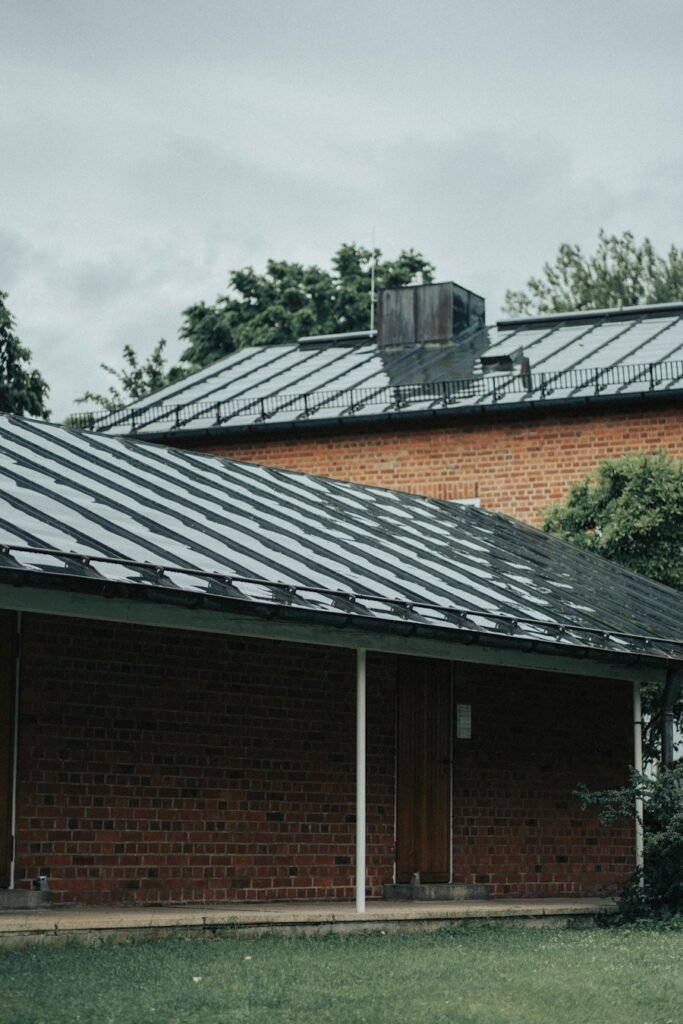
Hoboken and Downtown Jersey City brownstones
Hoboken’s Mile Square and Jersey City’s Paulus Hook, Van Vorst Park, Hamilton Park and Harsimus Cove are lined with nineteenth-century brick and brownstone row houses. Behind the cornice is a nearly flat roof that drains to the rear, with shared parapet walls, a bulkhead or hatch and often a roof deck. Leaks start at the parapet cap, at the joint with the neighbour’s roof and around old chimneys that now serve as vents.
Union City and West New York walk-ups
On top of the Palisades, Union City and West New York are packed with three- and four-story frame and brick walk-ups and two-families on narrow lots, many from the early 1900s. Roofs are flat or slightly pitched to the rear, with tar patches layered over modified bitumen. Because buildings touch on both sides, water from a bad seam can travel along a joist and appear in a neighbouring unit.
Jersey City Heights and Greenville frame row houses
The Heights, Journal Square, Bergen-Lafayette and Greenville have long blocks of wood-frame row houses and two- and three-families with mansard fronts covered in slate, asphalt or metal, and flat rear roofs. These mixed roofs need two skills: repairing the steep mansard face and keeping the flat section above it watertight where it meets the box gutter and cornice.
Bayonne two-families and peninsula homes
Bayonne’s blocks between Broadway and the water mix frame two-families with low-slope rear roofs, brick row houses and detached homes with shingle roofs, especially toward Bergen Point. The peninsula takes wind from Newark Bay, the Kill van Kull and Upper New York Bay, so shingles lift on exposed ends of blocks and salt air shortens the life of steel flashing and fasteners.
Kearny, Harrison and East Newark brick and frame homes
Kearny’s Arlington and Manor sections have two-families, bungalows and colonials with pitched shingle roofs, while Harrison and East Newark have dense brick row houses, mixed-use buildings and former industrial buildings converted to apartments. Expect valleys and dormers on Kearny houses, and flat roofs with parapets and internal drains closer to the Passaic River in Harrison.
Waterfront condos and towers
Newport, Exchange Place, Port Imperial in Weehawken, the Hoboken north end and the Jersey City and Bayonne waterfronts carry mid-rise and high-rise condo and rental buildings with TPO, PVC or modified bitumen roofs, mechanical penthouses and amenity decks. Repairs here are commercial-grade work coordinated through a property manager or board, with insurance certificates and access procedures.
Secaucus and North Bergen single-family and townhome roofs
Secaucus near the Meadowlands and parts of North Bergen have more detached houses, townhome communities and garden condos than the rest of the county, mostly with asphalt shingle roofs. Low ground in Secaucus near the Hackensack River means flood planning, while North Bergen’s cliff-top homes along Boulevard East take exposed wind off the river and need high-wind shingle nailing.
Hudson County weather
How Does Hudson County Weather Damage Roofs?
Hudson County roofs face storm surge and tidal flooding, extreme rain that overwhelms flat-roof drains, wind off open water and heavy snow that loads flat roofs and drifts against parapets. The county’s recent storm history shows each of these at work.
Sandy, October 29, 2012: surge and wind
Sandy’s surge overtopped the wall at Exchange Place, flooded Downtown Jersey City including City Hall and the medical center, filled about half of Hoboken and forced nearly every resident of Weehawken’s Shades neighbourhood out. Hoboken counted more than 3,000 substantially damaged properties. Roofs took wind damage at the same time, and many buildings had roof and flood repairs going on together.
Ida, September 1-2, 2021: flash flooding
Ida’s remnants dropped 8.72 inches on Harrison and similar totals across the county in a few hours. Flat roofs depend on scuppers, leaders and interior drains, and on many Union City and Jersey City buildings those were undersized or partly clogged. Water backed up against parapets and found every weak seam, and streets flooded at the same time, so basements and roofs leaked together.
December 23, 2022 gale: wind and high water
A southeast to south gale hit at high tide on December 23, 2022, pushing the Bergen Point gauge off Bayonne to 9.1 feet above mean lower low water, one of its highest readings after Sandy, while up to two inches of rain fell. For roofs, strong southerly wind drives rain under parapet caps and loose flashing on the Bayonne peninsula and along the Hudson waterfront.
January 2016 blizzard: snow load on flat roofs
The January 23-24, 2016 blizzard dropped 25.0 to 26.5 inches across Hudson County. On flat roofs, snow does not slide off; it sits, drifts against parapets and bulkheads and melts slowly into any open seam. Older walk-ups in Union City and the Heights, with original joists, need roof drains clear so meltwater can leave, and owners should watch for sagging ceilings.
February 23, 2026 blizzard: record snow next door
The February 23, 2026 blizzard set a Bergen County record of 30.7 inches in Lyndhurst, just across the Hackensack River from Kearny and Secaucus, with Carlstadt at 30.2 inches. Hudson totals were not in the reports we found, but storms of that size bring the same risks here: heavy loads on flat roofs, drifts against parapets and ice in box gutters.
Salt air, open-water wind and freeze-thaw
Much of Hudson sits within a mile of tidal water. Salt air corrodes galvanized flashing, steel parapet caps and cheap fasteners faster than inland, so stainless or coated fasteners and aluminum or copper metals last longer. Buildings on the Palisades edge in Weehawken, Guttenberg and North Bergen catch wind off the river, and winter freeze-thaw opens brick and mortar at parapets.
Roofing services
Which Roofing Services Do Hudson County Buildings Need Most?
In Hudson County, flat-roof repair, leak tracing on attached buildings, parapet and drain work, and storm and emergency response make up most of the work, with shingle and slate repair on Bayonne, Kearny, Secaucus and mansard-front homes. Here is how each service applies in this county.
Roof Leak Repair in Hudson County
On attached Hudson buildings a leak can enter on your roof, a neighbour’s roof or the parapet between them. We trace water from the top-floor ceiling to the entry point, check the shared wall and flashing, and photograph the source so owners, tenants and boards see the same evidence.
Emergency Roof Repair in Hudson County
After a storm or a sudden collapse of a patched area, send an emergency request through the contact page at any hour. We temporarily seal or tarp flat and pitched roofs, clear blocked drains causing ponding, and photograph conditions for insurers and associations.
Storm Damage Roof Repair in Hudson County
Sandy, Ida and the December 2022 gale all hit Hudson roofs with wind, rain and water at once. We separate wind and storm damage on the roof from flood damage below, so your claim and any association reserve claim show the roof’s condition clearly.
Roof Replacement in Hudson County
When a Jersey City or Union City flat roof has several layers of old patches and soft deck underneath, patching is no longer economical. We tear off to the deck, replace damaged boards, and install a new modified bitumen, EPDM or TPO system with proper flashing.
Roof Inspection in Hudson County
Buying a brownstone or condo in Hoboken or Jersey City means sharing roof responsibility. Our inspection covers membrane condition, parapets, drains, bulkheads, roof decks and the joint with neighbouring roofs, with a photo report for buyers, boards or lenders.
Flat Roof Repair in Hudson County
Flat roofs are the core of Hudson County roofing. We repair blisters, splits and seams in modified bitumen and EPDM, weld TPO and PVC seams, rebuild flashing at parapets, bulkheads and rooftop units, and fix scuppers and drains so water leaves the roof.
Metal Roof Repair in Hudson County
Metal on Hudson buildings includes cornices, box gutters, mansard faces, parapet copings and older standing-seam porch roofs. We repair and recoat galvanized and terne metal, replace rotted box-gutter liners, and use corrosion-resistant metals near the water.
Slate Roof Repair in Hudson County
Slate is common on the mansard fronts of Jersey City Heights and Bergen-Lafayette row houses and on some Hoboken and Bayonne homes. We replace broken slates with matched stone, fix the flashing where the mansard meets the flat roof, and keep the original look.
Shingle Roof Repair in Hudson County
Shingle roofs are concentrated in Secaucus, Kearny, Bayonne and North Bergen. We replace wind-lifted shingles on exposed waterfront blocks, swap failed pipe boots, re-flash dormers and chimneys, and use high-wind nailing where the house faces open water.
Roof Cleaning in Hudson County
Hudson roofs collect soot, grit and leaves in drains and against parapets more than moss. We clean flat roofs so seams can be inspected, clear debris from scuppers and drains, and gently clean shingle roofs in shaded Kearny and North Bergen streets without damaging granules.
Gutter Repair in Hudson County
Many Hudson buildings drain through rear gutters, box gutters behind cornices or scuppers into leaders. We repair and reline box gutters, fix leader connections, add collector boxes at scuppers and size drainage to handle storms like Ida.
Commercial Roofing in Hudson County
Mixed-use buildings on Washington Street in Hoboken, Bergenline Avenue and Central Avenue, plus warehouses in Secaucus and Kearny, need commercial-grade low-slope roofing. We repair and replace these roofs and coordinate with tenants, managers and boards on access and scheduling.
Hudson County rules
Do You Need a Permit for Roof Repair in Hudson County?
Permits & local review
Most Hudson County roof work needs a permit, because most buildings here are attached or have three or more units. Under N.J.A.C. 5:23-2.7, replacing or repairing roof covering is ordinary maintenance only on detached one- and two-family dwellings, which are a minority here and mostly found in Bayonne, Kearny, Secaucus and North Bergen. Row houses, brownstones, walk-ups, condo buildings and commercial buildings need a permit from the local construction office for roofing work, as does any job on any building that replaces deck boards or rafters or adds a third layer.
Historic districts add another review. Hoboken’s Historic Preservation Commission reviews exterior alterations visible to the public within its locally designated historic district and on landmarks, so visible roof changes, new roof decks, bulkheads and parapet changes may need review. Jersey City’s Historic Preservation Commission reviews work in districts such as Paulus Hook, Van Vorst Park, Hamilton Park and Harsimus Cove; its records include certificate of appropriateness reviews for roof decks. In flood-prone areas, repairs after a flood that reach a large share of the building’s value can trigger floodplain rules. Dumpsters and hoists on the street may need town permission. Check with your construction office before work starts.
Insurance claims
In Hudson County, the key insurance question is usually whether water came from above or below. Homeowners and condo policies typically cover sudden roof damage from wind, falling objects or weight of snow, and rain that enters through that damage. Flood, meaning rising water from surge, tide or overflowing streets, is excluded and needs separate flood insurance; many Hoboken, Jersey City and Secaucus owners carry it because of their flood zone. Some policies near the water also carry separate wind or named-storm deductibles, so read your declarations page before storm season. For condos and co-ops, the association’s master policy usually covers the roof itself, while your HO-6 policy covers your unit’s interior and improvements. After a storm, photograph the roof, top-floor ceilings and any flooding separately and with dates. We provide an inspection report that describes the roof damage only, which helps adjusters keep roof and flood claims apart. Your policy and agent have the final word.
Pricing · updated November 2026
How Much Does Roof Repair Cost in Hudson County?
As of November 2026, typical Hudson County roof repairs run from about $350 for small shingle or flashing work to $2,500 or more for flat-roof seam, parapet and deck repairs. Access is the biggest local cost driver: many buildings have no driveway, no side yard and roof access only through a hatch or bulkhead, which adds labor to every job.
Small shingle repairs
$350 – $800
A few wind-lifted shingles on a Bayonne or Kearny two-family, resealed tabs on a Secaucus townhome, or a small mansard-face patch on a Jersey City Heights row house.
Pipe boots and vent flashing
$250 – $600
Replacing cracked boots and re-flashing plumbing vents, exhaust fans and old chimney flues on flat roofs, a common source of top-floor leaks in Union City and West New York walk-ups.
Single leak tracing and repair
$400 – $1,500
Finding one leak on an attached building, including checks at the parapet, the neighbour’s roof joint and the bulkhead, and fixing it. Price depends on access and how much must be opened.
Flat-roof patch, seam or drain
$400 – $2,500
Cutting out blistered or split membrane, re-welding TPO or PVC seams, rebuilding a scupper with a collector box or resetting an interior drain on a Hoboken or Jersey City building.
Skylight, chimney and parapet flashing
$400 – $1,800
Skylight re-flashing usually $400 to $1,200 and chimney re-flashing $600 to $1,800. On Hudson buildings this often includes new parapet cap flashing and counterflashing set into masonry.
Emergency tarp or deck section
$300 – $2,000+
Emergency tarping or temporary seal $300 to $1,200; rotted deck section under a flat roof $500 to $2,000 or more. Older joists and planks under layered patches are common in pre-1940 buildings.
What moves the price in Hudson County
- Access through the building. Many Hoboken and Jersey City roofs are reached only through a hatch or bulkhead inside the building, so materials are carried up stairwells or hoisted from the sidewalk.
- No driveways. Dumpsters and trucks sit on the street, which can require town permission, meter bags or scheduling around street cleaning.
- Permits on attached buildings. Row houses, walk-ups and condos are outside the one- and two-family exemption, so most roofing jobs carry permit fees and inspections.
- Shared walls and neighbouring roofs. Tying a repair into a neighbour’s roof or a shared parapet takes extra flashing work and coordination.
- Roof decks. Decks must often be lifted or partly removed to repair the membrane beneath, which adds labor and sometimes carpentry.
- Layered patches and old decks. With nearly 30 percent of homes built before 1940, many flat roofs hide multiple patch layers and soft planks.
- Salt-resistant materials. Near the water, stainless fasteners and aluminum or copper metals cost more than galvanized steel but last longer.
- Association requirements. Condo boards often require insurance certificates naming the association, scheduled access and written scopes.
Planning ranges, not quotes, updated November 2026, based on the site-wide repair ranges, the Roof Observations New Jersey roof cost guide (January 2026) and Fixr’s 2026 New Jersey replacement figures. Low-slope EPDM, TPO and PVC replacement runs about $5.85 to $7.85 per square foot installed before insulation. Your written itemized quote follows a free inspection. See our roof repair cost guide for more detail.
Who does the work
Why Hudson County Homeowners Choose Roof Repair SNJ
- Repairing NJ roofs for 25+ years
- General liability + workers’ comp insurance
- Workmanship warranty: 2 years on repairs, 10 years on full replacements, in writing
- Photo report with every inspection
Check any roofer before you sign in Hudson County
Ask for the 13VH registration number and confirm it on the NJ license lookup. NJ law requires a signed written contract showing the registration number and total price, and gives you until midnight of the third business day to cancel (N.J.S.A. 56:8-151).
12 towns
Roof Repair Notes for Hudson County Towns
All 12 Hudson County towns are dense, but their roofs differ: brownstones in Hoboken, walk-ups in Union City, two-families in Bayonne and shingle homes in Secaucus. These notes cover each town or pair of towns; the full municipality list appears below. Homes just west of the Passaic are covered on our Essex County roof repair page.
Jersey City
Jersey City has every Hudson roof type: Downtown brownstones in Paulus Hook, Van Vorst Park and Hamilton Park; frame row houses with mansard fronts in the Heights and Bergen-Lafayette; walk-ups around Journal Square; and towers in Newport and Exchange Place. Sandy flooded Downtown in 2012. Roof decks, parapets and historic-district review are frequent issues in the older neighbourhoods.
Hoboken
Hoboken’s Mile Square is mostly nineteenth-century brick and brownstone row houses and walk-ups, with newer condo buildings at the north end and along the waterfront. Roofs are flat behind cornices, often with decks. About half the city flooded in Sandy, and about 79 percent of it fell in FEMA’s 2013 advisory flood zones, so roof and flood planning go together here.
Bayonne
Bayonne’s narrow peninsula takes wind from three bodies of water. Blocks of frame two-families have low-slope rear roofs and shingle or siding fronts, and detached homes toward Bergen Point have pitched shingle roofs. The Bergen Point gauge recorded 14.6 feet during Sandy and 9.1 feet in the December 2022 gale. Wind-lifted shingles and corroded flashing are common.
Union City
Union City sits on the Palisades with block after block of three- and four-story walk-ups and two-families on narrow lots. Roofs are flat with layered patches, shared parapets and rear scuppers. Ida showed how quickly undersized drains back up. Access is often only through a building hatch.
North Bergen
North Bergen combines cliff-top towers and older homes along Boulevard East with dense two-families on the hill and more detached homes toward the Meadowlands. Cliff-edge buildings take strong river wind. Shingle repairs on detached homes and flat-roof repairs on attached blocks are both common, and the township’s construction office handles permits for attached buildings.
West New York and Guttenberg
West New York and Guttenberg line the Palisades with walk-ups, two-families and high-rise condos, many with views straight across the Hudson. The older buildings along and off Bergenline Avenue have flat roofs with parapets, while the towers have commercial membranes and mechanical penthouses managed by boards. Wind off the river and freeze-thaw on parapet masonry are steady problems.
Kearny
Kearny has more detached and two-family homes with pitched roofs than most of Hudson, especially in Arlington and the Manor section, along with brick buildings near Kearny Avenue. Expect asphalt shingles, valleys, dormers and chimneys. Kearny borders the Meadowlands and the Passaic, and the February 2026 blizzard left more than 30 inches just across the Hackensack River in Lyndhurst.
Secaucus
Secaucus is Hudson’s most suburban town, with detached houses, townhome communities and garden condos alongside warehouses near the Meadowlands. Most homes have asphalt shingle roofs, and townhome roofs usually belong to an association. Low ground near the Hackensack River makes flood insurance and flood-zone rules part of any big repair or renovation decision.
Weehawken
Weehawken spans cliff-top row houses and two-families in the Heights to Port Imperial’s waterfront condos and the low-lying Shades neighbourhood, where nearly every resident had to relocate after Sandy. Cliff-top roofs catch strong wind off the Hudson, and older brownstone-style buildings have flat roofs, parapets and cornices that need regular flashing and coping work.
Harrison and East Newark
Harrison and East Newark sit on the Passaic River across from Newark, with dense brick row houses, two-families and former industrial buildings now converted to apartments and lofts. Harrison logged 8.72 inches of rain during Ida, one of the highest totals in the region. Flat roofs with internal drains and parapets need drainage checks before summer storm season.
All 12 municipalities we serve in Hudson County
Jersey City · Bayonne · Union City · North Bergen · Hoboken · West New York · Kearny · Secaucus · Harrison · Weehawken · Guttenberg · East Newark
Seasonal roof care
When Should Hudson County Owners Maintain Their Roofs?
In Hudson County, check flat roofs and drains every spring and fall, clear drains before hurricane season, and keep an eye on snow loads and parapets in winter. Here is what each season means for Hudson roofs.
Spring is inspection season for flat roofs. After winter freeze-thaw, look for splits and blisters in modified bitumen and EPDM, open seams in TPO, and cracks in parapet caps and the mortar under them. Check where your roof meets the neighbours’ roofs on row houses and walk-ups, because winter movement often opens those joints. Clear scuppers, interior drains and leaders of sand, grit and debris that collected during winter. On roof decks in Hoboken and Downtown Jersey City, check that deck boards have not trapped leaves and that drains under the deck are open. For pitched roofs in Secaucus, Kearny and Bayonne, look for shingles lifted by winter wind on exposed ends of blocks. Spring is also a good time to plan larger repairs, since condo boards often approve spending at spring meetings and permits take time in busy construction offices.
Summer brings heat, thunderstorms and the start of hurricane season. Hudson has seen what tropical rain can do: Ida dropped 8.72 inches in Harrison in 2021. Before August, make sure every drain, scupper and leader can carry heavy rain; a single clogged scupper can turn a flat roof into a pool. Heat softens old patches and roofing cement, so layered patches on Union City and West New York roofs can open up in July. Dark roofs bake in the sun, so light-colored or reflective membranes help on top-floor apartments. If you plan to add or replace a roof deck, summer is a busy time; remember that decks on historic buildings in Hoboken and Jersey City may need commission review. Also check that rooftop air conditioning units are on proper curbs or stands and that condensate lines drain off the roof rather than onto the membrane.
Fall is the time to get ready for nor’easters and winter. Clean leaves out of rear gutters and box gutters, especially on blocks with street trees in Jersey City’s Hamilton Park and Van Vorst Park areas and in Kearny and North Bergen. Check that parapet caps are tight and that counterflashing is secure, since strong fall and winter winds off the water drive rain under loose metal. Fall nor’easters and gales like the December 2022 storm push water high on the Bayonne peninsula and along the waterfront, so make sure your roof and your flood plans are both ready. If a flat roof needs replacing, early fall offers good temperatures for membrane adhesives and welding. For condos and co-ops, fall is a good time to have roofs inspected before boards set next year’s budget and reserve contributions.
Winter is about snow load, drifts and ice in gutters. Hudson recorded 25.0 to 26.5 inches in the January 2016 blizzard, and the February 2026 blizzard set a record of 30.7 inches just across the Hackensack in Lyndhurst. Snow on flat roofs stays put and drifts against parapets, bulkheads and taller neighbouring buildings. Keep drains clear so melt can leave, and watch top-floor ceilings for cracks or sagging on older walk-ups. Do not shovel a membrane roof with metal tools; punctures are a common winter repair. Ice can fill box gutters and back water under cornices and mansards. If a leak starts, place buckets, photograph the ceiling and send an emergency request through the contact page. Temporary repairs can hold until a dry day allows a permanent fix, since most membrane work needs dry conditions.
In depth
Hudson County Roofing Questions Most Roofers Skip
Who is responsible when a row house roof leaks at the shared wall?
It depends on where the water enters: your roof, your neighbour’s roof, or the shared parapet or flashing between them. In Hoboken, Downtown Jersey City, Union City and West New York, many row houses and walk-ups share a party wall that rises above the roofline as a parapet. Each owner’s roof membrane should run up the wall and be covered by flashing and a cap. When one side is re-roofed and the other is not, the joint between old and new is often the weakest part.
The first step is finding the source. We check both sides of the parapet if the neighbour allows access, look for open laps, cracked caps and failed counterflashing, and sometimes water-test sections in sequence. Photos showing exactly where water enters are the best way to settle who needs to repair what.
If the source is the shared parapet, neighbours often split the cost of rebuilding the cap and flashing. If it is your roof, the fix is yours. Written agreements help, especially when one owner is replacing a roof and the new membrane must tie into the neighbour’s older roof. Because row houses are attached buildings, roof work needs a permit, and the construction office may ask how the new roof connects to adjoining buildings. Our roof leak repair service starts with this kind of tracing.
Should I patch or replace my Jersey City or Union City flat roof?
Patch when the membrane is mostly sound and the problem is local; replace when there are several patch layers, soft deck boards or widespread blistering and cracking. Many Hudson flat roofs have decades of patches: roofing cement, aluminum coating, rolled roofing and pieces of modified bitumen. Each patch adds weight and traps water, and leaks keep moving around.
Signs a roof is past patching include soft or spongy spots when walked on, ponding that never fully drains, and leaks in more than one place. Old built-up and layered roofs can also hide rotted planks. Replacement means removing old layers down to the deck, replacing damaged boards, adding tapered insulation or crickets to move water toward drains, and installing a new membrane.
Common choices in Hudson are modified bitumen, which handles foot traffic and roof decks well, EPDM rubber, which is durable and simple to repair, and TPO or PVC, which have welded seams and reflective surfaces that help keep top-floor units cooler. Each needs proper flashing at parapets, bulkheads, drains and rooftop units. Installed costs for low-slope EPDM, TPO and PVC run about $5.85 to $7.85 per square foot before insulation. Our flat roof repair in Hudson County page compares systems.
How do roof decks affect leaks and repairs in Hoboken and Jersey City?
Roof decks are one of the most common sources of hidden leaks on Hudson County buildings, because the deck covers the membrane and its supports pass through or sit on it. Many Hoboken and Downtown Jersey City brownstones and condos have decks built on sleepers, pedestals or posts. Fasteners through the membrane, sleepers that trap debris and drains hidden under deck boards all create risk.
When a roof under a deck leaks, the deck often has to be partly or fully lifted to find and fix the source. A well-designed deck uses pedestals or a floating frame that does not penetrate the membrane, protective pads under supports, and removable sections over drains so they can be cleaned. Before building or rebuilding a deck, check that the roof below is in good condition; it is far cheaper to replace a membrane before a deck goes on than after.
Permits are required for roof decks, and on landmarked or historic-district buildings in Hoboken and Jersey City, decks visible from the street may need historic preservation review. Jersey City’s commission records include certificate of appropriateness reviews for roof decks. Condo decks may also need board approval and should be shown on association records. We can repair the membrane under existing decks and coordinate with the carpenter who removes and reinstalls them.
My building is a condo or co-op. Who pays for the roof?
In most Hudson County condo and co-op buildings, the roof is a common element maintained by the association, and repairs are paid from association funds or a special assessment. With most Hudson households in multi-family buildings, this is the rule here more often than the exception.
Check your master deed, bylaws or proprietary lease. Some small Hoboken and Jersey City condos, often two to four units in a converted row house, assign the roof as a limited common element to the top-floor unit, which can shift costs to that owner. Roof decks used by one unit are frequently treated this way.
Associations usually require contractors to provide insurance certificates naming the association, written scopes and scheduled access through common areas. If water from the roof damages your unit, the master policy may cover the building and your HO-6 policy may cover your interior and improvements, depending on the documents and deductibles.
For boards, a regular roof inspection with photos supports reserve planning and helps explain spending to owners. In small self-managed associations, it also prevents disputes when one owner sees leaks and others do not. We prepare inspection reports and itemized quotes suitable for board review and owner meetings, and our commercial roofing team handles larger condo buildings.
What should I do with my roof after a flood or coastal storm in Hudson County?
Deal with safety first, then document the roof and the flood damage separately, because they are usually covered by different policies and handled by different rules. Sandy showed how surge and wind can hit Hudson at the same time; Ida showed rain flooding streets and overflowing roofs on the same night.
Once safe, photograph the roof, top-floor ceilings and any roof debris, and separately photograph ground-floor and basement flooding, with dates. Roof damage from wind or rain entering through storm damage is usually a homeowners or master-policy claim; rising water is a flood-insurance claim. Mixing them in one report slows everything.
If your building is in a flood zone, like much of Hoboken, parts of Jersey City, Weehawken’s Shades and low ground in Secaucus, larger post-flood repairs can trigger floodplain management rules. As general practice under FEMA’s program, when repairs reach a substantial share of the building’s market value, local floodplain managers may require the building to be brought into compliance. Roof work alone rarely reaches that level, but it can be part of a larger renovation that does. Ask your construction office or floodplain manager before major work. We document roof damage for the claim, tarp or temporarily seal openings, and schedule permanent repairs once permits and adjusters are ready.
How do I choose a roofer for a Hudson County building?
Choose a registered, insured roofer who has real experience with flat roofs on attached buildings and who can work within your town’s permit and parking rules. Every New Jersey home improvement contractor must register with the Division of Consumer Affairs; the number starts with 13VH and can be checked on the state’s license verification site. Registration requires at least $500,000 in commercial general liability coverage.
Under N.J.S.A. 56:8-151, your contract must be written and signed and list the contractor’s legal name, address, registration number, total price and a copy of the insurance certificate, with a three-business-day right to cancel.
For Hudson buildings, ask how the roofer will reach the roof and move materials, where the dumpster will go and who obtains street permission, how they will protect stairwells and common areas, and how the new roof will tie into neighbouring roofs and parapets. Ask which membrane they recommend and why, and whether they will clear and test drains. Be wary of anyone offering a quick coating over a roof with soft deck, or a price without seeing the roof. Ask for photos before, during and after the job; with attached buildings, photos are often the only proof of what was done.
FAQ
Roof Repair in Hudson County, NJ: Frequently Asked Questions
How much does flat roof repair cost in Hudson County, NJ?
As of November 2026, most Hudson County flat-roof patches, seam repairs and drain fixes run from about $400 to $2,500. Access through hatches, permits for attached buildings and soft deck under old patches push costs higher. A free inspection with photos gives you an exact written quote.
Do I need a permit to repair a roof in Hoboken or Jersey City?
Usually yes. The no-permit ordinary maintenance rule covers only detached one- and two-family homes. Row houses, brownstones, walk-ups, condos and commercial buildings need a permit for roofing, and visible changes in historic districts may also need historic preservation review.
Why does my top-floor apartment in Union City leak when it rains hard?
Heavy rain often overwhelms clogged or undersized scuppers and drains, so water backs up against parapets and enters through weak seams or old patches. Storms like Ida, which dropped over eight inches nearby, expose these weaknesses. A repair should fix both the leak and the drainage.
Does insurance cover roof damage from a storm surge in Hudson County?
Homeowners and condo policies usually cover wind damage to the roof and rain entering through that damage. Rising water from surge or street flooding is excluded and needs flood insurance. Document roof and flood damage separately with dated photos to keep the two claims clear.
Who pays for roof repair in a Hoboken condo building?
In most condo buildings, the roof is a common element maintained by the association. Some small condos assign the roof or a roof deck to the top-floor unit as a limited common element. Check your master deed and bylaws, and notify the board in writing when you see a leak.
Can a roof deck cause leaks in a Jersey City brownstone?
Yes. Deck fasteners, sleepers that trap debris and drains hidden under boards are common leak sources. Repairs often require lifting part of the deck. A deck on pedestals that does not penetrate the membrane, with access over drains, reduces the risk.
What is the best flat roof material for Hudson County buildings?
Modified bitumen handles foot traffic and roof decks well, EPDM is durable and easy to repair, and TPO or PVC offer welded seams and reflective surfaces for cooler top floors. The best choice depends on deck use, drainage and budget, and every system needs proper parapet and drain flashing.
How does salt air affect roofs in Bayonne and along the Hudson?
Salt air corrodes galvanized flashing, steel parapet caps and ordinary fasteners faster than inland. Near the water, stainless or coated fasteners and aluminum or copper flashing last longer. Wind off open water also lifts shingles on exposed blocks, so high-wind nailing is worth asking for.
How do I check if a Hudson County roofer is registered?
New Jersey home improvement contractors must register with the Division of Consumer Affairs, and their number starts with 13VH. Verify it at newjersey.mylicense.com and ask for a liability insurance certificate. Condo associations often require that certificate to name the association.
What should I do if my roof leaks during a snowstorm in Hudson County?
Place buckets, move belongings, photograph the ceiling and send an emergency request through our contact page. Keep roof drains clear if you can safely reach them, but do not chip ice or use metal shovels on a membrane roof. Temporary repairs hold until a dry day allows a permanent fix.
Reviewed by the Roof Repair SNJ team · Last updated November 2026
Nearby
Roof Repair Near Hudson County
We also work in the counties next to Hudson County. See every county we serve on our New Jersey service areas page, or start from our roof repair NJ homepage.
Free inspection
Get a Free Roof Inspection in Hudson County
From a leaking parapet on a Hoboken brownstone to ponding on a Union City walk-up or a lifted shingle in Bayonne, start with a free inspection and photos you can share with neighbours or your board. Request a free roof inspection in Hudson County or send us your roof photos. You get a written itemized quote first, and every repair carries a 2-year written workmanship warranty.
No pressure and no obligation. If a repair will do, we’ll tell you.
Roof Repair SNJ
- Serving all 12 Hudson County towns
- Request roof service in Hudson County
- Mon–Fri 5:00 AM–10:00 PM · Sat 5:00 AM–6:00 PM · Emergencies 24/7
Sources: N.J.A.C. 5:23-2.7 Ordinary maintenance (Cornell LII) · NJ Division of Consumer Affairs license verification · N.J.S.A. 56:8-151 Home improvement contracts (Justia) · Rutgers: Hudson County Rental Housing Profile (ACS 2022) · Stacker: Counties with the oldest homes in New Jersey (ACS 2023 5-year) · NJ Department of Health: Housing built before 1980 by county · Effects of Hurricane Sandy in New Jersey (Wikipedia) · New Jersey Monitor: Ten years after Sandy, Hoboken · National Weather Service: Bergen Point water level impacts · Fund for a Better Waterfront: Hoboken in FEMA’s new flood zone (2013) · Office of the NJ State Climatologist: Ida rainfall totals · Office of the NJ State Climatologist: January 2016 recap · Patch: February 2026 blizzard ranks in NJ history · Hoboken Historic Preservation Commission · Jersey City Historic Preservation · Jersey City HPC roof deck COA staff report (245 Third Street) · Roof Observations: New Jersey roof cost guide (Jan 2026) · Fixr: Roof replacement cost in New Jersey (2026). Prices are planning ranges, not quotes. Permit and insurance information is general guidance; your town, policy and agent have the final word.