
Roof Repair NJ › Shingle Roof Repair
Asphalt shingle repair · All 21 NJ counties
Shingle Roof Repair in NJ: Missing, Damaged and Worn Asphalt Shingles Fixed Right
Roof Repair SNJ repairs and replaces asphalt shingles on New Jersey homes in all 21 counties. We match your 3-tab, architectural or designer shingle, nail it in the manufacturer’s nailing zone, seal it so it holds through the next nor’easter, and give you dated photos and a written itemized quote before any work starts.
- Free inspection with dated photos of every slope
- Matched shingles, correct nailing, hand-sealed when cold
- Written itemized quote before any work starts
Free inspection, written quote
Photos of every problem we find and an itemized price before any work. 24/7 emergency service.
Roof Repair SNJ
Serving all 21 New Jersey counties
Free inspection
Roof, attic and gutters checked at no cost.
Insured
Liability and workers’ comp; certificate on request.
Written quotes
Itemized price in writing before any work.
Photo-documented
Every problem photographed, before and after.
What you’ll notice
What Signs Mean You Need Shingle Roof Repair in NJ?
You need shingle roof repair when shingles are missing, lifted, curled, cracked, shedding granules or showing raised nail heads. Any one of these lets wind and water reach the underlayment. Most of them are easy to spot from the yard with binoculars after a storm, and none of them fix themselves.
Missing shingles or exposed mat
A dark rectangle on the roof, or shingle pieces in the yard after a windy night, means a tab or a whole shingle has torn off. The underlayment under it is now your only water barrier, and most underlayment is designed to sit covered by shingles. Weeks of sun and rain break it down.
Granules in gutters and downspouts
Coarse sand-like grit at the downspout outlet is shingle granule. A little after a new install is normal. Steady loss on an older roof means the asphalt is drying out and losing its UV shield, which speeds up cracking and shortens the remaining life of every shingle on that slope.
Curling or cupping edges
Curling is when the corners or bottom edge lift upward; cupping is when the center of the tab sinks and the edges rise. Both usually come from heat aging, poor attic ventilation or an older organic-mat shingle. Raised edges catch wind and let wind-driven rain run under the course above.
Cracks and thermal splits
Straight vertical cracks running up through a tab, often lined up across several courses, are thermal splits from the shingle expanding and contracting through hot days and cold nights. Random cracks can come from hail or foot traffic. Either way, water reaches the nail line and the deck below.
Lifted or creased tabs
A faint horizontal line across the tab about where the course above ends is a wind crease. It means the seal strip let go, the tab flapped and the mat folded. Creased shingles often look fine from the ground but will tear off in the next strong gust.
Nail pops and raised bumps
A small bump or a nail head poking up through a shingle is a nail pop. It happens when a nail was driven crooked, missed the rafter-side sheathing or backs out as the deck moves with the seasons. The hole it leaves is a classic source of a small ceiling stain.
Blisters on the surface
Raised bubbles that pop and leave round bare spots are blisters. They usually trace back to trapped moisture or a hot, poorly vented attic cooking the shingle from below. A few blisters are cosmetic; a field of them means granule loss and faster aging across the whole slope.
Black streaks or green growth
Dark streaks running down the slope are algae, most common on north-facing and tree-shaded NJ roofs. Moss and lichen hold moisture against the shingle and can lift edges as they grow. Streaks alone are cosmetic, but they are a sign that a cleaning or algae-resistant shingle is worth discussing.
Why it happens in NJ
What Causes Asphalt Shingle Damage on New Jersey Roofs?
Most shingle damage in New Jersey comes from nor’easter and tropical-storm wind, freeze-thaw cycles, summer attic heat, coastal salt air and shaded, humid lots. Installation shortcuts such as high nailing or shingles that never sealed in cold weather make every one of those forces worse.
Nor’easter and tropical-storm wind
Between October and April, nor’easters push sustained wind across the state for a day or more, and tropical systems from June through November add gusty bursts, as Sandy in 2012 and the remnants of Ida in 2021 showed. Wind gets under a tab that has lost its seal, lifts it, creases it and eventually tears it off. Rakes, ridges and eaves see the highest uplift, so damage clusters there first.
Freeze-thaw and ice dams in the north and west
Sussex, Warren, Morris, Passaic and Hunterdon counties see the most freeze-thaw cycling and ice dams. Water that melts on a warm upper roof refreezes at the cold eave, backs up under the shingles and lifts them. Repeated freezing of trapped water also widens cracks and pops nails. Eaves without a proper ice barrier membrane under the first courses take the worst of it.
Summer heat and a hot attic
On a July afternoon an asphalt roof in Middlesex or Camden County can get far hotter than the air. If the attic is poorly vented, the shingle cooks from both sides. That drives off the oils in the asphalt, leading to blistering, curling, cupping and early granule loss. Many shingle problems that look like product defects are really ventilation problems.
Coastal wind and salt air at the Shore
Homes in Ocean, Monmouth, Atlantic and Cape May counties get steadier wind and salt-laden air. Salt speeds up deterioration of roofing materials and corrodes exposed fasteners and flashing. Shore roofs tend to land in the lower half of a shingle’s expected life, and they need a higher wind-rated product and full nailing when they are repaired or replaced.
Shade, humidity and algae
Mature trees in older suburbs across Bergen, Essex, Union and Morris counties keep roofs shaded and damp. That feeds the algae that causes black streaks, plus moss and lichen. Debris piles up in valleys and behind chimneys, holding water against the shingles. Branches rubbing in the wind scour granules, and falling limbs crack or puncture shingles outright.
Installation shortcuts
Nails driven above the manufacturer’s nailing zone, too few nails, nails overdriven through the mat, or a missing starter strip at the eaves and rakes all show up years later as blow-offs. Roofs installed late in the fall or in winter may never fully seal if no one hand-sealed them, so the first strong winter wind finds every unsealed tab.
Age and older organic-mat shingles
Every asphalt shingle wears out as UV breaks down the asphalt. Some older NJ roofs still carry organic felt-mat shingles, a type no longer made in North America. Those absorb moisture, curl hard and crack as they age. Once a roof reaches the late part of its service life, patching starts chasing new failures every season.
Foot traffic and other trades
Satellite installers, chimney sweeps, gutter crews and solar contractors walk shingle roofs. In cold weather a stiff shingle cracks under a boot; in summer heat the granules scuff off. Old dish mounts leave lag-bolt holes behind. We regularly trace leaks on otherwise healthy roofs to a spot where someone else worked.
How we do it
How We Repair Shingle Roofs in NJ, Step by Step
We inspect and photograph the roof, identify your exact shingle, release the seals and nails on the damaged area, install matched shingles in the correct nailing zone, seal them, and check the ridge, starter and flashing nearby. You get before-and-after photos and a written record of what we did.
1. Inspect and photograph every slope
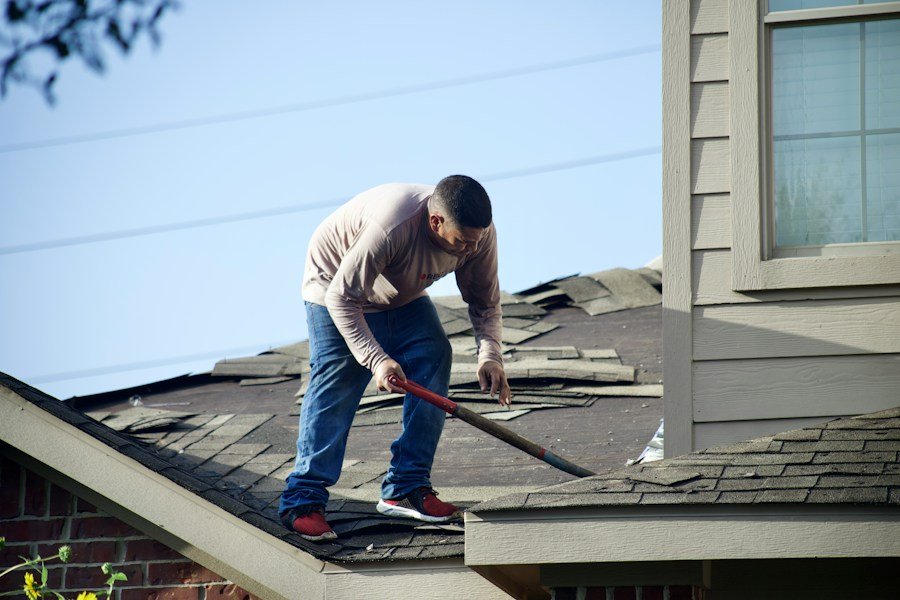
We walk the roof when it is safe and use binoculars or a camera pole when it is not. We photograph each slope, then the damaged shingles up close, and check the attic for stains, daylight, frost or damp sheathing. The goal is to find every problem now, including creased tabs that look fine from the ground, so you do not need us back on the roof after the next storm.
2. Identify the shingle and source a match
We check the shingle’s size, exposure, shape and color, and look for a leftover bundle wrapper in the garage or attic. That usually tells us the manufacturer and product line. If the product is discontinued, we find the closest current match and show you a sample against your roof before ordering. You approve the color before we buy anything.
3. Release the seals and pull the nails
A shingle is held by its own nails and by the nails of the course above, which pass through its top edge. We use a flat bar to gently break the seal strips on the damaged shingle and the course above it, then lift and remove each nail. Working this way avoids tearing healthy shingles, which is how careless repairs turn into bigger ones.
4. Check and repair what is underneath
With the shingle off, we look at the underlayment and deck. Torn felt or synthetic underlayment gets patched or replaced and lapped correctly. Soft, delaminated or rotted plywood gets cut out and replaced with matching thickness sheathing. If the area is at an eave or valley, we check for ice barrier membrane and add it where the repair allows.
5. Install with the correct nailing
The new shingle slides in, aligned with the course lines and the existing exposure. We nail it in the manufacturer’s marked nailing zone, with the nail count the wrapper calls for and never fewer than four per strip shingle. Then we re-nail the course above through its original line. Nails are driven flush with the surface and never left exposed.
6. Seal by hand when the weather calls for it
Shingle seal strips are activated by sun and heat. In NJ from roughly late fall through early spring, or on a shaded slope, they may not bond for weeks. On those jobs we hand-seal the new tabs and the tabs we lifted with dabs of approved asphalt roofing cement, so the repair holds against the next nor’easter instead of waiting for warm weather.
7. Check ridge, starter and flashing nearby
Wind damage rarely stops at one shingle. We check the ridge cap for cracked or lifted pieces, the starter strip at the eaves and rakes, and the step flashing, pipe boots and chimney flashing within reach of the repair. Small issues get fixed on the same visit if you approve them, so you are not paying for a second trip.
8. Clean up and document the work
We remove old shingles, nails and wrappers, run a magnet over the driveway, walkways and beds, and clean debris out of the gutters near the work. You get before-and-after photos, a note of the product used, and the itemized invoice. Those records help with warranty questions, insurance claims and selling the house later.
Pricing · updated November 2026
How Much Does Shingle Roof Repair Cost in NJ?
As of November 2026, replacing a few asphalt shingles on a New Jersey home typically runs $350 to $800, a single-source shingle leak repair $400 to $1,500, and re-shingling runs about $7.20 to $9.85 per square foot installed with tear-off, depending on the shingle grade. Pitch, height, access, matching and deck condition move the price within each range.
A few shingles or tabs
$350 – $800
Matching and replacing a small group of missing, creased or cracked shingles on one slope, re-nailing the course above, hand-sealing when needed, and a check of nearby ridge, starter and flashing.
Pipe boot or vent flashing
$250 – $600
Replacing a cracked rubber pipe boot or rusted vent flashing set into the shingles, plus the surrounding shingles that must be lifted or replaced to lap the new flashing correctly.
Shingle leak repair
$400 – $1,500
Tracing a single leak through the shingle roof to its source, such as nail pops, a failed seal, a split shingle or flashing, then repairing the shingles, underlayment and flashing involved in that one area.
Valley repair
$500 – $1,500
Opening a worn or leaking shingle valley, replacing the valley lining or metal, installing ice barrier membrane where it is missing, and rebuilding the cut or woven shingle valley with correct nailing back from the center.
Rotted deck section
$500 – $2,000+
Removing shingles and underlayment over soft or rotted sheathing, cutting out and replacing the bad plywood or boards, and re-shingling the area. Larger or structural areas need a permit and are quoted on inspection.
Re-shingle a slope or roof
$7.20 – $9.85 per sq ft
Tear-off, new underlayment, ice barrier at eaves and valleys, drip edge, starter strip, shingles and ridge cap. The low end is 3-tab, about $7.95 architectural, the high end luxury or designer grades.
What moves the price
- Pitch and height. A walkable 4/12 ranch roof is quicker than a 10/12 colonial or a three-story Victorian. Steep or cut-up roofs can run up to about 30% more on full re-roofs, and steep repairs need roof jacks, harnesses and more time.
- Shingle grade. 3-tab is the cheapest per square foot, architectural is the mid-range most NJ homes now carry, and designer or luxury shingles cost the most to buy and match.
- Matching difficulty. A current, in-stock product is simple. A discontinued color may need samples, a special order or borrowing shingles from a hidden area, which adds labor.
- What is under the shingles. Torn underlayment, a missing ice barrier at the eave, or soft plywood adds material and time. We price deck work per section once it is exposed and photographed.
- Number of layers. A second layer of shingles makes spot repairs messier and full replacements more expensive because both layers must be torn off and hauled away.
- Season. Cold-weather repairs need hand-sealing and more careful handling of stiff shingles. Emergency storm visits and tarping cost more than scheduled work.
- Access and site. Tight lots in Hudson or Essex County, decks, pools, gardens and solar panels change how we stage ladders and catch debris.
- Related flashing and ridge work. Repairs near a chimney, skylight, wall or ridge often include re-flashing or ridge cap replacement, priced by length or by piece on the written quote.
Repair ranges are typical NJ planning ranges used across our site. Per-square-foot re-roof figures come from the Roof Observations New Jersey Roof Cost Guide (updated January 2026; residential, installed, tear-off included at about $1.50 per sq ft, 6/12 pitch): 3-tab $7.20, architectural $7.95, luxury or premium $9.85. Fixr (2026) puts a typical NJ roof replacement at $8,500 to $17,000, about $13,500 for roughly 1,700 sq ft. These are planning ranges, not quotes. Your written itemized quote after a free inspection is the number that counts.
Methods & materials
Asphalt Shingle Types, Repair Methods and Installation for NJ Homes
Most NJ homes have architectural (laminated) shingles, with older roofs still carrying 3-tab and higher-end homes using designer shingles. Each repairs the same basic way, but they differ in wind resistance, lifespan, how easy they are to match, and when a repair stops making sense.
3-tab shingles are single-layer and flat, architectural shingles are two or more laminated layers with a dimensional look, and designer shingles are heavier multi-layer products built to look like slate or cedar shake.
3-tab (strip) shingles. One flat layer of fiberglass mat coated in asphalt and granules, with two cutouts that make each strip look like three separate tabs. They were the standard on NJ tract housing for decades. They are light, cheap and easy to install, but they are also the most likely to lift and crease in wind because the thin tab gives the wind an easy edge. Roof Observations lists a regular 3-tab service life of about 12 to 25 years, and premium 3-tab at about 20 to 35 years.
Architectural (laminated or dimensional) shingles. Two layers bonded together, with the lower layer showing through irregular cutouts to create shadow lines. They are thicker and heavier than 3-tab, usually carry higher wind ratings, and hide minor deck unevenness better. This is what most NJ re-roofs use now. Regular architectural shingles are rated at roughly 25 to 40 years of service life and premium architectural at 35 to 50, though actual life on a given NJ roof depends on ventilation, exposure and installation.
Designer (luxury) shingles. Thicker, multi-layer shingles with larger tabs or shaped edges meant to mimic slate or hand-split shake. You see them on newer custom homes and on older homes in places like Montclair, Princeton or Summit where owners want a slate look at a fraction of the weight and cost. They are the most expensive to buy, about $9.85 per square foot installed in NJ by the Roof Observations figures, and the hardest to match years later because product lines and colors change.
What this means for repairs. All three are repaired by releasing seals and nails and slipping in a new piece. You cannot mix types on the same slope without it showing, and you should not mix a 3-tab and an architectural on one roof plane for looks and wind performance. Knowing exactly what you have is the first step of every repair we do.
A proper shingle repair removes the damaged shingle completely and installs a new one in the correct nailing zone, then reseals everything that was lifted. Gluing a tab back down or smearing roofing cement over a crack is a temporary measure.
Single-shingle replacement. Each shingle is held by four or more of its own nails and by the nails of the course above, which pass through its top. We break the seal strips on the damaged shingle and on the one above it with a flat bar, slide the bar under each nail head and pull it, then remove the shingle. The new shingle goes in aligned with the existing courses, nailed in the manufacturer’s nailing zone, and the course above is re-nailed through its own line. Every lifted tab is then sealed down.
Re-sealing lifted tabs. If a tab has lifted but is not creased or torn, it can be cleaned and resealed with asphalt roofing cement. If the mat is creased across its width, it has lost its strength and should be replaced, because it will tear off in the next strong wind.
Nail pops. We pull the popped nail, install a new nail beside it in solid sheathing, and seal the old hole. Smearing caulk over a raised nail head leaves the nail free to keep backing out.
Ridge cap repairs. Ridge cap shingles take the most wind and sun on the roof. Cracked or blown-off ridge pieces get replaced with matching ridge cap, nailed with longer fasteners that reach solid wood, and the exposed nail heads on the last piece are sealed. If the ridge is vented, we make sure the replacement does not block the ridge vent.
Starter strip repairs. The starter strip is the adhesive-backed row at the eaves and rakes that seals the first course down. A missing or failed starter is a common reason the bottom row and the rake edges blow off. We add or replace starter during repairs at those edges.
Temporary fixes. After a storm, before matched shingles arrive, we can tarp or install a temporary patch. That is covered on our emergency roof repair page.
A good shingle match starts with identifying the exact product, and when that product is discontinued, the fix is the closest current color, a borrowed shingle from a hidden slope, or re-shingling the visible plane.
Finding out what you have. The fastest clue is a leftover bundle or wrapper in the garage, basement or attic, which shows the manufacturer, product line and color. Closing paperwork or a roofing invoice from the last owner can help too. Without that, we measure the shingle, note the exposure, the cutout shape and the shadow-line pattern, and compare it with current and recently discontinued lines.
Why new shingles look different. Even the same color from the same manufacturer will look brighter than shingles that have weathered for ten years. Granule blends also shift between production runs and plants. Most of that difference fades as the new shingles weather, but a strong mismatch on a front slope can stay noticeable.
When the product is discontinued. Shingle lines and sizes change over time, and older metric and non-metric sizes do not always line up. Our options are:
- Pick the closest current color and dimension and show you a sample against the roof before ordering.
- Take sound shingles from a hidden area, like a rear dormer or a low back porch, use them on the visible repair, and put the new shingles where they will not be seen.
- Re-shingle the entire affected plane, ridge to eave and rake to rake, so the change follows a natural break line.
Insurance and matching. When storm damage leaves you with a visible mismatch, how much your policy pays to make the roof uniform depends on the policy language and how your insurer handles it. We document the product, the search for a match and photos of the result. That gives your adjuster something to work from. Our storm damage roof repair page covers the claim side in more detail.
Sizes must match too. A shingle with a different exposure or length will not line up with the courses around it and can leave nails exposed. If we cannot get a dimension that fits, we tell you and recommend re-shingling the plane.
A durable shingle installation in NJ has a clean deck, drip edge, ice barrier at the eaves and valleys, underlayment, starter strip at eaves and rakes, shingles nailed in the nailing zone, and a vented ridge. Shortcuts on any one of those show up as blow-offs or leaks later.
Deck and edges. We tear off to the sheathing, re-nail loose plywood and replace soft sections. The International Residential Code requires drip edge at the eaves and rakes of shingle roofs. Drip edge supports the shingle edge and directs water into the gutter instead of behind the fascia.
Ice barrier and underlayment. The code requires an ice barrier membrane where there is a history of ice forming at the eaves, extending from the eave edge to a point inside the exterior wall line. That describes much of New Jersey and especially the northwest. We also run membrane in valleys and around chimneys and skylights, then underlayment over the rest of the deck.
Starter strip. A purpose-made starter strip goes along the eaves and up the rakes. Its sealant bonds the first course of shingles down, which is where wind uplift usually starts.
Nailing. The IRC requires at least the manufacturer’s minimum number of fasteners, and never fewer than four per strip shingle. Nails must be corrosion-resistant roofing nails with at least a 12-gauge shank and a 3/8-inch head, long enough to go at least 3/4 inch into the sheathing or through it. Many manufacturers call for six nails for high-wind areas or to qualify for their top wind warranty. Nails go in the marked nailing zone, driven flush. High nails are the most common install defect we see on blown-off shingles.
Wind ratings. Self-sealing shingles are classified under ASTM D7158: Class D for 115 mph, Class G for 150 mph and Class H for 190 mph design wind speeds. Older ratings under ASTM D3161 are Class A (60 mph), Class D (90 mph) and Class F (110 mph). The rating is printed on the bundle label.
Ridge and ventilation. We finish with a ridge vent or other exhaust balanced with soffit intake, then ridge cap. Full replacement is covered on our roof replacement page.
Repair makes sense when the damage is limited, the shingles around it are still flexible and holding granules, and the roof has years of life left; replace a slope or the whole roof when failures are widespread, the roof is near the end of its life, or a match is impossible.
Repair is usually right when:
- A storm took off a handful of shingles or tabs on a roof that is otherwise in good shape.
- The problem is a single nail pop, pipe boot, failed seal or one cracked shingle.
- The surrounding shingles bend without cracking and still have most of their granules.
- You can get a reasonable match, or the repair is on a slope no one sees.
Re-shingle one slope when:
- One face of the roof, often the south or west slope that takes the most sun or the windward side at the Shore, is wearing out faster than the others.
- Repairs on that slope keep coming back every season.
- A storm damaged most of one plane and a spot repair would leave a patchwork.
- The product is discontinued and the damaged slope faces the street.
Replace the whole roof when:
- Granule loss, curling, cupping or cracking show up on most slopes.
- The roof is in the late part of its expected life and you are paying for repairs more than once a year.
- There are already two layers. New Jersey allows at most two, and a third layer needs a permit and is not allowed under code limits, so the next step is a full tear-off.
- The deck is soft in several areas or there are multiple leaks.
- You are planning solar panels. Putting panels on a roof with only a few years left means paying to remove and reset them later.
A useful rule of thumb. If the repair quote approaches a meaningful share of what a new roof would cost and the roof is already past the middle of its life, the repair money is usually better spent on replacement. We put both options in writing so you can compare them. See roof repair cost for full-roof numbers.
For most NJ homes, a good choice is an architectural shingle with a high ASTM D7158 wind class, algae-resistant granules and a full manufacturer system; Shore and hilltop homes should lean toward the highest wind class and six-nail installation.
Wind rating. Look on the bundle label for the ASTM D7158 class (D, G or H) or the ASTM D3161 class (A, D or F). The baseline ASTM D3462 shingle specification already requires at least Class A fire resistance and 60 mph wind resistance, but coastal towns in Ocean, Monmouth, Atlantic and Cape May counties and exposed ridgetop homes in Sussex and Warren benefit from more. Ask your installer what class the product carries and what nailing the manufacturer requires to reach its wind warranty.
Algae resistance. The black streaks on NJ roofs are an algae called Gloeocapsa magma. Algae-resistant shingles use granules containing copper that slowly release copper ions when wet, which keeps the algae from taking hold. Depending on the product, the protection can last a long time. If your roof is shaded or north-facing, algae resistance is worth asking for. For streaks on an existing roof, see roof cleaning.
Impact resistance. Shingles rated UL 2218 Class 4 have passed the highest impact class in the standard’s steel-ball test. Hail is less of an issue in NJ than in the Plains, but impact-rated shingles also resist cracking from falling branches. Some insurers offer discounts for them; ask your agent.
Accessories from the same system. Starter strip, ridge cap, underlayment and ice barrier from the same manufacturer are often required for the higher system warranties. Mixing brands can limit the warranty.
Weight and thickness. Thicker shingles generally last longer. Designer shingles are heavier, which matters on older homes with undersized rafters. We check framing in the attic before recommending a heavy product.
Color and heat. Darker shingles absorb more heat. On a roof with weak attic ventilation, fixing the ventilation does more for shingle life than picking a lighter color.
NJ rules
NJ Permits and Insurance for Shingle Roof Repair
Permits
Replacing shingles on a detached one- or two-family home in New Jersey does not need a permit. Since March 5, 2018, repair or replacement of existing roof covering on those homes counts as ordinary maintenance under the Uniform Construction Code, N.J.A.C. 5:23-2.7, with no permit, inspection or notice to the town. That covers spot shingle repairs, re-shingling a slope and a full tear-off and re-shingle.
A permit is needed when the shingle job also involves replacing roof sheathing or deck, any rafter or truss repair, other structural work, a home that is attached (townhouses and many condos), larger multi-family buildings, commercial buildings, or adding a third layer of roofing, which code limits do not allow anyway. Ordinary maintenance is not a waiver from the code. The work still has to meet code and the manufacturer’s instructions, including nailing and ice barrier requirements. If your town or HOA has extra rules on color or appearance, check those before choosing a shingle.
Insurance
Homeowners insurance usually covers shingles damaged suddenly by wind, hail, a falling tree or the weight of ice and snow, and usually excludes shingles that failed from age, wear or neglect. Curling, granule loss and thermal splitting are generally treated as wear. Wind creasing and torn-off shingles after a named storm or nor’easter are generally treated as sudden damage. Coastal policies often carry a separate wind or hurricane deductible that can be higher than the regular one. Your policy and agent have the final word.
To document a shingle claim, photograph the roof and any shingle pieces in the yard the day it happens, note the date and the storm, and keep the pieces. Take interior photos of any stains. Make temporary repairs to prevent more damage and keep the receipts. We provide dated photos of each damaged area, the shingle product, notes on matching and an itemized repair quote, which give the adjuster clear evidence to review.
Who does the work
Why NJ Homeowners Choose Roof Repair SNJ for Shingle Roof Repair
- Repairing NJ roofs for 25+ years
- General liability + workers’ comp insurance
- Workmanship warranty: 2 years on repairs, 10 years on full replacements, in writing
Check any NJ roofer before you sign
Ask for the 13VH registration number and confirm it on the NJ license lookup. NJ law requires a signed written contract showing the registration number and total price, and gives you until midnight of the third business day to cancel (N.J.S.A. 56:8-151).
In depth
Shingle Roof Repair in NJ: What Homeowners Ask in Depth
Can I replace a few shingles myself?
A handy homeowner can replace a shingle on a low, walkable roof, but most NJ roofs are steep or high enough that the fall risk and the risk of damaging surrounding shingles make it a job for a pro.
The work itself is not complicated. The hard parts are getting the seals apart without tearing the shingles around the damaged one, pulling nails from two courses without cracking anything, getting the new shingle into the nailing zone, and sealing it properly. On a cold day, a stiff shingle cracks when you bend it back. On a hot day, the granules scuff off under your feet and the asphalt tears.
Safety is the bigger issue. Most two-story colonials and split-levels in New Jersey have roof pitches that are not safe to walk without fall protection. Ladder setup on soft lawns, wet shingles and wind gusts all add risk. If you decide to do it yourself, work only on a low-slope, single-story area, on a dry, mild day, with a helper holding the ladder.
Common DIY mistakes we fix:
- Nailing through the exposed part of the shingle, which leaves nail heads in the water path.
- Gluing a creased tab back down instead of replacing it.
- Covering nail pops with caulk instead of re-nailing.
- Using a shingle with a different exposure that leaves the course above misaligned.
- Tearing the shingles around the repair and creating a larger problem.
Before you climb, a free inspection tells you what is actually wrong. Often the shingle you can see from the ground is only one of several creased or unsealed pieces. Our roof inspection page explains what we check.
When is the best time of year for shingle work in NJ?
Late spring through early fall is the easiest time for shingle work in New Jersey because the seal strips bond quickly in the sun, but repairs can be done year-round with hand-sealing in the cold months.
Asphalt shingles have a heat-activated sealant strip. Sealing time depends on the slope, its orientation, temperature and sunlight. A south-facing slope in June may seal within days. A north-facing slope in December may not seal until spring. Until it seals, a shingle relies only on its nails, which makes it much more vulnerable to wind.
That matters in NJ because nor’easters run from October through April, which is exactly the season when new shingles seal slowest. A repair done in January without hand-sealing can blow off in a February storm. We hand-seal new and lifted tabs with asphalt roofing cement in cold weather.
Cold also changes how we handle the material. Shingles become stiffer and more brittle as temperatures drop, so we store bundles warm when we can, avoid bending or dropping them, and flatten them before nailing so the nail does not break through the surface.
Spring is a busy season because winter storm damage shows up when people look at their roofs again. Early fall is ideal for planned work like re-shingling a slope: the weather is mild, shingles seal before winter, and you go into nor’easter season with a sound roof. For storm damage, do not wait for good weather. Send us your storm damage details for a temporary repair and schedule the permanent fix.
How long do asphalt shingles last in New Jersey?
Most architectural shingle roofs in New Jersey last somewhere in the 25-to-40-year range for regular grades, with 3-tab roofs often closer to 12 to 25 years; ventilation, sun exposure, wind and installation quality decide where a given roof lands.
Published service-life ranges from Roof Observations are about 12 to 25 years for regular 3-tab, 20 to 35 for premium 3-tab, 25 to 40 for regular architectural and 35 to 50 for premium architectural. Manufacturer warranty terms are often longer than real-world life, because warranties are prorated and have conditions.
Things that push NJ roofs toward the shorter end:
- A hot, poorly vented attic that cooks the shingles from below.
- South and west slopes with full afternoon sun.
- Salt air and steady wind at the Shore.
- Freeze-thaw cycles and ice dams in the northwest counties.
- Shade, debris and algae on tree-covered lots.
- High nailing or a missing starter strip from the original install.
- A second layer of shingles, which holds more heat.
Things that help:
- Balanced intake and exhaust ventilation.
- Ice barrier at the eaves and valleys.
- Clean gutters and valleys, and trimmed branches.
- Prompt repair of small damage before water reaches the deck.
A useful way to judge age is to look at the granules and the flexibility of the shingles. If granules are mostly gone, the mat is visible, and shingles crack instead of bending, the roof is near the end regardless of its age on paper.
How does attic ventilation affect shingle life?
Poor attic ventilation is one of the biggest reasons shingles fail early in New Jersey, because trapped summer heat ages the shingles from below and trapped winter moisture rots the deck and feeds ice dams.
A shingle roof is designed to sit over an attic that breathes. Cool outside air comes in through soffit or eave vents low on the roof and hot, moist air leaves through ridge or high vents. When that flow is blocked or unbalanced, several things happen.
In summer, the attic gets very hot. The shingles bake from both sides, which drives off oils in the asphalt. You see blistering, curling, cupping and early granule loss, usually worst on the sunny slopes.
In winter, warm, moist air from the house rises into the attic. It condenses on cold sheathing and nails, which rusts nails, delaminates plywood and causes nail pops. Heat leaking into the attic also melts snow on the upper roof, which refreezes at the eave and forms ice dams.
Common ventilation problems we find on NJ homes:
- Soffit vents painted over or blocked by insulation.
- A ridge vent added without any intake vents.
- Mixed exhaust types, like a ridge vent plus gable vents, which can short-circuit the airflow.
- Bathroom fans venting into the attic instead of outside.
Ventilation also matters for your warranty. Manufacturers require adequate ventilation, and improper ventilation can void a shingle warranty. When we repair or replace shingles, we check the attic and tell you if airflow is the real cause.
How do ridge cap and starter strip repairs work?
Ridge cap and starter strip repairs fix the two edges of a shingle roof that take the most wind: the peak and the eaves and rakes. They are small jobs that prevent large failures.
Ridge cap. Ridge cap shingles are bent over the peak and sit fully exposed to sun and wind. They crack along the fold as they age, and in storms individual pieces lift and blow off. Using cut-up 3-tab shingles as ridge cap is a common cost-cutting choice; a purpose-made ridge cap shingle is thicker and holds up better. To repair, we remove cracked or missing pieces, check the ridge vent and the shingles underneath, and install new ridge cap with longer nails so they penetrate solid wood. The final piece is face-nailed and sealed.
Starter strip. The starter strip is the first row along the eaves and up the rakes, under the first visible course. It provides a sealant line that bonds the first course down and covers the joints between shingles. When the starter is missing, installed wrong, or made from upside-down 3-tabs without the sealant lined up, the bottom course and rake edges are easy for wind to catch. Repair means lifting the edge shingles, installing a proper starter, and re-nailing and sealing the first course.
Signs you need these repairs:
- Missing ridge pieces visible from the street.
- Cracks along the ridge fold.
- Shingles lifting along the rake edges or the bottom row.
- Leaks at the top of interior walls under the ridge.
Ridge and starter work is quoted by length on your written estimate.
What about black streaks, moss and lichen?
Black streaks are algae and are mostly cosmetic, while moss and lichen can lift shingle edges and hold moisture, so they should be removed carefully and never with a pressure washer.
The dark streaks common on NJ roofs are Gloeocapsa magma, an airborne algae that feeds on the limestone filler in asphalt shingles. It spreads from roof to roof on the wind and thrives on shaded, damp, north-facing slopes. The streaks do not usually damage the shingle on their own, but they make a roof look older and they show the roof is staying damp.
Moss and lichen are more serious. Moss grows into thick mats that hold water against the shingle, and as it grows it can push up the bottom edges of tabs. Lichen bonds tightly to the granules, and pulling it off can take granules with it.
What to do:
- Do not pressure wash. High pressure strips granules and can lift and break seals, shortening the life of the roof.
- Use a soft wash with a cleaner meant for asphalt shingles, applied at low pressure, with plants protected and rinsed.
- Trim branches to let more sun and air reach the roof.
- Keep valleys and gutters clear of debris.
- When you replace shingles, choose an algae-resistant product with copper granules.
Some homeowners install zinc or copper strips near the ridge. We discuss those case by case because the nails must be placed and sealed correctly. For cleaning, see our roof cleaning service.
Will a repair affect my shingle warranty?
A repair done with the right materials and method usually leaves a manufacturer warranty intact, but improper repairs, mixed products or poor ventilation can limit or void coverage.
Shingle warranties come in two parts. The manufacturer covers the material, usually with a prorated or non-prorated period depending on the product and system. The installer covers workmanship for a stated period. Higher system warranties often require specific starter, ridge cap, underlayment and ventilation products from the same manufacturer, plus installation by a credentialed contractor.
What can affect coverage:
- Installing shingles in a way that does not follow the manufacturer’s instructions, like nailing outside the nailing zone.
- Mixing shingle brands or accessories on a system-warranty roof.
- Inadequate attic ventilation, which manufacturers treat as a reason to deny or limit claims.
- Adding a second layer of shingles where the warranty requires a tear-off.
- Damage from foot traffic or other trades.
If your roof is still under a workmanship warranty from the original installer, contact them first for any covered issue. If you are not sure, find the paperwork or ask us to check your shingle roof. We document the product we use and the method so your records stay clean. Keep copies of every repair invoice and photo. They help with warranty claims, insurance and when you sell the house.
How do I choose a contractor for shingle repair in NJ?
Choose a New Jersey-registered home improvement contractor who inspects before quoting, explains the shingle type and repair method, and gives you a written contract that meets state law.
Start with registration. NJ home improvement contractors must register with the Division of Consumer Affairs and carry a registration number that starts with 13VH. Registration requires at least $500,000 in commercial general liability insurance and a business address. You can look up any contractor at newjersey.mylicense.com.
Under the Contractors’ Registration Act, N.J.S.A. 56:8-151, your home improvement contract must be in writing and signed, include the contractor’s legal name, business address and registration number, state the total price, include a copy of the liability insurance certificate, and include a Notice to Consumer explaining your right to cancel for any reason before midnight of the third business day after you receive a copy.
Questions to ask about shingle work specifically:
- What shingle do I have, and can you match it?
- How many nails per shingle will you use, and where?
- Will you hand-seal if it is cold?
- Will you check the ridge, starter and flashing near the repair?
- What happens if you find rotted deck?
- Do I get photos of the work?
Be cautious with anyone who knocks after a storm, asks for full payment up front, or quotes without getting on the roof or showing photos.
Service areas
Shingle Roof Repair Across New Jersey
We provide shingle roof repair in all 21 New Jersey counties. Find your county and town on our New Jersey service locations page for local roof types, permit notes and prices.
FAQ
Shingle Roof Repair in NJ: Frequently Asked Questions
How much does it cost to replace a few shingles in NJ?
In New Jersey, replacing a few shingles typically costs $350 to $800 as a planning range in November 2026. The price depends on roof pitch, height, how easy the shingle is to match, and whether the underlayment or deck needs work. A free inspection with photos gives you a written itemized quote.
Can you replace just one shingle on a roof?
Yes. A single asphalt shingle can be replaced by breaking the seal strips, pulling the nails from that shingle and the course above, sliding in a matched shingle, nailing it in the nailing zone and sealing it. Most single-shingle jobs also include checking nearby shingles for creases.
What is the difference between 3-tab and architectural shingles?
3-tab shingles are one flat layer with cutouts that create three tabs. Architectural shingles are two or more laminated layers with a dimensional look. Architectural shingles are thicker, usually carry higher wind ratings, last longer, and are what most New Jersey homes now use when re-roofing.
Do I need a permit to repair shingles in New Jersey?
No permit is needed to repair or replace shingles on a detached one- or two-family home under N.J.A.C. 5:23-2.7. A permit is needed if the work includes replacing sheathing, structural repairs, an attached or larger multi-family building, commercial property, or a third roofing layer.
Why are my shingles blowing off?
Shingles usually blow off because their seal strips failed or never bonded, they were nailed above the nailing zone, there were too few nails, or the starter strip at the eaves and rakes is missing. Age and heat also weaken seals. Nor’easters and tropical storms find those weak spots first.
Can new shingles match my old roof?
Often, yes, if the product line is still made. New shingles look brighter at first and blend as they weather. If your shingle is discontinued, options include the closest current color, borrowing shingles from a hidden slope, or re-shingling the full visible plane so the change follows a natural break.
Can shingles be repaired in winter in NJ?
Yes. Shingles can be repaired in cold weather, but the heat-activated seal strips may not bond for weeks. Roofers should hand-seal new and lifted tabs with asphalt roofing cement and handle stiff shingles carefully so they do not crack. That keeps the repair from lifting in a winter nor’easter.
Does homeowners insurance cover missing shingles?
Usually, if wind, hail, a falling tree or the weight of ice and snow caused sudden damage. Insurers usually exclude shingles that failed from age or wear. Coastal NJ policies may have a separate wind deductible. Photograph damage the same day, keep shingle pieces, and check your policy with your agent.
How long do architectural shingles last in New Jersey?
Regular architectural shingles are rated for roughly 25 to 40 years of service life, and premium grades 35 to 50 years. In New Jersey, a poorly vented attic, salt air at the Shore, full sun or freeze-thaw cycles can push a roof toward the low end. Good ventilation helps reach the high end.
Should I repair shingles or replace the roof?
Repair when damage is limited, surrounding shingles are flexible and the roof has years left. Re-shingle a slope when one face is wearing out or a match is impossible. Replace the roof when failures appear on most slopes, there are already two layers, or repairs keep recurring.
Reviewed by the Roof Repair SNJ team · Last updated November 2026
Roof repair
Related roof repair services
Shingle Roof Repair is part of our roof repair services. See every service on our roof repair NJ homepage.
Free inspection
Get Your Shingle Roof Fixed: Free Inspection Anywhere in NJ
Book a free shingle roof inspection through our contact page. We photograph every slope, identify your shingle, and give you a written itemized quote for repair or re-shingling, so you can decide with real information. If storm damage has left your roof open, send an emergency request any time, because our 24/7 emergency service handles requests around the clock. No pressure and no obligation, just a clear answer about your roof.
No pressure and no obligation. If a repair will do, we’ll tell you.
Roof Repair SNJ
- Serving all 21 NJ counties
- Send a shingle roof repair request
- Mon–Fri 5:00 AM–10:00 PM · Sat 5:00 AM–6:00 PM · Emergencies 24/7
Sources: N.J.A.C. 5:23-2.7 Ordinary maintenance (Cornell LII) · N.J.S.A. 56:8-151 Contractors’ Registration Act contract requirements (Justia) · NJ Division of Consumer Affairs license verification · Roof Observations: New Jersey Roof Cost Guide (Jan 2026) · Fixr: Roof Replacement Cost in New Jersey (2026) · Roof Observations: Typical Roof Lifespan for Every Type of Roof System · Professional Roofing: Understanding asphalt shingle standards (ASTM D3161, D7158, D3462, UL 2218) · GAF Technical Bulletin R-138: Wind Resistance of Asphalt Shingles · IRC 2021 asphalt shingle fastening (R905.2.5, R905.2.6), ice barrier and drip edge summary · ARMA: Recommendations for Installation of Asphalt Roofing Shingles in Cold Weather · Copper Development Association: Copper Ions Keep Roofs Clean. Prices are planning ranges, not quotes. Permit and insurance information is general guidance; your town, policy and agent have the final word.