
Roof Repair NJ › Flat Roof Repair
Flat & low-slope roofs · All 21 NJ counties
Flat Roof Repair in NJ: EPDM, TPO, PVC and Modified Bitumen
Roof Repair SNJ repairs and replaces flat and low-slope roofs on New Jersey homes, rowhouses, additions, porches and garages. We fix EPDM rubber, TPO, PVC, torch-down and built-up roofs, correct ponding water and failed flashing, and start with a free inspection with photos and a written, itemized quote. Leaks get 24/7 emergency service, and you can request a free flat roof inspection online.
- Every membrane: EPDM, TPO, PVC, torch-down
- Ponding water and drainage problems corrected
- Free photo inspection, itemized written quote
Free inspection, written quote
Photos of every problem we find and an itemized price before any work. 24/7 emergency service.
Roof Repair SNJ
Serving all 21 New Jersey counties
Free inspection
Roof, attic and gutters checked at no cost.
Insured
Liability and workers’ comp; certificate on request.
Written quotes
Itemized price in writing before any work.
Photo-documented
Every problem photographed, before and after.
What you’ll notice
Signs Your Flat Roof Needs Repair in NJ
A flat roof needs attention when water stays on it more than two days, seams or flashing start lifting, or stains show up on the ceiling below. Flat roofs fail at their edges, seams and penetrations long before the field of the membrane wears out, so most problems are repairable if you catch them early.
Water still standing after 48 hours
The roofing industry defines ponding as water that remains more than 48 hours after rain when conditions allow drying. Short-lived puddles are normal on a low-slope roof. Water that sits for days adds weight, collects dirt, freezes in winter and ages the membrane faster at the low spot.
Ceiling stains under the roof
Brown rings on the top-floor ceiling of a brownstone, or in the room under a rear addition, mean water has already passed the membrane and the insulation. On flat roofs, the stain is often several feet away from the actual opening, because water travels along the deck and the insulation boards before it drips.
Seams lifting or peeling open
On EPDM rubber, look for laps where the edge has curled up and you can slide a finger under it. On TPO or PVC, look for seams that were never fully welded. Open seams let wind-driven rain and melting snow run straight under the sheet and into the roof deck.
Blisters and soft bubbles
Blisters are pockets of air or moisture trapped between layers of modified bitumen, built-up roofing or a coating. Small, intact blisters can be watched. Blisters that crack, grow every summer or squish water when stepped on need to be cut out and patched before they split.
Flashing pulling away from walls
Where a flat roof meets a parapet, a brick party wall or the house siding, the membrane turns up the wall and is covered by counter flashing or coping. When that termination bar loosens or the mortar joint behind it opens, water gets behind the flashing and runs down inside the wall.
Clogged drains and overflowing scuppers
Rowhouse roofs in Hoboken, Jersey City and Newark often drain to one internal drain or a single scupper and leader. Leaves, grit and roofing debris build up around the strainer. When the drain slows, water backs up across the roof and finds every weak seam on its way.
Spongy or soft spots underfoot
A roof that feels soft or dips when you walk on it usually has wet insulation or a rotting wood deck below the membrane. Wet insulation loses most of its insulating value and keeps feeding moisture to the deck, so a soft area needs core cuts or a moisture scan to size the repair correctly.
Cracking, crazing or bare spots
Alligator cracking on built-up roofs, worn-off granules on modified bitumen, and chalky, crazed coatings all show that the surface has lost its UV protection. Sun and heat do the most damage on south-facing additions and garage roofs. Once the surface cracks through, every freeze-thaw cycle opens the cracks a little wider.
Why it happens in NJ
What Causes Flat Roof Leaks in New Jersey?
Most New Jersey flat roof leaks come from poor drainage, failed flashing at walls and parapets, opened seams, and freeze-thaw damage at low spots where water sits. Age and UV wear finish the job on roofs that were installed without enough slope or with too few drains.
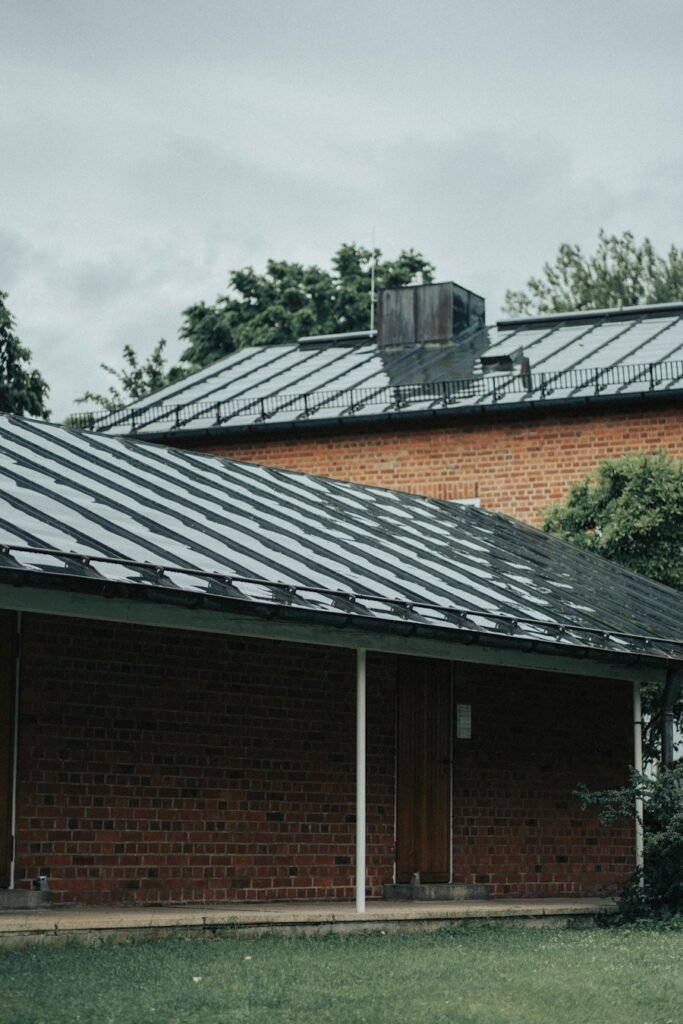
Ponding water from too little slope
Building codes call for a design slope of at least 1/4 inch per foot for modified bitumen and single-ply membranes, which is about a 2 percent grade. Many older NJ rowhouse and addition roofs were framed nearly dead flat, and joists sag over time. The low spots hold water, which stresses seams, grows algae and turns into ice from December through March.
Freeze-thaw cycles and ice
New Jersey winters swing above and below freezing again and again, especially in Sussex, Warren, Morris, Passaic and Hunterdon counties. Water that sits in a ponded area freezes, expands and moves. Ice can scrub the membrane surface and pry open small cracks. A seam that leaked a little in November can be wide open by March.
Parapet walls and brick party walls
Hudson and Essex County brownstones and rowhouses have masonry parapets and shared party walls on both sides of the roof. Water gets in through cracked coping stones, open mortar joints and loose counter flashing, then runs down behind the roof membrane. Many leaks blamed on the roof are actually the wall above it.
Nor’easters and wind-driven rain
Nor’easters from October to April push rain sideways for hours. Wind lifts loose membrane edges, peels back metal edge flashing and drives water uphill under laps. Tropical systems from June to November, like the remnants of Ida in 2021, dump inches of rain faster than a single small drain can handle.
Clogged drains, scuppers and leaders
Flat roofs depend on a few drain points. Leaves from street trees, tennis balls, nests and grit block strainers, scuppers and the leaders below them. In older Newark, Paterson and Jersey City homes, the internal drain line can also crack or separate inside the building, which looks exactly like a roof leak.
Failed seams and old patches
EPDM seams depend on adhesive or seam tape that can let go after years of heat and cold. TPO and PVC seams are heat-welded and fail where the original weld was cold or narrow. Old patches made with roofing cement or the wrong material for the membrane are a common source of repeat leaks.
Foot traffic, HVAC units and satellite mounts
Flat roofs in NJ cities double as equipment decks. Condenser units, satellite dishes, solar racks and the contractors who service them puncture membranes with dropped tools, sharp screws and unprotected stands. HVAC condensate lines that drain onto the roof also keep one area wet all summer, which feeds algae and wears that patch of membrane first.
Summer heat and UV on dark roofs
Black EPDM and unsurfaced asphalt roofs get very hot on July afternoons, then cool fast in a thunderstorm. That daily expansion and contraction stresses flashing corners and seams. UV breaks down the surface of unprotected built-up roofs and older coatings, leaving them brittle and cracked by their second decade, often on the south-facing additions that get the most sun.
How we do it
How We Repair Flat Roofs in NJ, Step by Step
We find where water is actually getting in, repair it with materials that match your membrane, test the repair, and send you photos of every step. If repair no longer makes sense, we show you why and quote replacement separately.

1. Interior check and leak history
We start inside. We look at the stain, the ceiling, the top of the wall and any attic or cockloft space under the roof, and we ask when the leak shows up: every rain, only in wind, or only after snow melts. That pattern tells us whether to look first at seams, flashing, drains or the parapet walls.
2. Roof surface inspection and photos
On the roof, we identify the membrane type and check every seam, corner, penetration, drain, scupper, pitch pocket and wall termination. We probe EPDM laps, check TPO and PVC welds with a seam probe, and look for blisters and soft areas. Everything is photographed so you see what we see.
3. Moisture check of the roof system
Water under a flat roof spreads sideways. Where we suspect wet insulation, we take small core cuts or use a moisture meter to map how far the water has traveled. This decides whether a surface patch will work or whether wet insulation and deck boards need to come out first.
4. Written, itemized repair plan
You get a written quote that lists each repair, the materials, and what is included, with our registration number and the three-day cancellation notice New Jersey law requires. If we see problems a repair cannot solve, like structural ponding or a roof past its service life, we explain the replace option on a separate line.
5. Surface prep and dry-in
Membrane repairs only hold on clean, dry, primed surfaces. We remove debris and old failed patch material, clean EPDM with the manufacturer’s cleaner or primer, and scrub TPO and PVC so a weld can bond. If rain is coming, we dry-in the area so no more water enters before the permanent repair.
6. Permanent repair matched to the membrane
EPDM gets primer and seam tape or a cured or uncured EPDM patch. TPO and PVC get a hot-air welded patch or new cover strip of the same material. Modified bitumen gets a cut-and-patch with matching cap sheet, torched or self-adhered. Flashings are rebuilt with new termination bar, counter flashing and sealant.
7. Water test and seam probe
We probe every new weld and lap edge, and where it is safe and useful, we run water at the repair area to confirm it is tight. Drains are flushed and checked for flow. On parapet repairs, we look at the wall and coping above the roof, since that is often the second source.
8. Cleanup, photo report and care notes
We take all scrap, old patch material and fasteners off the roof and out of your yard or alley. You get before-and-after photos, a list of what was done, and notes on anything we saw that is aging and worth watching, so you can plan the next repair or replacement on your schedule.
Pricing · updated November 2026
How Much Does Flat Roof Repair Cost in NJ?
As of November 2026, most New Jersey flat roof repairs fall between $400 and $2,500, and full flat roof replacement typically runs about $5.85 to $7.85 per sq ft for single-ply without insulation and $13.50 to $19.90 per sq ft with R-30 insulation. Small residential roofs often land at the higher end per sq ft because of setup, access and minimum job costs.
Patch or seam repair
$400 – $2,500
Cleaning, priming and patching a puncture, tear or open seam on EPDM, TPO, PVC or modified bitumen, plus a few cut-out blisters. Price depends on the number of spots, roof access, and whether the area under it is wet.
Flashing, drain or scupper repair
$400 – $1,800
Rebuilding membrane flashing at a wall, parapet, curb or skylight, replacing termination bar and counter flashing, resetting a drain clamping ring, re-flashing a scupper, or refilling and capping a pitch pocket around a pipe or post.
Emergency leak dry-in
$300 – $1,200
Temporary waterproofing during or right after a storm: securing a lifted membrane edge, tarping or covering an open section, or applying temporary patch material so water stops coming in until a permanent repair can be made in dry weather.
Coating or resurfacing a small roof
$1,500 – $5,000+
Cleaning, repairing seams and flashings, priming and applying a reinforced silicone or acrylic coating over a sound existing roof, such as a porch, garage or rear addition. Only suitable when the insulation underneath is dry and the roof still drains.
Membrane replacement, no new insulation
$5.85 – $7.85 per sq ft
Tear-off and new EPDM, TPO or PVC membrane with new flashings, edge metal and drain connections, on a roof whose deck and slope are sound. Modified bitumen runs about $11.80 to $12.45 per sq ft for the same scope.
Full replacement with insulation
$13.50 – $19.90 per sq ft
Tear-off, deck repairs as needed, new insulation to about R-30 (including tapered insulation to correct ponding), new single-ply membrane and flashings. Modified bitumen over R-30 insulation runs about $21.60 to $26.15 per sq ft.
What moves the price
- Membrane type. EPDM and TPO repairs use fast, clean methods. Torch-down and built-up roofs take more labor, and PVC requires PVC-compatible materials.
- Wet insulation or rotted deck. A patch over wet insulation fails. If core cuts find water, the price includes removing and replacing the wet boards and any soft plywood or plank deck, and replacing roof sheathing triggers a permit.
- Access. A Hoboken or Jersey City rowhouse reached through a roof hatch or from a narrow alley costs more to work on than a garage roof you can reach with a ladder from the driveway. Hoisting materials four stories adds labor.
- Parapets and party walls. Masonry parapets need coping, counter flashing and sometimes repointing. Wall flashing is slower, detailed work, and it is where many rowhouse leaks start.
- Drainage corrections. Adding a scupper, enlarging a drain, or installing tapered insulation and crickets to stop ponding adds materials and time, and it is often the repair that ends repeat leaks.
- Number of penetrations. Every vent stack, HVAC curb, skylight, satellite mount and solar stand is a detail that needs its own flashing.
- Roof size and minimums. Small roofs cost more per sq ft. A 300 sq ft porch has nearly the same setup, travel and cleanup as a 1,000 sq ft rowhouse roof.
- Season and urgency. Emergency repairs during a nor’easter cost more than a scheduled repair. Most membranes and coatings also have minimum temperature limits, so some winter jobs need a temporary fix first and a permanent one in spring.
Planning ranges, not quotes. Replacement per-sq-ft figures are New Jersey low-slope installed costs from the Roof Observations New Jersey Roof Cost Guide (updated January 2026), which reports them for commercial low-slope work; small residential roofs often price higher per sq ft. Coating and resurfacing ranges reflect Fixr’s 2026 flat roof repair cost data (January 2026). Repair ranges are Roof Repair SNJ’s typical NJ planning ranges. Your price comes from a free inspection and a written, itemized quote.
Methods & materials
Flat Roof Materials, Repair Methods and Replacement in NJ
Each flat roof membrane is repaired a different way: EPDM with primer and seam tape, TPO and PVC with hot-air welding, modified bitumen with torched or self-adhered patches. Using the wrong product, like roofing cement on rubber, is the most common reason flat roof repairs fail.
A good flat roof repair uses the same family of material as the roof, bonds to a clean, primed surface, and extends well past the damage. Here is how we repair each system.
EPDM rubber. EPDM is a black (sometimes white) synthetic rubber sheet, glued or held down at the edges. Seams were made with contact adhesive on older roofs and with seam tape on newer ones. To repair a seam or puncture, we clean the rubber with the manufacturer’s cleaner, apply primer, set seam tape or a peel-and-stick EPDM patch, roll it with a silicone hand roller so the bond is complete, and seal the edges with lap sealant. A rounded-corner patch at least a few inches past the damage on every side holds far better than a small square.
TPO and PVC. These are heat-welded thermoplastic sheets, usually white. Their seams are fused with hot air. To repair them, we clean and scrub the area, then weld a patch of matching material with a hand-held hot-air welder and probe the seam to confirm it fused all the way across. Older TPO can be hard to weld; when a test weld fails, we use a manufacturer-approved primer and tape method or replace that section.
Modified bitumen (torch-down or peel-and-stick). Mod bit is asphalt reinforced with polyester or fiberglass, usually with a granule cap sheet. For a blister, we cut it open in an X, let it dry, press the flaps back down, and cover it with a larger patch of cap sheet. Patches are torched or set with self-adhered sheet, depending on the roof and fire risk at that location.
Built-up roofing (BUR). Tar-and-gravel and asphalt BUR roofs are repaired by scraping back the gravel, installing new plies with compatible asphalt or cold-process adhesive, and re-embedding gravel.
Flashings, drains and pitch pockets. Most leaks come from details. We rebuild wall and parapet flashing with new membrane, termination bar and counter flashing. Drains get a reset clamping ring and new strainer. Pitch pockets, the small metal boxes filled with sealer around pipes and posts, get cleaned out and refilled, or replaced with prefabricated pipe flashings.
A full flat roof replacement removes the old roof down to the deck, repairs the deck, adds insulation and slope where needed, and installs a new membrane with new flashings and edge metal. On most homes the work takes one to three days, weather permitting.
Tear-off and deck inspection. We remove the old membrane and insulation in sections so the house is never left open overnight. Rowhouse and addition roofs often have plank or plywood decks that are soft near the drain or along the parapets. Rotted sections are cut out and replaced. If more than spot repairs to the sheathing are needed, that work requires a permit, which we tell you about in the quote.
Insulation and slope. This is where a new roof earns its keep. We lay rigid insulation boards, usually polyiso, and where the roof holds water, we use tapered insulation that slopes toward the drains or scuppers at the code minimum of 1/4 inch per foot. Crickets, small triangular built-up areas, are added behind chimneys and HVAC curbs, and saddles between drains, so water has nowhere to sit.
Cover board and membrane. A cover board protects the insulation and gives the membrane a smooth, firm base. Then the membrane is installed: EPDM fully adhered or mechanically fastened, TPO or PVC fastened and welded at the seams, or modified bitumen in two plies, a base sheet and a granulated cap sheet.
Flashings and edges. Membrane runs up every wall, parapet and curb at least 8 inches where the building allows, then gets termination bar and counter flashing or new coping. Edges get new drip edge or gravel stop, drains get new clamping rings, and scuppers are wrapped and sealed into the new leaders.
Testing and closeout. Every weld is probed, every drain is flushed, and you get a photo record of the deck, insulation and flashing before they were covered. Manufacturer warranty paperwork, when it applies, is registered and given to you. For full system pricing beyond the flat section, see our roof replacement page.
Repair a flat roof when the problem is limited to a few seams, flashings or penetrations and the insulation below is dry. Replace it when the membrane is near the end of its life, water has soaked a large area of insulation, or the roof ponds because it was built without slope.
Here are the rules of thumb we use on NJ homes.
- Repair if the leak traces to one detail: a parapet flashing, a drain, an open seam, a puncture under an AC unit. These are fixed for a few hundred to a couple of thousand dollars and can buy the roof many more years.
- Repair if the membrane is still flexible, seams elsewhere are tight, and a moisture check shows dry insulation away from the leak.
- Consider a coating if the roof is sound and dry but the surface is weathered. A coating renews UV protection on a porch or garage roof without tear-off.
- Replace if you are paying for leak repairs every year, especially in different spots. Repeat leaks usually mean the membrane is failing everywhere at once.
- Replace if more than a quarter to a third of the insulation tests wet. Patching over wet insulation traps water against the deck and the roof will feel soft within a few seasons.
- Replace if the roof ponds over large areas. You can only add slope by removing the roof and installing tapered insulation, or by reframing.
- Replace if the roof already has two layers. Codes allow at most two layers, so a third layer is not an option, and a recover over two old roofs hides wet material.
Age matters but is not the whole story. A well-drained EPDM or modified bitumen roof can outlast its expected life, and a badly drained one can fail in half the time. We show you photos and moisture readings so the decision rests on what is actually on your roof. For pricing a full replacement, see our roof repair cost in NJ guide.
For most New Jersey homes, the best flat roof material is EPDM, TPO or self-adhered modified bitumen, chosen by how the roof drains, how much foot traffic it gets, and the fire risk of torching near wood framing.
EPDM (rubber roof). EPDM stays flexible in cold weather, which suits NJ freeze-thaw winters. Residential sheets are typically 45 or 60 mil thick, and the 60 mil is our usual choice. It is easy to repair years later. The downside is that black EPDM gets hot in summer, and seams depend on adhesive or tape that must be installed carefully.
TPO. White TPO reflects sunlight, which keeps top-floor rooms under rowhouse roofs cooler in July. Its seams are heat-welded, so a good installation creates seams that are about as strong as the sheet. Quality varies between manufacturers and older TPO can be harder to repair, so we use established brands and thicker sheet.
PVC. PVC is also heat-welded and white, and it resists grease and chemicals, which is why it shows up under restaurant exhaust fans in mixed-use buildings. It typically costs more than TPO. Repairs require PVC materials; PVC and TPO do not weld to each other.
Modified bitumen. Mod bit is tough, handles foot traffic well and is familiar to NJ inspectors and roofers. Torch-down sheets are melted in place with an open flame, which bonds well but carries fire risk near wood decks, parapet cavities, cornices and old dry framing. Peel-and-stick (self-adhered) sheets go down without flame. On wood-framed homes, rear additions and anything close to a neighbor’s wall, we generally choose self-adhered sheets or a cold-applied system.
Built-up roofing. Multi-ply tar-and-gravel roofs still cover some older NJ rowhouses and commercial buildings. They are durable but heavy and messy to repair, and most homeowners replace them with single-ply or mod bit.
Coatings. Silicone and acrylic coatings are maintenance and restoration products applied over an existing sound roof. They do not replace a membrane on a roof that has failed.
If water stays on your flat roof more than 48 hours after rain, it is ponding, and the fix is to give the water a path off the roof: more slope, a lower or larger drain, or an added scupper.
The National Roofing Contractors Association defines ponding as water that remains more than 48 hours after precipitation under drying conditions. Short puddles after a storm are normal. Long-standing water is a problem for three reasons. It adds weight that can make a sagging deck sag further, which makes the pond deeper. It collects dirt and grows algae that degrade the surface. And in a New Jersey winter, it turns to ice that scrubs the membrane and stresses seams.
Code minimum slope for modified bitumen and single-ply membranes is 1/4 inch per foot. Many older roofs never had it. Here is how we correct ponding, from smallest to largest fix:
- Clear and reset drains. Clean strainers and leaders, and reset a drain that sits higher than the roof around it.
- Add a scupper or overflow. A new opening through a parapet at the low point, with a collector box and leader, gives water an exit and adds backup if the main drain clogs.
- Fill a small low spot. On some membranes, a localized low area can be built up under a new patch with tapered material.
- Install crickets and saddles. These small sloped areas push water around chimneys, HVAC curbs and between drains.
- Tapered insulation during replacement. Boards manufactured with a built-in slope are laid in a pattern that directs every square foot toward a drain. This is the permanent cure for a flat roof that was built level.
- Reframe. Rarely, sagging joists need structural repair, which requires a permit.
We also reroute HVAC condensate lines that drip onto the roof and keep one area permanently wet. Drainage often connects to the gutters and leaders below the roof, which we cover on our gutter repair page.
A roof coating makes sense when your flat roof is still sound and dry and you want to renew its surface; silicone usually suits roofs where some water lingers, and acrylic suits roofs that drain well. A coating does not fix wet insulation, failed seams or a roof that holds water for days.
Silicone coatings are not water-based, and coating manufacturers recommend them where water collects because they hold up better under standing water. They are highly reflective, which helps on dark EPDM and asphalt roofs. Silicone does have tradeoffs: it gets slippery when wet, dirt can stick to it, and most other materials do not bond to it later, so future repairs usually have to be made with more silicone. Manufacturers also call for the proper primer before silicone goes over ponding areas or certain substrates.
Acrylic coatings are water-based, easy to apply and usually less expensive. They are bright white and work well on roofs with good slope and drainage. On roofs where water sits for long periods, acrylics can soften, lose adhesion and peel. Reinforced acrylic systems with polyester fabric embedded at seams and flashings perform better than coating alone.
When a coating is the right call on an NJ home:
- The roof is a porch, garage, carport or addition with a weathered but intact surface.
- A moisture check shows the insulation is dry.
- Seams and flashings are repaired and reinforced first.
- Application happens in dry weather above the manufacturer’s minimum temperature, typically late spring through early fall in New Jersey.
When to skip it: the roof has multiple active leaks, the insulation is wet, there are already two roof layers with trapped moisture, or the roof ponds over large areas. In those cases a coating hides the problem and the money is better spent on repair or replacement. We tell you plainly which case your roof fits.
NJ rules
NJ Permits and Insurance for Flat Roof Repair
Permits
Repairing or replacing the roof covering on a detached one- or two-family home in New Jersey is ordinary maintenance and needs no permit; attached rowhouses, condos, mixed-use buildings and deck replacement usually do. Since March 5, 2018, N.J.A.C. 5:23-2.7 treats repair or replacement of an existing roof covering on detached one- and two-family dwellings as ordinary maintenance, with no permit, inspection or notice required. That covers a typical flat roof repair or membrane replacement over a detached home, porch, garage or addition. Flat roofs bring the exceptions up more often than shingle roofs do. A permit is needed when the building is not a detached one- or two-family dwelling, which includes attached rowhouses and townhomes in Hoboken, Jersey City and Newark, and larger multi-family and commercial buildings. It is also needed for replacing roof sheathing or deck boards, reframing sagging joists, other structural work, or adding a third roof layer. Ordinary maintenance still has to meet code, including slope and flashing requirements. We tell you in the quote whether your job needs a permit and handle the filing when it does.
Insurance
Homeowners insurance usually covers flat roof damage from a sudden event like wind, a fallen limb, hail or the weight of snow and ice, and usually excludes leaks caused by age, wear, ponding or neglected maintenance. That distinction matters more on flat roofs than on sloped ones, because adjusters often see ponding stains, old patches and worn seams and decide the leak is a maintenance issue. To give a legitimate storm claim its best chance, photograph the roof and the interior damage as soon as it is safe, note the date and the storm, and keep receipts for any emergency dry-in work. Stop further damage quickly, since most policies expect you to prevent additional loss. Our inspection photos show the membrane, seams and flashing condition, which helps your adjuster tell storm damage from long-term wear. Coastal policies at the Shore often carry separate wind or hurricane deductibles. Your policy and your agent have the final word on coverage. For a full walkthrough of storm claims, see our storm damage roof repair page.
Who does the work
Why NJ Homeowners Choose Roof Repair SNJ for Flat Roof Repair
- Repairing NJ roofs for 25+ years
- General liability + workers’ comp insurance
- Workmanship warranty: 2 years on repairs, 10 years on full replacements, in writing
Check any NJ roofer before you sign
Ask for the 13VH registration number and confirm it on the NJ license lookup. NJ law requires a signed written contract showing the registration number and total price, and gives you until midnight of the third business day to cancel (N.J.S.A. 56:8-151).
In depth
Flat Roof Questions NJ Homeowners Ask Us Most
Where are flat roofs most common in New Jersey?
Flat and low-slope roofs are most common on Hudson and Essex County brownstones and rowhouses, rear kitchen additions across North Jersey, porches and sunrooms, detached garages, and mixed-use buildings with apartments over stores.
In Hoboken, Jersey City, Union City, West New York, Weehawken and Bayonne, nearly every attached rowhouse has a low-slope roof hidden behind a front parapet or cornice. The roof drains toward the back to a scupper and leader, or to one internal drain. Party walls on each side are shared with neighbors, which makes flashing and coordination part of every repair.
In Newark, the Oranges, Montclair, Bloomfield and Paterson, flat roofs show up on two- and three-family homes, on rear additions of Victorian and Colonial houses, and on the many mixed-use buildings along main streets. Elizabeth, Bayonne and Perth Amboy have similar housing stock.
Across the suburbs, the flat roof is usually the part of the house you forget about: the rear addition off the kitchen, a low-slope porch roof under a second-floor window, a sunroom, a dormer deck, or the detached garage. These small roofs often get built with the cheapest available material and minimal slope, and they leak at the wall where they meet the main house.
At the Shore, low-slope roofs are common on modern raised homes, roof decks and garages. Salt air corrodes metal edge flashing and fasteners faster there, so we choose stainless or coated components and inspect edges more often.
If your building is larger, such as a strip center, warehouse or apartment complex, our commercial roofing team handles those systems separately.
Can I patch a flat roof myself?
A homeowner can make a short-term emergency patch on a flat roof, but a lasting repair needs the right product for the membrane, a clean primed surface and a way to test the result.
The most common DIY repair we remove is roofing cement or a can of rubberized spray smeared over an EPDM seam. Asphalt-based cement is incompatible with EPDM rubber and many TPO and PVC sheets. It does not bond, it can soften some membranes, and it makes the professional repair harder, because every bit has to be cleaned off before primer and tape will stick.
If you have an active leak and the roof is safe to reach, here is what is reasonable:
- Clear the drain or scupper. Many leaks stop as soon as the water has a way off the roof.
- Move water inside: buckets, towels, and a small hole in a bulging ceiling to let trapped water out in a controlled way.
- Cover an obvious tear with a weighted tarp, keeping sandbags or weights away from roof edges.
What you should leave to a roofer: welding TPO or PVC, torching modified bitumen, any work near a parapet edge four stories up, and anything involving wet insulation. Torch work in particular causes roof fires every year when done by people without training and a fire watch.
Also check your warranty. Many manufacturer warranties require repairs by an approved contractor using approved materials, and a DIY patch can give the manufacturer a reason to deny a claim. When in doubt, send us your flat roof leak details or see our emergency roof repair service, and we will dry the roof in properly.
How long does a flat roof last in NJ?
Most well-installed flat roofs in New Jersey typically last about 15 to 30 years depending on the membrane, the drainage and how well they are maintained, and patches and coatings can extend that.
Industry and manufacturer figures for typical service life vary, but in general terms:
- EPDM rubber roofs commonly last 20 to 30 years when seams and flashings are maintained.
- TPO roofs commonly last about 20 years or more, with thicker sheets lasting longer.
- PVC roofs commonly last about 20 years or more.
- Modified bitumen commonly lasts about 15 to 20 years, longer with a well-maintained cap sheet or coating.
- Built-up roofs can last 20 years or more with periodic resurfacing.
- Coatings typically need recoating on a cycle set by the manufacturer and the thickness applied.
Those are typical ranges and carry no guarantee. The things that shorten a flat roof’s life in NJ are the ones you can control or correct: water that ponds for days, clogged drains, unprotected foot traffic around HVAC units, and flashing that was never sealed properly to the parapet. A roof that drains well and gets inspected after major storms usually beats its expected life. A dead-flat roof with one undersized drain can fail long before.
The best way to know where your roof stands is an inspection with moisture readings. We document membrane condition, seam strength and any wet areas, and give you a realistic estimate of remaining life. You can book that through our roof inspection service.
When is the best time of year for flat roof work in NJ?
Late spring through early fall is the best window for flat roof replacement and coatings in New Jersey, but leak repairs should be done whenever the leak appears, using cold-weather methods or a temporary dry-in in winter.
Temperature matters more for flat roofs than for shingles. Seam adhesives, primers, tapes and coatings each have minimum application temperatures and need a dry surface. Self-adhered sheets bond more slowly when cold. TPO and PVC welding works in cooler weather but requires adjusting the welder and testing more often. Coatings need dry days and nights above the manufacturer’s limits so they can cure before dew or rain.
Here is how the NJ year usually plays out:
- March to May: the busiest repair season. Winter freeze-thaw and nor’easters have opened seams and flashing, and the leaks show up with spring rain. Book early.
- June to September: the best time for replacements, tapered insulation and coatings. Watch for heat waves and thunderstorms; we stage tear-off in sections so the roof is never left open.
- October to November: a good window to fix problems before winter. Clean drains after leaves fall.
- December to February: emergency repairs and dry-ins. Ice and snow over a flat roof hide problems, so we make the area watertight and schedule permanent work for a warm, dry stretch.
Tropical systems from June to November can bring sudden, heavy rain. If your flat roof has a single small drain, have it cleaned and checked before late summer.
A simple flat roof maintenance schedule
Inspect a flat roof twice a year, in spring and fall, and after every major storm, and keep drains and scuppers clear in between. Small problems on a flat roof stay small only if someone looks at them.
Spring (March to May)
- Check for winter damage: open seams, lifted edges, cracked coping and loose counter flashing.
- Look for ponding areas and note how long water stays after a rain.
- Clear drains, strainers, scuppers and leaders.
Summer
- Look at the membrane around HVAC units, satellite mounts and solar stands after any service visits.
- Make sure condensate lines drain into a drain or leader and not onto the roof.
Fall (October to November)
- Clear leaves from drains and scuppers after the trees drop, especially on tree-lined Hudson and Essex streets.
- Check parapet coping joints and mortar before freeze-thaw season.
- Fix small seam or flashing issues now rather than in January.
After storms
- After a nor’easter or tropical storm, look for lifted edges, debris and standing water, and check the top-floor ceilings.
Good habits: put walk pads on regular foot paths, never use a shovel or ice chopper on the membrane, and keep a folder with photos and repair records. That record helps with warranty claims, insurance claims and the eventual replacement decision. If you would rather not climb onto the roof, our inspections include photos of every area.
Residential flat roofs vs commercial flat roofs
Residential flat roofs use the same membranes as commercial roofs, but they are smaller, more detailed per square foot, and closer to living space, so the priorities are different.
A rowhouse or addition roof might be 300 to 1,500 sq ft. In that area, it can have two party walls, a front parapet, a chimney, a skylight, a roof hatch, several vent stacks and an AC unit. That means more flashing detail per square foot than a large commercial roof, where most of the area is open field membrane. Flashings are where leaks start, so a residential flat roof needs careful detail work more than speed.
Residential roofs are also directly over bedrooms and kitchens. Any leak shows up fast and does real damage, and there is often no drop ceiling to catch it. That favors fully adhered systems, careful dry-in during tear-off, and self-adhered or cold-applied products over open-flame torching close to wood framing.
Permits differ too. A detached one- or two-family home usually needs no permit for re-covering, while attached rowhouses, multi-family buildings and commercial properties typically do.
Commercial roofs bring their own concerns: large areas of insulation, mechanical fastening patterns, wind uplift ratings, rooftop units, tenant schedules and long manufacturer warranties with inspection requirements. Those projects are handled on our commercial roofing page. If you own a small mixed-use building with apartments over a storefront, we can handle it either way; tell us when you describe your building in a repair request.
Flat roof warranties: what they cover
A flat roof usually comes with two warranties, a manufacturer warranty on the materials or system and a contractor warranty on the workmanship, and repairs by the wrong people or with the wrong products can void either one.
Manufacturer warranties vary. Some cover only the membrane as a material defect. Others, often called system warranties, cover the membrane, flashings and accessories when installed by an approved contractor and inspected. Many exclude damage from ponding water, foot traffic, rooftop equipment, storms beyond stated wind speeds, and repairs made with non-approved products.
Before any repair on a roof that is still under warranty, we ask for the paperwork. If the warranty requires the original installer or an approved contractor to make repairs, we tell you, so you do not lose coverage by hiring the wrong company. If we can make the repair under the manufacturer’s rules, we use their specified materials and document the work with photos.
For repairs, ask for the workmanship terms in writing. A small patch on an old roof cannot carry the same promise as a new roof, because the rest of the membrane keeps aging. A fair repair warranty covers the area that was repaired. New Jersey law also requires a written, signed contract for home improvement work that shows the contractor’s legal name, address and registration number, the total price, and the three-day right to cancel. Put any warranty in that contract.
Keep every invoice, warranty certificate and photo report in one place. You will need them for a warranty claim, an insurance claim, or when you sell the house.
How to choose a flat roof contractor in NJ
Choose a flat roof contractor who is registered in New Jersey, carries insurance, works with your specific membrane every week, and gives you a written, itemized quote with photos of the problem. Many roofers mainly install shingles and treat flat roofs as a sideline.
Questions to ask:
- Are you registered? New Jersey home improvement contractors must register with the Division of Consumer Affairs and carry at least $500,000 of general liability insurance. Their registration number starts with 13VH. You can check it at the state verification site.
- What membrane is on my roof, and how will you repair it? A qualified roofer should name the material and describe the method: primer and seam tape on EPDM, hot-air welding on TPO or PVC, patching on mod bit.
- Will you check for wet insulation? A quote for a patch with no moisture check is a guess.
- Where is the water actually getting in? On rowhouses, ask them to look at parapets, coping and party walls too.
- Will you torch on my house? Ask what precautions they take near wood, and whether a self-adhered product is an option.
- Does this job need a permit? They should know the difference between a detached home and an attached rowhouse.
- What is the warranty, in writing?
Red flags: a quote over the phone without seeing the roof, pressure to sign the same day, a large cash deposit, a coating pitched as the cure for a roof that is leaking in several places, and no photos. Your contract must include the three-day cancellation notice. Ready to have your roof looked at? Get a written flat roof repair quote after a free inspection.
Service areas
Flat Roof Repair Across New Jersey
We provide flat roof repair in all 21 New Jersey counties. Find your county and town on our New Jersey service locations page for local roof types, permit notes and prices.
FAQ
Flat Roof Repair in NJ: Frequently Asked Questions
How much does flat roof repair cost in NJ?
Most flat roof repairs in New Jersey run about $400 to $2,500 as of November 2026, depending on the membrane, the number of problem spots, access and whether insulation underneath is wet. Flashing and drain repairs often fall between $400 and $1,800. A free inspection gives you an itemized written price.
How much does a new flat roof cost per square foot in NJ?
New Jersey data from January 2026 puts installed EPDM, TPO or PVC at about $5.85 to $7.85 per sq ft without insulation and $13.50 to $19.90 with R-30 insulation. Modified bitumen runs higher. Small residential roofs often cost more per square foot because setup and access costs stay fixed.
Is ponding water on a flat roof normal?
Puddles that dry within a day or two are normal on a low-slope roof. The roofing industry calls it ponding when water stays more than 48 hours after rain under drying conditions. Long-standing water adds weight, grows algae and freezes in winter, so it should be corrected with better drainage or tapered insulation.
Can a rubber roof be repaired instead of replaced?
Yes. EPDM rubber roofs are very repairable. Open seams, punctures and loose flashings are cleaned, primed and covered with seam tape or a peel-and-stick EPDM patch, then rolled and edge-sealed. Replacement makes sense when leaks keep appearing in new places or large areas of insulation underneath are wet.
Which is better for a NJ home, EPDM or TPO?
Both work well in New Jersey. EPDM stays flexible in cold weather and is simple to repair for decades. White TPO reflects summer heat, which helps top-floor rooms under rowhouse roofs, and has heat-welded seams. The right choice depends on drainage, roof traffic, budget and what details the roof has.
Is torch-down roofing safe on a house?
Torch-down modified bitumen is a proven roof, but the open flame carries fire risk near wood decks, cornices, parapet cavities and neighboring walls. Trained crews use fire precautions and watch the roof after torching. On many wood-framed homes we prefer self-adhered modified bitumen or cold-applied systems, which need no flame.
Do I need a permit for flat roof repair in New Jersey?
Not on a detached one- or two-family home, where roof covering repair or replacement is ordinary maintenance under N.J.A.C. 5:23-2.7. A permit is usually needed for attached rowhouses and townhomes, larger multi-family or commercial buildings, deck or sheathing replacement, structural work, or a third roof layer.
Should I coat my flat roof with silicone?
A silicone coating makes sense on a sound, dry roof where some water lingers, because it holds up under standing water and reflects heat. It is the wrong choice over wet insulation or a roof with many active leaks. Most other materials do not stick to silicone later, so future repairs use silicone too.
How long does a flat roof last in NJ?
Most flat roofs in New Jersey typically last about 15 to 30 years. EPDM often reaches 20 to 30 years, TPO and PVC about 20 years or more, and modified bitumen about 15 to 20. Good drainage, clear drains and prompt seam and flashing repairs are what push a roof toward the long end.
Does homeowners insurance cover a leaking flat roof?
Usually only if a sudden event caused it, such as wind lifting the membrane, a falling limb, hail or heavy snow load. Leaks from age, worn seams, ponding or skipped maintenance are usually excluded. Take photos right away, prevent further damage, and check with your agent, because your policy has the final word.
Reviewed by the Roof Repair SNJ team · Last updated November 2026
Roof repair
Related roof repair services
Flat Roof Repair is part of our roof repair services. See every service on our roof repair NJ homepage.
Free inspection
Get Your Flat Roof Fixed: Free Inspection in NJ
Tell us where the water is showing up and what kind of roof you have, if you know. We will inspect the membrane, seams, flashing and drains, check for wet insulation, and send you photos with a written, itemized quote. Active leak? Send an emergency flat roof request any time; emergency requests are handled around the clock. There is no cost for the inspection and no pressure to sign.
No pressure and no obligation. If a repair will do, we’ll tell you.
Roof Repair SNJ
- Serving all 21 NJ counties
- Send a flat roof repair request
- Mon–Fri 5:00 AM–10:00 PM · Sat 5:00 AM–6:00 PM · Emergencies 24/7
Sources: N.J.A.C. 5:23-2.7 Ordinary maintenance (Cornell LII) · N.J.S.A. 56:8-151 Contractors’ Registration Act, contract requirements · NJ Division of Consumer Affairs license verification · Roof Observations: New Jersey Roof Cost Guide (Jan 2026) · Fixr: How Much Does Flat Roof Repair Cost? (Jan 2026) · NRCA Roofing Glossary: Ponding · ARMA: The Effects of Ponding Water · Minimum roof pitch for modified bitumen (IRC R905.11.1, IBC 1507.11.1) · Minimum roof pitch for single-ply (IRC R905.12.1, IBC 1507.12.1) · Western Colloid via RoofersCoffeeShop: Which coating better withstands ponding water · PM Silicone: Silicone vs Acrylic. Prices are planning ranges, not quotes. Permit and insurance information is general guidance; your town, policy and agent have the final word.