
Roof Repair NJ › Commercial Roofing
Low-slope commercial roofs · All 21 NJ counties
Commercial Roofing in NJ: Repair, Restoration and Replacement for Low-Slope Buildings
Roof Repair SNJ handles commercial roofing across New Jersey: leak repair, maintenance plans, coatings, recovers and full replacement on TPO, EPDM, PVC, modified bitumen, built-up and metal roofs. Every job starts with a free inspection with photos, a written itemized quote and 24/7 emergency service for active leaks, so you can ask for a commercial roof survey or report a leak at any hour.
- TPO, EPDM, PVC, mod bit and metal
- Photo reports property managers can forward
- COIs issued before crews arrive
Free inspection, written quote
Photos of every problem we find and an itemized price before any work. 24/7 emergency service.
Roof Repair SNJ
Serving all 21 New Jersey counties
Free inspection
Roof, attic and gutters checked at no cost.
Insured
Liability and workers’ comp; certificate on request.
Written quotes
Itemized price in writing before any work.
Photo-documented
Every problem photographed, before and after.
What you’ll notice
Signs Your Commercial Roof in NJ Needs Attention
A commercial roof needs attention when you see ceiling stains, standing water 48 hours after rain, open seams, blistering, or wet insulation that feels spongy underfoot. On a low-slope roof, small defects spread sideways through the insulation long before a drip shows up inside, so early signs matter more than on a pitched house roof.
Stained ceiling tiles
Brown rings on drop-ceiling tiles are the most common first sign in NJ offices and retail units. Water often enters the roof several feet away from the stain, travels along the deck flutes or under the insulation, then drops at a joist or light fixture. Mark the stains and save the photos for the roofer.
Ponding after 48 hours
Most membrane manufacturers treat water that stays on the roof more than 48 hours after rain as ponding. It adds weight, speeds up membrane aging, collects dirt that feeds algae, and turns any small puncture into a steady leak. It usually points to clogged drains, sagging deck or crushed insulation.
Open or lifting seams
On TPO and PVC, look for seam edges you can lift with a fingernail. On EPDM, look for seam tape or adhesive that has let go and curled. Seams take the most movement during NJ freeze-thaw cycles, and an open lap lets water straight into the insulation below the membrane.
Blisters and ridges
Blisters on modified bitumen and built-up roofs are pockets of trapped air or moisture between plies. Ridges on single-ply often follow insulation board joints that have shifted. Both are warnings that the layers have lost adhesion, and both crack open when walked on or hit by summer heat.
Soft or crunchy spots
If the roof feels spongy or crunches underfoot, the insulation below is probably wet. Wet polyiso or fiberboard loses most of its insulating value, adds weight, and can rust a steel deck or rot a wood one. This is the single biggest factor in whether a roof can be repaired or must be replaced.
Failing flashings and curbs
Rooftop units, exhaust fans, skylights and pipe penetrations are where most commercial leaks start. Look for split corners at curbs, pitch pans that have dried out and cracked, loose termination bar, and sealant that has pulled away from walls. Every penetration added by a mechanical contractor is a new flashing to watch.
Loose edge metal or coping
Perimeter edge metal and parapet coping hold the membrane down against wind. After a nor’easter, check for bent gravel stop, coping caps that rattle, or membrane flapping at the edge. A loose edge lets wind get under the sheet, and that is how large sections peel off in a storm.
Rising energy bills
Heating or cooling costs that climb with no change in use can mean wet insulation. Water conducts heat far better than dry foam board, so a roof that is quietly soaking up water loses its R-value. An infrared scan on a cool evening often shows these areas as warm patches.
Why it happens in NJ
What Causes Commercial Roof Problems in New Jersey?
Most NJ commercial roof failures come from poor drainage, flashing failures at rooftop equipment, freeze-thaw movement, wind uplift during nor’easters, and roofs simply running past their service life. Foot traffic from HVAC and cell-tower crews causes more punctures than most owners realize.
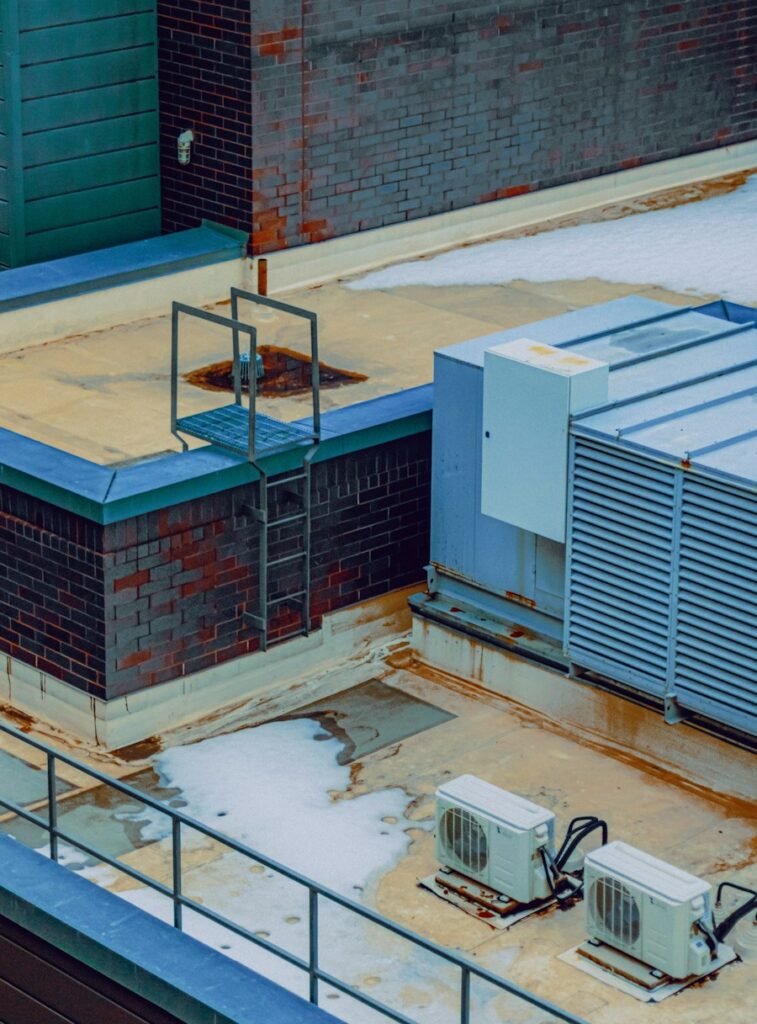
Clogged drains, scuppers and gutters
Low-slope roofs rely on interior drains, scuppers and gutters to move water off. In NJ, fall leaves from nearby trees, cottonwood seed in spring and plain windblown trash block strainers in a single season. Once a drain clogs, water backs up over seams and flashings it was never meant to sit on. Strip centers and warehouses along wooded edges in Morris, Somerset and Hunterdon counties see this every October and November.
Freeze-thaw cycles
New Jersey winters swing above and below freezing many times. Water that gets into a seam or a crack in a mod bit cap sheet freezes, expands and widens the opening. The north and west of the state, including Sussex, Warren, Morris and Passaic counties, see the most cycles. Roofs that look fine in October can show open laps and cracked flashings by March.
Wind uplift from nor’easters and tropical storms
Nor’easters from October through April and tropical remnants from June through November put strong suction on roof edges and corners. Mechanically attached single-ply can flutter, pull fasteners or tear at the plates. Coastal buildings in Monmouth, Ocean, Atlantic and Cape May counties face this most, along with salt air that corrodes edge metal and fasteners faster than inland.
Rooftop equipment and added penetrations
Every new rooftop unit, exhaust fan, satellite dish, solar rack or conduit run means another hole in the membrane. Mechanical and electrical trades often flash these themselves with sealant or pitch pans that dry out in a few seasons. Restaurants in retail strips are a repeat case because grease from exhaust fans can soften some membranes around the fan.
Foot traffic and dropped tools
HVAC service techs, cell carriers and sign installers walk the roof often, and a dropped screwdriver or panel corner can puncture a TPO or EPDM sheet. Without walkway pads to service routes, these small holes add up. On many NJ office and retail roofs, the path to the units is where punctures cluster.
Poor original slope or crushed insulation
Older NJ buildings, especially 1960s to 1980s warehouses, offices and schools, were often built dead flat with little or no tapered insulation. Over time, foot traffic and ponding crush the insulation, creating low spots that hold water. Without crickets or tapered insulation to push water to drains, the problem keeps coming back no matter how many patches go on.
Summer heat and UV
Dark roofs in NJ summers get very hot. The U.S. Department of Energy notes conventional roofs can reach 150°F or more on a sunny afternoon. That heat dries out asphalt in mod bit and built-up roofs, shrinks older EPDM, and cracks sealants at terminations. Coatings and light membranes reduce the heat load but need regular checks of their own.
Age and deferred maintenance
Many commercial roofs in NJ were installed during a building’s last sale or major tenant change and then left alone. Without semi-annual checks, small seam and flashing defects let water into the insulation for years. By the time stains appear inside, a roof that could have been repaired or coated may need tear-off.
How we do it
How Our Commercial Roofing Process Works in NJ
We inspect and document the roof, find the source of any leak, recommend repair, restoration, recover or replacement based on the condition of the insulation, then schedule work around your tenants and finish with a photo report. Property managers get the paperwork they need at every stage: COIs, scope, photos and close-out notes.

1. Intake and site access
When you send a request through our contact page, we ask for the building address, roof access point (interior hatch, ladder or lift needed), tenant contacts, any alarm or key requirements, and the location of the leak or concern. If your management company needs a certificate of insurance naming the owner or manager as additional insured, we arrange it before anyone goes on the roof.
2. Roof walk and photo inspection
A roofer walks the full field, perimeter, drains, curbs and penetrations. We photograph seams, flashings, edge metal, coping, drains and any ponding or damage, and we check the interior where leaks show. You get a photo report with each issue marked, which is the free inspection with photos we offer on every roof.
3. Leak tracing and moisture checks
For active leaks we trace water from the interior stain back to the likely entry point, checking flashings and seams upslope first. If the roof feels soft or the decision is between repair and replacement, we recommend a moisture survey: infrared scanning, a moisture meter grid, and small core cuts to see the actual layers and test for wet insulation.
4. Written scope and options
You get a written itemized quote. Where it makes sense, we lay out more than one option, such as targeted repair now versus a coating or recover, with the reasoning for each. The scope lists square footage, system, insulation, flashings, edge metal, drains, and what is excluded, so it can be compared line by line with other bids.
5. Permits and scheduling
Commercial reroofing generally needs a permit from the local construction office, so we check requirements for your municipality before work starts. We then build a schedule around your tenants: early starts, weekend work for offices, staging areas away from storefronts, and odor or noise controls near air intakes and occupied spaces.
6. Safe installation or repair
Crews set up fall protection that follows OSHA rules for low-slope roofs, covers skylights and roof openings, and keep the area under the work zone protected. Work proceeds in sections so the building is watertight at the end of each day. Seams are probed, welds are checked, and flashings are terminated mechanically where the system calls for it.
7. Water test and final walk
After repair or installation we flush or water-test drains where practical, check new seams and flashings, and walk the roof with you or your facilities lead if you want. Interior leak points are checked during the next rain. Debris, fasteners and old material are removed from the roof and the ground.
8. Close-out documentation
You receive before-and-after photos, a summary of what was done and where, and any product or warranty paperwork that applies to the job. For maintenance clients, we keep the roof history on file so the next visit starts with the last report, which helps budget planning and any future warranty or insurance claim.
Pricing · updated November 2026
How Much Does Commercial Roofing Cost in NJ?
As of November 2026, NJ commercial single-ply replacement (TPO, EPDM, PVC) typically runs about $5.85 to $7.85 per sq ft without added insulation and about $13.50 to $19.90 per sq ft with R-30 insulation; modified bitumen runs higher. Leak repairs on a flat roof usually fall between $400 and $2,500. These are planning ranges from published NJ data, not quotes.
Commercial leak or seam repair
$400 – $2,500
Leak tracing, patch or re-weld of TPO or PVC seams, EPDM seam repair, flashing repair at a curb or penetration, and photos of the repair. Larger or multiple leak sources, lift access and after-hours emergency work raise the price.
Single-ply, no added insulation
$5.85 – $7.85 per sq ft
TPO, EPDM or PVC installed without new insulation, typical of recovers or roofs with existing dry insulation. Published NJ averages include about $1.50 per sq ft for tear-off and disposal. Ballasted and fully adhered systems sit at the low end.
Single-ply with R-30 insulation
$13.50 – $19.90 per sq ft
Tear-off, new polyiso insulation to R-30, cover board where specified, new TPO, EPDM or PVC membrane, flashings and edge metal. This is the typical full replacement on an NJ warehouse, school or office where insulation is wet or below current levels.
Modified bitumen replacement
$11.80 – $26.15 per sq ft
Multi-ply SBS or APP modified bitumen. The low end is without added insulation; the high end includes R-30 insulation. Common on smaller buildings, mixed-use and older strip centers where a tough, traffic-resistant surface matters.
Metal roof systems
$10.65 – $27.45 per sq ft
Commercial metal from basic exposed-fastener steel panels at the low end to PVDF-coated aluminum standing seam at the high end, with R-30 insulation. Used on pre-engineered buildings, churches and some low-slope additions.
Spray foam with silicone coating
$14.80 – $17.10 per sq ft
About 5 inches of spray polyurethane foam with a silicone top coat, from light to heavy surface prep. Adds insulation and slope correction in one step and avoids tear-off where the existing roof is sound and dry.
What moves the price
- Wet insulation. The amount of wet insulation found by an infrared scan or core cuts decides whether you can repair, coat or recover, or must tear off. Wet areas are removed and replaced, which is where budgets move the most.
- Insulation level. Published NJ data notes that NJ sits in climate zones 4 and 5 and that above-deck systems on replacements need a minimum of R-30 continuous insulation. Insulation adds about $1 to $1.50 per sq ft per inch installed.
- Tear-off. Removing an existing commercial roof typically adds $1 to $3 per sq ft, more if there are two existing layers or gravel ballast to remove.
- Attachment method. Ballasted and fully adhered single-ply price differently from mechanically attached systems. The building’s height, wind exposure and deck type often decide which is allowed.
- Penetrations and equipment. Every rooftop unit, curb, pipe and drain needs its own flashing. A roof crowded with equipment costs more per square foot than an open warehouse roof, and units may need to be lifted by a mechanical contractor.
- Access and staging. Crane or hoist needs, tight urban lots in Hudson or Essex County, and limited staging near storefronts all add labor.
- Schedule limits. Night, weekend or phased work to keep tenants open costs more than a straight weekday run.
- Deck repair. Rusted steel deck or rotted wood found during tear-off is priced separately per area, which is why we list unit prices for deck replacement in the quote.
Per-square-foot ranges come from the Roof Observations New Jersey Roof Cost Guide (updated January 7, 2026), which reports installed averages for a typical 25,000 sq ft commercial roof including about $1.50 per sq ft for tear-off and disposal. The repair range is our typical NJ planning range. All figures are planning ranges, not quotes; your price comes from an inspection and written itemized quote.
Methods & materials
Commercial Roofing Systems and Methods for NJ Buildings
Most NJ commercial roofs are TPO, EPDM, PVC, modified bitumen, built-up or metal, and each one is repaired, restored or replaced with its own methods. The right choice depends on the building type, how wet the existing roof is, what is on the roof, and how long the owner plans to hold the property.
Each building type in NJ tends to end up with a particular roof system for practical reasons. Knowing why helps you judge a proposal.
- Warehouses and light industrial. Large open roofs along the Turnpike corridor in Middlesex, Mercer and Gloucester counties, and older ones in Union and Passaic. TPO and EPDM dominate because they cover large areas at a lower cost per square foot. Older buildings often have steel decks, little slope and many skylights, so drainage and fall protection around skylights are key.
- Retail and strip centers. Multiple tenants, many rooftop units, restaurant exhaust, and sign penetrations. TPO, PVC and mod bit are common. PVC is often chosen near grease exhaust, which is why it shows up over restaurants.
- Offices. Mid-size roofs with parapets, coping and more mechanical equipment. Single-ply and mod bit are both common. Tenant comfort and noise control drive scheduling.
- Schools. Often a patchwork of additions from different decades, with built-up, mod bit and single-ply side by side on one campus. Work is usually planned for summer break.
- Churches. Steep sanctuary roofs in slate or shingle paired with low-slope wings and fellowship halls. The low-slope parts are usually mod bit, EPDM or TPO, and the junctions between steep and flat sections leak most. For the steep parts, see slate roof repair.
- Multi-family. Garden apartments and mid-rise buildings with flat roofs over townhouse-style units, many small penetrations, and residents underneath. Single-ply and mod bit are common, and resident notice is part of the plan.
For smaller buildings and mixed-use storefronts, our flat roof repair page goes deeper into patching and seam repair on a small scale.
TPO, EPDM and PVC are single-ply membranes; modified bitumen and built-up roofing are multi-ply asphalt systems; metal and coatings round out the options. Here is how they differ in NJ use.
- TPO (thermoplastic polyolefin). A white or light sheet with heat-welded seams. Welded seams become one piece with the sheet, which resists the seam failures common on older EPDM. Widely used on NJ warehouses and retail. Quality of the welding crew matters a great deal.
- EPDM (rubber). A black or white synthetic rubber sheet with taped or glued seams. Flexible in cold weather, tolerant of freeze-thaw, and easy to repair. Seams and flashings are its weak points as it ages.
- PVC. A thermoplastic like TPO with welded seams. Often chosen where chemicals or grease are present, such as over restaurants. Higher upfront cost in published NJ data.
- Modified bitumen. Asphalt sheets modified with SBS or APP polymers, installed in two or more plies by torch, hot asphalt, cold adhesive or self-adhered. Tough under foot traffic, common on smaller buildings and older stock. Torch work carries fire risk near combustibles, so many owners and insurers prefer cold-applied or self-adhered methods.
- Built-up roofing (BUR). Alternating layers of felt and hot asphalt or coal tar topped with gravel. Still found on many NJ schools and older industrial buildings. Repairs need compatible materials, and coal tar should not be mixed with asphalt.
- Metal. Standing seam or through-fastened panels on pre-engineered buildings. Fastener backout, seam leaks and rust are the common issues; see metal roof repair.
- Coatings. Silicone, acrylic and other fluid-applied coatings restore an existing roof. Silicone resists ponding water, while acrylic should not go where water ponds, according to manufacturer guidance.
Commercial roof repair means fixing the specific defect with materials compatible with the existing system, then checking the insulation around it. A good repair lasts as long as the roof around it.
- TPO and PVC seams. We clean the area, prep the old membrane, and hot-air weld a new patch or re-weld the lap. Aged TPO can be hard to weld, so test welds and a seam probe check the bond.
- EPDM seams and punctures. The area is cleaned and primed, then covered with seam tape or a cured EPDM patch with pressure-sensitive adhesive. Rolled and edge-sealed.
- Mod bit and BUR. Cracks and blisters are cut out, dried, and patched with compatible plies set in adhesive or asphalt, then surfaced to match. Coal tar roofs get coal tar compatible material.
- Flashings. Curb corners, pipe boots and wall flashings are the top leak sources. We replace failed flashings with new membrane flashing, termination bar and counter flashing. Pitch pans get replaced with prefabricated boots where possible, since sealant-filled pans dry out.
- Drains and scuppers. Clamping rings get reset, strainers replaced, and the membrane at the drain bowl re-flashed. Scuppers get new membrane and sealed metal.
- Edge metal and coping. Loose sections are re-fastened or replaced with continuous cleats, which matter in coastal wind.
- Wet areas. Where a leak has soaked insulation, we cut out the wet board, replace it, and patch the membrane. Leaving wet insulation under a patch keeps the deck wet and hides the next leak.
Emergencies after hours follow the process on our emergency roof repair page.
A commercial replacement removes the old roof down to the deck, repairs the deck, installs insulation and cover board, then the new membrane, flashings and edge metal, in sections that are sealed watertight every night.
- Pre-construction. Confirm permits, staging, crane or hoist location, tenant notices and protection for rooftop units. A mechanical contractor disconnects or lifts units if curbs must be raised.
- Tear-off in daily sections. Crews remove only what they can close up the same day. Old material goes down chutes or by crane to dumpsters.
- Deck inspection and repair. Steel deck is checked for rust-through and wood deck for rot. Damaged areas are replaced at unit prices listed in the contract.
- Insulation and slope. Polyiso board is installed in staggered layers, with tapered insulation and crickets to send water to drains. Published NJ data cites R-30 continuous insulation for above-deck systems in NJ’s climate zones; your designer or construction office confirms what applies.
- Cover board. A gypsum or high-density board protects the insulation from foot traffic and hail, and helps the membrane bond.
- Membrane. TPO or PVC is mechanically fastened, adhered or induction welded, with heat-welded seams. EPDM is adhered or fastened with taped seams. Mod bit goes down in multiple plies.
- Flashings and details. Curbs, walls, pipes, drains and expansion joints get new flashings and termination bar. Edge metal and coping are installed to resist uplift.
- Inspection and close-out. Seams are probed, the construction official inspects as required, and the owner gets photos and warranty documents.
For the decision side of replacement, see our roof replacement page.
The choice between repair, restore (coating), recover and replace comes down to how much of the roof is wet, how sound the membrane is, how many layers already exist, and how long the owner plans to keep the building. A moisture survey answers the first question with evidence.
- Repair when the membrane is in fair to good shape overall, leaks come from a few seams or flashings, and the insulation is dry outside small areas. This is the cheapest step and the right first step for many roofs.
- Restore with a coating when the membrane is aged but intact, the insulation is mostly dry, and the roof has not reached the end of its service life. Manufacturers say coatings should go on before the existing membrane fails and over a clean, dry, sound surface. Wet areas must be cut out and replaced first. Coating work may be treated as maintenance in some owners’ budgets, which helps cash flow.
- Recover when the existing roof is dry and sound enough to serve as a base and there is only one roof on the building now. Codes allow at most two roof layers, so a recover is off the table if there are already two. A recover board goes over the old roof, then a new membrane.
- Replace when insulation is widely wet, the deck is damaged, there are already two roofs, the slope must be rebuilt, or the membrane has failed across the field.
How the moisture survey works. An infrared scan, usually done on a clear evening after a sunny day, shows wet insulation as areas that hold heat. A roofer marks those areas, then confirms with a moisture meter and small core cuts that show each layer. Cores are patched the same day. The result is a map with wet areas outlined and measured, which turns a guess into a budget. If the wet area is small, repair or coating is usually sensible. If it is a large share of the roof, replacement often costs less over time than repeated patching. A roof inspection is the starting point.
For most NJ commercial roofs, a reinforced TPO or EPDM over polyiso insulation and a cover board is a practical default, with PVC over restaurants and mod bit where foot traffic is heavy. The details matter more than the brand.
- Membrane thickness. Thicker sheets (for example 60 mil versus 45 mil TPO or EPDM) add puncture resistance and service life, and many manufacturers require them for longer warranties.
- Color and reflectivity. The U.S. Department of Energy says reflective roofs can stay more than 50°F cooler than conventional roofs on sunny days, which cuts cooling loads. DOE also notes a winter heating penalty in colder climates. NJ buildings with large cooling loads, such as warehouses with offices or retail, usually benefit. Product ratings are listed in the Cool Roof Rating Council directory.
- Cover boards. A gypsum or high-density cover board adds hail and traffic resistance, which helps on roofs serviced often by HVAC techs.
- Walkway pads. Pads along service routes to rooftop units prevent most traffic punctures and are cheap to add.
- Coastal choices. Shore buildings in Ocean, Monmouth, Atlantic and Cape May counties benefit from fully adhered systems or tighter fastening patterns at corners and edges, along with coated or non-ferrous edge metal that resists salt.
- Coatings. Silicone suits roofs with minor ponding. It is slippery when wet, according to its manufacturers, so walkways matter.
- Insulation. Polyiso has one of the highest R-values per inch among common roof insulations, and tapered polyiso fixes drainage on dead-flat NJ buildings. Ask for the R-value and taper plan in writing so you can compare bids on equal terms.
NJ rules
NJ Commercial Roofing Permits, Insurance and Paperwork
Permits
Commercial roofing in NJ generally needs a construction permit, because the residential no-permit rule does not cover commercial buildings. Under the NJ Uniform Construction Code, N.J.A.C. 5:23-2.7, repair or replacement of roof covering counts as ordinary maintenance with no permit only on detached one- and two-family dwellings. Buildings that are not detached one- or two-family homes, including commercial buildings, larger multi-family and attached townhomes, fall outside that exemption. Deck replacement, structural work and adding a third roof layer also need a permit, and codes allow at most two roof layers. Ordinary maintenance is never a waiver from code compliance. Small repairs on commercial buildings may be handled differently by each construction office, so we check with the local construction office in your municipality before work begins. Public schools and some institutional owners also have their own procurement and approval steps that add time.
Insurance
Commercial property policies usually respond to sudden damage like wind blow-off, hail, fallen limbs or a roof collapse from snow load, and usually exclude wear, age, neglect and long-term leaks. Your policy and broker have the final word, and coastal properties may carry separate wind or named-storm deductibles. To document damage, photograph the roof and interior right away, note the date and storm, save ceiling tiles or damaged stock if the adjuster may want to see them, and keep invoices for emergency tarps or temporary repairs. Our photo reports are written so you can forward them to a carrier or adjuster. On the contractor side, ask for a certificate of insurance before work starts, naming the owner and management company as additional insured if your lease or policy requires it. NJ home improvement contractors must carry at least $500,000 in commercial general liability to register, and you can look up a registration number at the NJ license lookup. See storm damage roof repair for claim steps.
Who does the work
Why NJ Homeowners Choose Roof Repair SNJ for Commercial Roofing
- Repairing NJ roofs for 25+ years
- General liability + workers’ comp insurance
- Workmanship warranty: 2 years on repairs, 10 years on full replacements, in writing
Check any NJ roofer before you sign
Ask for the 13VH registration number and confirm it on the NJ license lookup. NJ law requires a signed written contract showing the registration number and total price, and gives you until midnight of the third business day to cancel (N.J.S.A. 56:8-151).
In depth
Commercial Roofing in NJ: Detailed Answers for Owners and Property Managers
What does a semi-annual commercial roof maintenance plan include?
A typical semi-annual plan includes a spring and fall roof walk, drain and gutter cleaning, minor seam and flashing repairs, and a written photo report with budget notes. In NJ, spring catches winter freeze-thaw and nor’easter damage, and fall clears leaves before freezing weather.
A standard visit usually covers:
- Clearing debris from drains, scuppers, gutters and downspouts, and checking strainers and clamping rings.
- Walking the full field to check seams, punctures, blisters, ponding and soft areas.
- Checking flashings at every curb, pipe, wall and skylight, and re-sealing termination bar and counter flashing where sealant has failed.
- Checking edge metal, coping and expansion joints for loose sections after wind.
- Small repairs on the spot, up to an agreed limit, so a lifted seam does not become a leak.
- Noting new penetrations added by other trades since the last visit.
- A photo report with each issue marked, priorities, and rough budget years for larger work.
Many membrane manufacturers expect owners to maintain the roof and keep records, and a warranty claim can be harder to support without them. Many plans also add an after-storm check after a major nor’easter or tropical system. For buildings with heavy leaf load, a third visit in late November is often worth it.
How pricing works. Contractors usually price plans per visit or per year, based on roof size, access (interior hatch versus lift), number of penetrations and drains, and how many roofs are in a portfolio. Repairs beyond the included limit are quoted or billed at agreed rates. Portfolio pricing for property managers with several buildings is common. Ask exactly which repairs are included, the response window for leak requests, and whether the report includes photos and a roof plan. We quote plans after a first inspection so the price fits the roof.
How does a commercial leak response work for property managers?
A good leak response starts with the tenant report, moves to a roofer on site who stops the water and finds the source, and ends with a written report and a permanent repair scope. The faster you share the right details, the faster the leak gets fixed.
Emergency requests are handled around the clock. When you send us your commercial leak details through the contact page, include:
- Building address, unit number and tenant contact.
- Where the water shows inside, with photos if the tenant can take them.
- Roof access details: hatch location, ladder height, keys, alarm codes, or whether a lift is needed.
- Whether the leak is near electrical equipment, inventory or a food area, which changes priority.
- Any COI requirements for the building.
On site, the roofer checks the interior first, then the roof above and upslope of the stain, focusing on curbs, seams and drains. If rain is still falling or the source is unclear, a temporary repair goes on to stop the water. The permanent repair follows, often the same visit for a simple seam or flashing, or after a short quote for larger work.
You get a report with photos of the interior stain, the roof defect, and the repair, plus notes on anything else that needs attention. That report goes straight to the owner, the tenant or an insurer. Repeat leaks at the same spot are a sign of wet insulation or a design issue, and the report should say so. We do not promise fixed arrival times, because they depend on weather and request volume, but we tell you honestly when a crew can get there. See also our roof leak repair page.
What OSHA fall protection should a commercial roofer use?
OSHA requires fall protection for roofing work on low-slope roofs with unprotected sides and edges 6 feet or more above a lower level, using guardrails, safety nets, personal fall arrest, or a warning line combined with one of those or a safety monitor. This is set out in 29 CFR 1926.501(b)(10). On roofs 50 feet wide or less, a safety monitoring system alone is allowed.
Under 29 CFR 1926.502:
- Warning lines must be set no less than 6 feet from the roof edge when no mechanical equipment is used, and 10 feet from edges perpendicular to the direction of mechanical equipment. The line sits between 34 and 39 inches high, is flagged at least every 6 feet, and has a minimum tensile strength of 500 pounds.
- Safety monitors must be competent persons on the same roof, within sight and talking distance of the workers, with no other duties.
- Holes and skylights. OSHA 1926.501(b)(4) requires protection from falling through holes, including skylights, more than 6 feet above a lower level. Covers must support at least twice the expected load, be secured against wind and movement, and be marked HOLE or COVER.
Skylights are a real hazard on older NJ warehouses, where dozens of plastic domes sit in the field of the roof. Before work starts, we cover or guard them. For owners, this matters because an injury on your roof can involve you, and a crew without visible fall protection is a warning sign about the rest of the job. Ask any bidder how they will protect edges, skylights and the public below, and expect a specific answer.
What is an NDL warranty and do I need one?
An NDL (no dollar limit) warranty is a manufacturer warranty that typically covers the cost of repairs from material defects and installation workmanship for its term, without a cap tied to the original price. Terms vary by manufacturer and by system, so the document itself governs.
In general practice:
- Material-only warranties cover the membrane if it fails from a defect, often prorated, and usually not the labor to replace it.
- System or NDL warranties cover materials and installation labor for the warranted system. Manufacturers usually only issue them through contractors they have approved, and usually require a manufacturer inspection at completion before the warranty is issued.
- Contractor workmanship warranties are issued by the roofing contractor and cover their installation for a stated period. Read the length, exclusions and claim process.
Most manufacturer warranties exclude damage from storms beyond stated wind speeds, foot traffic, alterations by other trades, ponding beyond a set time, and lack of maintenance. Adding a new rooftop unit without notifying the manufacturer or using an approved contractor can void coverage near that penetration. Thicker membranes, cover boards and enhanced fastening are often required for longer terms or higher wind ratings, and they add cost.
Whether you need an NDL warranty depends on your hold period and lender or tenant requirements. Some leases and lenders require one. If you need a specific manufacturer warranty, tell bidders at the start so the system, details and installer qualify. Ask to see a sample warranty before signing. We will tell you plainly which warranties apply to the system we propose.
How do you work around tenants and business hours?
We plan commercial roofing around the building’s operations: daily work sections, quiet hours near occupied spaces, staging away from entrances, and written notice to tenants before work starts. Sharing the plan in advance prevents most surprises for tenants.
- Notice. Tenants get dates, hours, contact names and what to expect: noise, odors, crane days and parking changes. For multi-family, residents get notice through management.
- Odors and air intakes. Adhesives, primers and hot asphalt produce odors. We coordinate with your HVAC contractor to shut down or shield rooftop air intakes near the work area, and favor low-odor adhesives near schools, medical offices and restaurants.
- Noise. Tear-off and fastening are loud. Over offices, loud work can shift to early mornings, evenings or weekends. Over retail, we often work before opening.
- Interior protection. Fastening into steel deck can drop debris through deck seams. Where tenants have open ceilings or sensitive stock, protection is set inside before work.
- Watertight every night. Each day’s area is sealed with a tie-in before crews leave, so a surprise storm does not soak tenant space.
- Safety at ground level. Hoists, dumpsters and chutes are placed away from doors and parking, with barriers.
Schools usually schedule major roofing in July and August. Retail centers often avoid the November and December shopping season. Warehouses with 24-hour operations need staging that keeps truck courts clear. Tell us your peak periods and we schedule around them.
When is the best season for commercial roofing in NJ?
Late spring through early fall is the best window for most commercial roofing in NJ, because adhesives, primers, coatings and welding all work best in mild, dry weather. Repairs and emergency work happen all year.
Cold weather limits some products. Many adhesives and coatings have minimum application temperatures listed by the manufacturer, and silicone coatings need a dry surface because they are moisture cure. Self-adhered and cold-applied products bond poorly when the substrate is cold or frosty. Single-ply welding can be done in cool weather with adjustments, and mechanically attached systems are less temperature-sensitive than fully adhered ones.
Planning around the NJ calendar:
- Winter (December to February). Leak repair, temporary patches, snow and ice checks, and moisture surveys done during dry spells. Budget and bid the summer project.
- Spring (March to May). Inspect after freeze-thaw and nor’easters, repair damage, and start smaller replacements as temperatures rise.
- Summer (June to August). Peak season for replacements and coatings, school projects and tropical storm repairs. Book early.
- Fall (September to November). Finish projects before cold weather, clear drains of leaves, and do the fall maintenance visit.
Infrared moisture surveys need a clear, dry day followed by a calm evening, which is easiest in spring and fall. If you need a replacement in a budget year, start the inspection and survey the season before so bids and permits are ready.
How long do commercial roofs last in New Jersey?
Service life depends on the system, thickness, installation quality, drainage and maintenance, and most manufacturers tie their warranty terms to those choices. Maintenance is the one factor an owner controls after installation.
What shortens commercial roof life in NJ:
- Ponding. Standing water ages membranes faster and keeps any puncture leaking.
- Wet insulation. Once water gets into the insulation, it spreads and stays, and the roof loses R-value and adds weight.
- Untended flashings. Sealant at terminations and pitch pans lasts a few seasons, then needs renewal.
- Traffic. Unprotected HVAC routes puncture membranes.
- Freeze-thaw and UV. Both work on seams and asphalt surfaces every year.
What extends it:
- Semi-annual maintenance with records.
- Tapered insulation and clear drains.
- Walkway pads and controlled access.
- Timely coating while the membrane is still sound. Manufacturers note coatings can extend the life of a structurally sound roof and delay a full reroof.
- Fixing small leaks quickly so insulation stays dry.
When planning a budget, look at the roof’s install date, the original warranty term, the current moisture survey and the cost trend of repairs. If repair costs rise each year and wet areas grow, replacement planning should start. Our roof repair cost guide page explains how to budget for a full project.
How do I choose a commercial roofing contractor in NJ?
Choose a commercial roofer who inspects before quoting, explains repair versus replacement with evidence, provides insurance certificates up front, shows a real safety plan, and puts the full scope in writing. Price alone does not show you which bid is complete.
Questions to ask every bidder:
- Did you walk the whole roof and take photos? Will you share them?
- Did you check for wet insulation, and how? Infrared, meter, core cuts?
- What exactly is in the scope: square footage, insulation, cover board, membrane thickness, flashings, edge metal, drains, walkway pads?
- What is excluded, and what are the unit prices for deck replacement or extra wet insulation?
- Who pulls the permit, and who schedules inspections?
- How will you protect edges, skylights and the public below under OSHA rules?
- Can you provide a COI naming the owner and manager, and workers’ compensation proof?
- Which warranty applies, from whom, and what voids it? Can I see a sample?
- How will you handle tenants, noise, odors and staging?
- Who is my contact during the job, and how do you report progress?
For any residential portion of a mixed-use or multi-family job, confirm the contractor’s NJ registration number starting with 13VH at the state lookup. Compare bids line by line instead of by the total. A low bid often leaves out wet insulation replacement, edge metal or drains, then adds them as change orders. We give a written itemized quote so you can make that comparison. Start with a request for a free commercial roof inspection and bid.
Service areas
Commercial Roofing Across New Jersey
We provide commercial roofing in all 21 New Jersey counties. Find your county and town on our New Jersey service locations page for local roof types, permit notes and prices.
FAQ
Commercial Roofing in NJ: Frequently Asked Questions
How much does commercial roofing cost in NJ?
Published NJ data from January 2026 puts single-ply TPO, EPDM and PVC at about $5.85 to $7.85 per sq ft without added insulation, and about $13.50 to $19.90 with R-30 insulation. Modified bitumen runs $11.80 to $26.15. Flat roof leak repairs typically cost $400 to $2,500. These are planning ranges, not quotes.
Do I need a permit for commercial roof replacement in New Jersey?
Usually yes. Under N.J.A.C. 5:23-2.7, the no-permit ordinary maintenance rule for roof covering covers only detached one- and two-family homes. Commercial buildings, larger multi-family and attached townhomes fall outside it. Deck and structural work also need permits. Check with your local construction office before work begins.
Should I repair, coat, recover or replace my commercial roof?
It depends on how much insulation is wet, the membrane’s condition, and how many roofs exist now. Small wet areas and a sound membrane favor repair or coating. A dry single roof can be recovered. Widespread wet insulation, deck damage or two existing roofs usually mean tear-off and replacement.
What is TPO roofing and is it good for NJ?
TPO is a single-ply thermoplastic membrane with heat-welded seams, usually white. It is widely used on NJ warehouses, retail and offices because it covers large areas economically and its welded seams resist separation. It performs well when installed by an experienced welding crew and maintained, with clear drains and protected service routes.
How do you find wet insulation on a flat commercial roof?
Roofers use an infrared scan on a clear evening after a sunny day, when wet insulation holds heat and shows up as warm areas. Those areas are confirmed with a moisture meter and small core cuts that expose each layer. Cores are patched the same day, and wet areas are mapped and measured.
How often should a commercial roof be inspected in NJ?
At least twice a year, in spring and fall, plus after major storms. Spring catches freeze-thaw and nor’easter damage, and fall clears leaves from drains before winter. Manufacturers commonly expect regular maintenance and records, and many owners add a check after any nor’easter or tropical storm.
What OSHA rules apply to commercial roofers in NJ?
OSHA 29 CFR 1926.501(b)(10) requires fall protection on low-slope roofs with edges 6 feet or more above a lower level, using guardrails, nets, personal fall arrest, or warning lines with another method or a safety monitor. Skylights and roof holes must be covered or guarded under 1926.501(b)(4).
What is an NDL roof warranty?
An NDL, or no dollar limit, warranty is a manufacturer warranty that typically covers repair costs from material and workmanship defects in the warranted system for its term, without a cap tied to the original price. Manufacturers usually require an approved installer and a final inspection. Exclusions and maintenance rules vary by manufacturer.
Can commercial roofing work be done while my building is open?
Yes, in most cases. Work is done in sections sealed watertight each day, with tenant notice, staging away from entrances, coordination on rooftop air intakes to limit odors, and noisy work shifted to early or off hours over offices. Schools often schedule major work in summer.
Do you provide certificates of insurance for commercial jobs?
Yes. Tell us who must be named as certificate holder or additional insured, such as the owner, management company or landlord, and we arrange the certificate before crews go on the roof. Including the COI requirements when you send us a request online avoids delays on leak visits and scheduled work.
Reviewed by the Roof Repair SNJ team · Last updated November 2026
Commercial
Related commercial services
Commercial Roofing is part of our commercial services. See every service on our roof repair NJ homepage.
Free inspection
Get a Commercial Roof Inspection in NJ
Schedule a flat roof inspection for your building online. We walk the roof, photograph every issue, check for wet insulation where it matters, and send a written itemized quote with clear options for repair, coating, recover or replacement. Active leak? Send an emergency request any time through our contact page, because emergency requests are handled around the clock. There is no charge for the inspection and no pressure to sign.
No pressure and no obligation. If a repair will do, we’ll tell you.
Roof Repair SNJ
- Serving all 21 NJ counties
- Send a commercial roofing request
- Mon–Fri 5:00 AM–10:00 PM · Sat 5:00 AM–6:00 PM · Emergencies 24/7
Sources: Roof Observations: New Jersey Roof Cost Guide (updated Jan 7, 2026) · N.J.A.C. 5:23-2.7, Ordinary maintenance (NJ Uniform Construction Code) · OSHA 29 CFR 1926.501, Duty to have fall protection · OSHA 29 CFR 1926.502, Fall protection systems criteria and practices · U.S. Department of Energy, Energy Saver: Cool Roofs · GAF: The advantages of silicone roof coatings · New Jersey Division of Consumer Affairs license verification. Prices are planning ranges, not quotes. Permit and insurance information is general guidance; your town, policy and agent have the final word.