Roof Repair NJ › NJ Locations › Camden County
Cherry Hill · Camden · Haddonfield · 36 towns
Roof Repair in Camden County, NJ
Roof Repair SNJ repairs leaks, flat roofs, slate and storm damage in all 36 Camden County towns, from Camden City row homes and Collingswood porches to Cherry Hill split-levels, Haddonfield’s historic district and Winslow’s newer subdivisions. You get a free inspection, dated photos and a written, itemized quote. Send us your roof photos to get started.
- Flat, slate and shingle repairs countywide
- Photo report and itemized written quote
- Written warranty: 2 years on repairs
Free roof inspection in Camden County
Photos of every problem we find and an itemized written price before any work. Emergency requests handled 24/7.
Roof Repair SNJ
36 Camden County towns · all 21 NJ counties
Free inspection
Roof, attic and gutters checked at no cost.
Insured
Liability and workers’ comp; certificate on request.
Written quotes
Itemized price in writing before any work.
Photo-documented
Every problem photographed, before and after.
Camden County at a glance
Camden County at a Glance: Old Housing, Dense Towns
Camden County’s housing is older than Burlington’s or Gloucester’s, with a median build year of 1966, and much of it is attached: row homes, twins and townhomes. That makes flat-roof repair, party-wall flashing and historic-district rules bigger issues here than in Burlington or Gloucester.
County seat
Camden
The City of Camden has 71,791 residents and a large stock of brick row homes with flat or low-slope roofs behind parapet walls.
Municipalities
36 towns
523,485 residents in 2020 Census municipal totals, from Cherry Hill at 74,553 to Tavistock at 9. Twenty-six of the 36 are boroughs, most of them small and densely built.
Housing units
214,642
Census ACS 2024 one-year estimate. Median owner-occupied value was $334,900, about two-thirds of the New Jersey median.
Median year built
1966
Census ACS 2023 five-year data via Stacker ranks Camden 7th oldest of 21 NJ counties, older than Burlington (1977) and Gloucester (1979).
Historic review
Haddonfield, Merchantville
Haddonfield requires a Certificate of Appropriateness for roofing in its historic district; Merchantville has two locally designated historic districts.
Pinelands towns
5 municipalities
Chesilhurst and Waterford lie wholly in the Pinelands Area, and Winslow, Berlin Borough and Berlin Township are also listed by the Pinelands Commission.
Homes & roofs
What Kinds of Homes and Roofs Does Camden County Have?
Camden County’s roofs follow its growth outward from the Delaware: city row homes, early-1900s railroad and trolley suburbs, postwar Cherry Hill and Pennsauken subdivisions, then 1970s to 2000s townhomes and Pinelands-edge lots in the south. Attached homes and flat roofs make up a large part of the housing, so we inspect party walls and drains as closely as shingles.
Camden City brick row homes
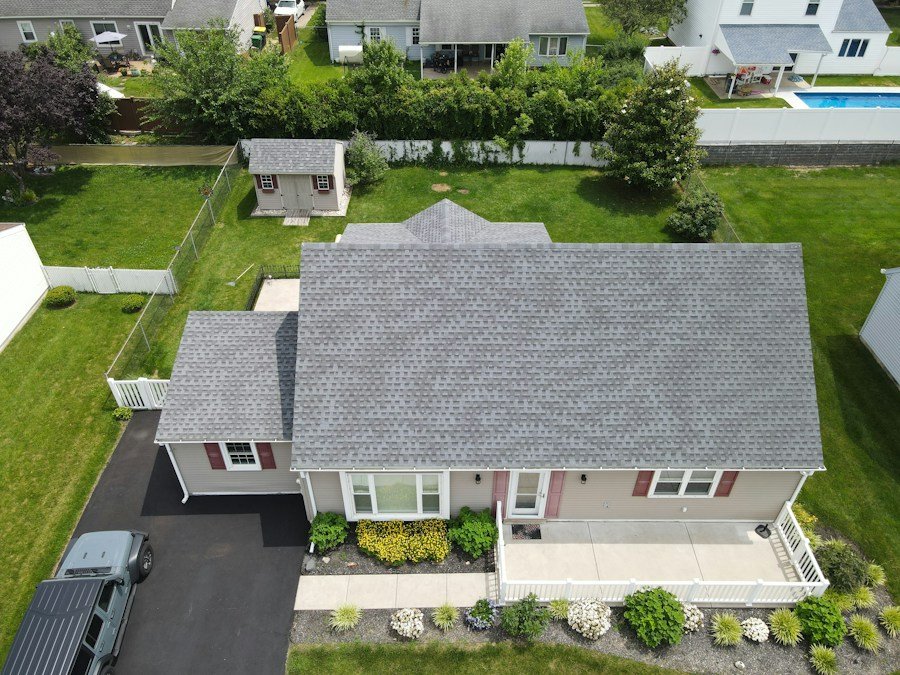
Parkside, Cramer Hill, East Camden, Whitman Park and the blocks around Cooper Grant are lined with two- and three-story brick row homes, most with flat or shed roofs behind short parapets. Roof leaks here usually start at parapet copings, cracked flashing where the roof meets the party wall, clogged scuppers and patched-over built-up roofs. One neighbor’s failed roof can push water into the next house, so we check both party walls.
Fairview’s 1918 garden village
Fairview, first called Yorkship Village, broke ground on May 1, 1918 as wartime housing for shipyard workers, designed by architect Electus Litchfield with garden-city ideas. Its attached groups and twins around Yorkship Square have pitched roofs, dormers and shared ridges. Much of the neighborhood sits in a historic district on the state and national registers, so owners should keep repairs in character and confirm any local review before changing materials.
Haddonfield historic houses
Haddonfield’s historic district covers colonial-era, Federal and Victorian houses along Kings Highway and the surrounding streets, with slate, cedar, standing-seam porch roofs and built-in gutters. The borough states that roofing, siding or any alteration to a building’s exterior appearance requires a Certificate of Appropriateness. Slate repair, copper flashing and careful matching of existing materials make up most of our work here.
Collingswood, Westmont and the trolley-era suburbs
Collingswood grew from 1,633 residents in 1900 to 12,723 by 1930, and Haddon Township’s Westmont, Oaklyn, Audubon and Haddon Heights filled in during the same decades. Expect foursquares, twins, bungalows and big front porches. Porch roofs are often low-slope with failing roll roofing, dormers leak at step flashing, and twin houses share a roof line where one side was re-roofed and the other was not.
Cherry Hill’s postwar subdivisions
Cherry Hill, called Delaware Township until 1961, tripled from 10,358 people in 1950 to 31,522 in 1960. Erlton, Kingston Estates, Barclay, Woodcrest and Old Orchard are full of ranches, split-levels, bi-levels and colonials from the 1950s to 1970s. Low-slope sections over split-level garages, chimney flashing, attic ventilation and second or third roof layers are the usual repair issues.
Pennsauken, Bellmawr and the river boroughs
Pennsauken, Bellmawr, Gloucester City, Brooklawn, Runnemede and Mount Ephraim are mostly postwar capes, ranches and twins, with older brick and frame rows near the Gloucester City waterfront. Tight lots, overhead wires and street parking make access a planning issue. Many roofs here carry two layers, and low rear additions tie into the main roof with weak flashing.
Voorhees, Gloucester Township and Lindenwold townhomes
From the 1970s on, Voorhees, Gloucester Township (Blackwood, Erial, Sicklerville side), Lindenwold and Pine Hill added large townhome communities, garden apartments and colonial subdivisions. Attached units mean construction permits and HOA approvals on color and style. Shared valleys and long runs of ridge vent between units are where leaks usually start, and the association’s master deed and bylaws decide who pays for the repair.
Winslow, Waterford and the Pinelands edge
Winslow Township, Waterford, Chesilhurst and the Berlins are where Camden County turns rural, with farm buildings, older ranches on wooded lots and newer Sicklerville and Williamstown-line subdivisions. Pine needles in valleys, metal barn and outbuilding roofs, and long gutter runs on newer two-story homes are typical, and tear-off debris must be kept clear of septic fields. Chesilhurst and Waterford lie wholly within the Pinelands Area.
Camden County weather
How Does Camden County Weather Damage Roofs?
Camden County roofs face summer heat that ages flat membranes and shingles, short violent thunderstorms with tornadoes and microbursts under a mature tree canopy, and winter freeze-thaw that cracks masonry parapets and chimneys. The dated events below are from the National Weather Service, USGS and the state climatologist.
June 9, 2022: the Blackwood tornado
Around 5 a.m. on June 9, 2022, the National Weather Service confirmed an EF1 tornado with winds up to 90 mph in the Blackwood section of Gloucester Township, centered on Deer Park Circle near Erial Road. It was only about a quarter-mile long and 60 yards wide, but it tore apart sheds, scattered limbs and sent a tree limb through a home’s den ceiling. Short tornadoes like this leave scattered roof damage block to block.
July 12-13, 2004: Cooper River and Pennsauken Creek flood
USGS documented more than six inches of rain on average over the Cooper River, Pennsauken Creek and Rancocas Creek basins during July 12-13, 2004, with 45 dams topped, damaged or failed across Camden and Burlington counties. Rain at that rate overwhelms flat-roof drains and scuppers on row homes, and water ponds behind parapets until it finds a seam. Clear drains before summer storm season.
June 29-30, 2012: the derecho
The June 2012 derecho swept southern New Jersey with peak gusts near 90 mph across the region and knocked out power to hundreds of thousands of customers, some for a week. In Haddonfield, Collingswood and Cherry Hill, where old shade trees overhang roofs, derecho damage meant limbs through roofs and torn gutters. Trimming limbs back is the cheapest storm protection in the county.
January 23-24, 2016: the blizzard
The state climatologist recorded 13.0 to 22.0 inches of snow across Camden County in the January 2016 blizzard. Drifts pile against parapets on flat-roof row homes and porch roofs in Collingswood and Audubon, and melting snow behind a parapet that cannot drain becomes a leak. On pitched roofs in Cherry Hill, ice dams form at the eaves of poorly insulated ranches and split-levels.
South Jersey heat and long summers
The state climatologist places the southwest part of New Jersey, which includes much of Camden County, in the zone with the state’s highest average daily temperatures and longest growing season. Heat accelerates shingle granule loss, dries out sealant at flashing, and cooks black flat-roof membranes on row homes. A reflective coating or white TPO on a Camden flat roof lowers both roof temperature and top-floor heat.
Freeze-thaw on brick and stone
In southern counties, the state climatologist notes snow can fall from about mid-November to mid-April, and winter brings many days that cross the freezing point. Water that soaks into old brick parapets, chimneys and stone copings freezes and expands, cracking mortar and loosening flashing. In Camden City, Gloucester City and older Haddonfield houses, repointing and re-flashing chimneys and parapets is a large share of our winter repair work.
Roofing services
Roof Repair Services We Provide in Camden County
We provide all 12 of our roofing services across Camden County, with extra depth in flat-roof, slate and attached-home work because the county’s housing is older and denser than its neighbours. The cards below explain how each service applies here. Row-home owners will find flat-roof details in the questions further down this page.
Roof Leak Repair in Camden County
In Camden County, leaks often enter at parapet flashing on Camden row homes, porch roof tie-ins in Collingswood, chimneys on Cherry Hill ranches and slate valleys in Haddonfield. We trace the path from the attic or ceiling, photograph the source and repair it, including party-wall flashing that affects a neighbor.
Emergency Roof Repair in Camden County
When a limb comes through a Haddonfield roof or wind tears a flat roof open in Pennsauken, send an emergency request through our contact page any time. We stop water entry with a tarp or temporary membrane patch, photograph the damage and schedule the permanent fix.
Storm Damage Roof Repair in Camden County
Camden County storms are short and local, like the June 2022 Blackwood EF1. We inspect for lifted tabs, broken slate, torn flat-roof seams and bent coping, and document storm damage separately from age wear so your insurer gets an accurate written scope.
Roof Replacement in Camden County
Cherry Hill, Pennsauken and Bellmawr homes built in the 1950s to 1970s are often on a second layer, the legal maximum. Replacement means tear-off, deck repair, ice and water shield and balanced ventilation. Attached twins and townhomes require a permit. Full replacements carry our 10-year written workmanship warranty.
Roof Inspection in Camden County
Our free inspections include photos of shingles or membrane, flashing, chimneys, gutters and the attic. In Camden County we also check parapet copings and scuppers on row homes, party walls on twins, slate condition in Haddonfield and Merchantville, and layer counts on postwar ranches.
Flat Roof Repair in Camden County
Flat roofs cover most Camden City row homes, many Gloucester City and Woodlynne rows, and porch and addition roofs across Collingswood and Audubon. We repair modified bitumen, EPDM and TPO seams and blisters, rebuild parapet and coping flashing, clear and reset scuppers, and recoat aging roofs.
Metal Roof Repair in Camden County
Standing-seam porch roofs on Haddonfield and Haddon Heights Victorians, metal bays and dormers in Collingswood, and farm and outbuilding roofs in Winslow and Waterford all need specific care. We re-seam or patch panels, replace failed fasteners and sealant, and keep metal compatible to avoid corrosion.
Slate Roof Repair in Camden County
Haddonfield, Merchantville, Haddon Heights and older parts of Collingswood still have slate roofs. We replace broken slates with matching stock using copper nails or slate hooks, re-flash chimneys and valleys, and document materials for Haddonfield’s Certificate of Appropriateness process.
Shingle Roof Repair in Camden County
Asphalt shingles cover Cherry Hill, Voorhees, Gloucester Township and Winslow. We replace wind-damaged and creased shingles, reseal lifted tabs, fix nail pops and match color as closely as current lines allow. On split-levels, we pay close attention to where the low and high roofs meet.
Roof Cleaning in Camden County
Shaded roofs under the old oaks and maples of Haddonfield, Collingswood, Haddon Township and Merchantville grow algae and moss on north slopes. We clean with low pressure and shingle-safe solutions, clear gutters and valleys, and can install zinc or copper strips to slow regrowth.
Gutter Repair in Camden County
Built-in box gutters on Haddonfield and Collingswood houses, scuppers and leaders on Camden row homes, and long seamless runs on Voorhees and Winslow colonials all fail differently. We reline box gutters, re-flash gutter edges with drip edge, reset scuppers and repair sagging hangers.
Commercial Roofing in Camden County
Camden County’s commercial roofs include Route 70 and Route 38 retail in Cherry Hill, warehouses in Pennsauken, mixed-use buildings in Collingswood and Haddonfield, and city buildings in Camden. We repair TPO, EPDM and modified bitumen roofs, flash rooftop units and provide written condition reports.
Camden County rules
Camden County Roofing Permits, Historic Districts and Attached Homes
Permits & local review
A roof covering repair or replacement on a detached one- or two-family home in Camden County needs no permit, because New Jersey treats it as ordinary maintenance under N.J.A.C. 5:23-2.7. That exemption does not cover attached housing, which is a large share of this county: Camden City row homes, twins in Collingswood and Gloucester City, and townhomes in Voorhees, Lindenwold and Gloucester Township all need a construction permit from the municipal construction office for roof work. So do sheathing or rafter replacement, multi-family and commercial buildings, and any third layer.
Historic review adds another step. Haddonfield’s Historic Preservation Commission states that roofing, siding or any exterior alteration in its historic district requires a Certificate of Appropriateness, applied for through the Construction and Zoning Office, with the HPC reviewing design and the Planning Board giving final approval. Merchantville reviews changes in exterior appearance within its two local historic districts. Fairview in Camden sits in a state and nationally registered district. Five Camden County towns have Pinelands Area land, and Delaware River and creek-side blocks in Camden, Pennsauken and Gloucester City carry flood-zone rules.
Insurance claims
Homeowners policies usually cover sudden roof damage from wind, falling trees and the weight of snow, and usually exclude wear, age and neglect, which matters on Camden County’s older roofs. An adjuster looking at a 1960s Cherry Hill ranch on a second layer will separate storm damage from long-term wear, so photos taken soon after the event help. For row homes, damage often crosses property lines; a neighbor’s failed parapet that floods your top floor may be a claim on their policy, so document where water entered. Flat-roof leaks after heavy rain are often denied as maintenance unless there is a clear storm opening. Condo and townhome owners should check whether the association master policy covers the roof. We provide dated photos and a written scope; your policy and adjuster have the final word.
Pricing · updated November 2026
How Much Does Roof Repair Cost in Camden County?
As of November 2026, most Camden County roof repairs cost $350 to $1,800, while flat-roof repairs on row homes range from $400 to $2,500 and full replacements on typical New Jersey homes run about $8,500 to $17,000. Access in dense blocks, slate and attached-home permits move the number. See our New Jersey roof repair cost guide.
Shingle and nail-pop repair
$350 – $800
Replacing a few lifted or creased shingles and resealing tabs, the common fix after a thunderstorm on Cherry Hill, Voorhees and Gloucester Township roofs, with color matching and photos.
Pipe boot and vent flashing
$250 – $600
New boots and vent flashing on 1970s and 1980s Voorhees and Lindenwold townhomes and Cherry Hill colonials, where original boots have cracked and let water run down the vent pipe.
Single-source leak repair
$400 – $1,500
Tracing and fixing one leak, such as split-level roof tie-ins in Cherry Hill or dormer step flashing in Collingswood, with minor deck repair if needed.
Chimney or parapet re-flashing
$600 – $1,800
Re-flashing chimneys with new counter flashing cut into mortar, or rebuilding parapet flashing on Camden and Gloucester City row homes, often paired with repointing.
Flat-roof patch or seam
$400 – $2,500
Seam, blister, scupper or coping repair on modified bitumen, EPDM or TPO, the most common job on Camden City rows and Collingswood porch roofs.
Slate repair
$500 – $2,500+
Replacing broken slates, re-flashing valleys and chimneys on Haddonfield, Merchantville and Haddon Heights houses, with documentation for historic review where required.
What moves the price in Camden County
- Attached homes. Row homes, twins and townhomes need a construction permit, which adds fees and inspection time compared with detached houses.
- Access in dense blocks. Camden City, Collingswood and Gloucester City lots often lack driveways, so materials are carried by hand and dumpsters may need street permits.
- Flat-roof condition. Row-home roofs with several layers of patched built-up roofing can hide wet insulation, which raises cost once opened.
- Slate and historic materials. Haddonfield and Merchantville slate, copper and box gutters cost more to match, and Certificate of Appropriateness review can add steps.
- Layer count. Postwar Cherry Hill and Pennsauken homes on two layers require tear-off for replacement and limit what a repair can do.
- Masonry. Chimney and parapet repairs often need repointing before flashing will hold.
- Tree canopy. Old shade trees in Haddonfield and Haddon Township add cleanup and sometimes tree-service coordination.
- HOA rules. Voorhees and Gloucester Township associations may specify shingle brand and color.
Planning ranges, not quotes, as of November 2026. Repair ranges are our site-wide planning figures; replacement range from Fixr’s 2026 New Jersey roof replacement guide; per-square-foot material costs from the Roof Observations NJ cost guide (January 2026). Your written quote after inspection is the firm price.
Who does the work
Why Camden County Homeowners Choose Roof Repair SNJ
- Repairing NJ roofs for 25+ years
- General liability + workers’ comp insurance
- Workmanship warranty: 2 years on repairs, 10 years on full replacements, in writing
- Photo report with every inspection
Check any roofer before you sign in Camden County
Ask for the 13VH registration number and confirm it on the NJ license lookup. NJ law requires a signed written contract showing the registration number and total price, and gives you until midnight of the third business day to cancel (N.J.S.A. 56:8-151).
36 towns
Roof Repair Notes for Camden County Towns
We serve all 36 Camden County municipalities; these ten cover most of the county’s homes and its most distinct roof types. The full list of towns appears further down the page.
Cherry Hill
Camden County’s largest town at 74,553 residents. Renamed from Delaware Township in 1961, Cherry Hill’s Erlton, Kingston Estates, Barclay, Woodcrest and Old Orchard neighborhoods are full of 1950s to 1970s ranches, split-levels and colonials. Expect second-layer roofs, low-slope sections over split-level garages, chimney flashing issues and underventilated attics. Route 70 and Route 38 also carry commercial flat roofs.
Camden
The county seat has 71,791 residents and thousands of brick row homes with flat roofs behind parapets in Parkside, Cramer Hill, East Camden and Whitman Park. Fairview’s 1918 garden village adds pitched attached groups in a registered historic district. Work here centers on coping and parapet flashing, scuppers, membrane seams and party-wall leaks, and every attached-home job needs a permit.
Gloucester Township
With 66,034 residents across Blackwood, Erial, Glendora and Sicklerville-area subdivisions, Gloucester Township mixes 1960s capes and ranches with newer colonials and townhome communities. The June 9, 2022 EF1 tornado hit Deer Park Circle in Blackwood. Wind-lifted shingles, tree-fall damage and townhome ridge vent leaks are our common findings.
Winslow Township
Winslow’s 39,907 residents live in Sicklerville subdivisions, older ranches, farms and Pinelands woods. Newer two-story colonials have long gutter runs and complex valleys, while rural properties add pole barns and metal outbuildings. Part of the township is in the Pinelands Area, so check zoning before additions.
Pennsauken
Pennsauken’s 37,074 residents live mostly in postwar capes, ranches and twins, with industrial and warehouse roofs along Route 130 and the river. Many homes are on a second layer. Low rear additions, aging chimneys and twin-house roof lines that were re-roofed one side at a time are frequent repair points. Commercial flat roofs here are a big part of our work.
Voorhees
Voorhees grew from the 1970s on, and its 31,069 residents live in colonials, contemporaries and large townhome and condo communities. HOA approvals, permits on attached units, failing builder-grade pipe boots and shared valleys between townhomes are the typical issues. Contemporary homes with skylights and low-slope sections need careful flashing.
Lindenwold
Lindenwold’s 21,641 residents live in a mix of garden apartment and townhome complexes plus older capes and ranches on the side streets. Multi-family roofs need permits and are usually handled through property managers. On single-family homes, we often find worn 3-tab roofs and gutters undersized for heavy summer storms.
Haddon Township and Westmont
Haddon Township’s 15,407 residents live in Westmont and other neighborhoods filled with early-1900s twins, foursquares and colonials under mature trees. Porch roofs with failing roll roofing, dormer step flashing, box gutters and slate remnants are common. Mixed-use buildings on Haddon Avenue in Westmont bring flat-roof commercial work.
Collingswood
Collingswood grew from 1,633 residents in 1900 to 12,723 by 1930, and today’s 14,186 residents live in foursquares, twins, bungalows and apartment buildings from that boom. Front porch roofs, box gutters, slate and attached-twin roof lines are the main issues. Narrow lots and parked cars make access planning important.
Haddonfield
Haddonfield’s 12,550 residents include many in its historic district, where the borough requires a Certificate of Appropriateness for roofing, siding and exterior changes. Colonial-era, Federal and Victorian homes carry slate, cedar and standing seam. We document existing materials with photos before quoting so owners can take a complete package to the Construction and Zoning Office.
All 36 municipalities we serve in Camden County
Cherry Hill · Camden · Gloucester · Winslow · Pennsauken · Voorhees · Lindenwold · Haddon · Collingswood · Haddonfield · Bellmawr · Gloucester City · Pine Hill · Waterford · Audubon · Runnemede · Haddon Heights · Berlin Borough · Barrington · Stratford · Berlin Township · Somerdale · Clementon · Mount Ephraim · Magnolia · Oaklyn · Merchantville · Lawnside · Woodlynne · Gibbsboro · Laurel Springs · Brooklawn · Chesilhurst · Audubon Park · Hi-Nella · Tavistock
Seasonal roof care
Camden County Roof Maintenance Calendar
Camden County roofs need a spring drain and flashing check, summer heat and tree prep, fall gutter work under heavy canopy, and winter watch on parapets, chimneys and ice dams. Flat-roof row homes should treat drains as a monthly check in storm season.
Spring is when winter freeze-thaw damage becomes visible on Camden County roofs. On row homes in Camden City and Gloucester City, look at parapet copings and the flashing where the roof meets the wall; cracked mortar and loose metal let spring rains in. Check that scuppers and leaders are open, because spring storms can dump an inch of rain in an hour and a flat roof with a blocked drain fills like a tray. On Cherry Hill and Pennsauken ranches, look for shingles that slid off during winter wind and stains near chimneys. In Haddonfield and Merchantville, walk around with binoculars and look for slipped or broken slates, which are easiest to replace before they let water rot the deck. Spring is also a good time to book a non-urgent inspection and line up any historic-district paperwork before summer.
Summer brings Camden County’s heat and its fastest, most damaging thunderstorms. The state climatologist places the southwest part of New Jersey in the zone with the highest average temperatures, and dark flat roofs on Camden row homes get very hot, aging membranes and baking top-floor rooms. A reflective coating or white membrane helps. Trim limbs that overhang roofs in Haddonfield, Collingswood and Haddon Township, where old trees are the main storm risk, as the 2012 derecho showed. After any storm, look for creased or missing shingles along rakes and ridges, bent gutters and limbs resting on the roof. Townhome owners in Voorhees and Gloucester Township should report shared-valley or ridge damage to their association promptly. If water is coming in, send an emergency request through our contact page and move valuables away from the leak.
Fall is the most important maintenance season in Camden County because of its heavy tree canopy. Oaks, maples and sycamores in Haddonfield, Collingswood, Haddon Heights and Cherry Hill drop leaves into gutters, valleys and flat-roof drains through November. Clean gutters at least twice, once in October and again after leaf drop, and clear flat-roof scuppers on row homes at the same time. Inspect built-in box gutters on older houses for open seams, because a box gutter leak rots the cornice and wall framing behind it. Fall weather is also ideal for repairs: shingles seal well in mild temperatures, and a small flashing issue fixed in October will not become an ice-dam leak in January. If your Cherry Hill or Pennsauken roof is on a second layer and nearing the end of its life, a fall inspection gives you time to plan a spring replacement.
Winter roof risks in Camden County are snow behind parapets, ice dams on postwar ranches and freeze-thaw on masonry. The January 2016 blizzard dropped 13 to 22 inches across the county, and snow drifted against parapet walls on Camden row homes and porch roofs in Collingswood and Audubon. If it is safe to reach from a window or the ground, clear snow away from flat-roof drains so melt can escape. On ranches and split-levels, icicles at the eaves mean attic heat is melting snow that refreezes at the cold overhang; better attic insulation and ventilation fix the cause. Do not chip ice off shingles or walk on slate in winter. Watch for new ceiling stains near chimneys after thaws, since water in cracked mortar expands when it freezes. Note what you see and book an inspection once the roof is clear.
In depth
Camden County Roofing Questions, Answered in Depth
How do you fix a flat roof on a Camden row home?
Most Camden row-home roof leaks are fixed by repairing parapet and wall flashing, seams and drains; when the roof has several patched layers or wet insulation, a tear-off and new membrane is the lasting fix. The City of Camden and older parts of Gloucester City, Woodlynne and Pennsauken have thousands of brick rows with flat or shed roofs behind short parapets.
We start by finding where water collects and where it enters. Common sources are cracked flashing where the membrane turns up the parapet, open coping joints on top of the wall, blocked or undersized scuppers, failed seams in modified bitumen or rolled roofing, and penetrations like old vent stacks and skylight curbs. Ponding water is a warning: any area that stays wet two days after rain wears out quickly.
For roofs with one or two layers in fair condition, a targeted repair rebuilds the flashing, reseals seams and resets the scupper. For roofs with several layers of patches, soft spots underfoot or wet insulation, repairs do not hold, and a tear-off with a new modified bitumen, EPDM or TPO system makes more sense. A light-colored membrane or coating also cuts summer heat on the top floor.
Row homes are attached, so New Jersey’s ordinary-maintenance exemption does not apply; roof work needs a construction permit from the city. Party walls matter too. If the neighbor’s roof is failing at the shared wall, water can enter your house, and the fix may require coordination with the adjoining owner. We photograph both sides where we can and explain the findings in plain language. See our flat roof repair in Camden County service for membrane options.
What does Haddonfield’s Certificate of Appropriateness mean for my roof?
If your house is in Haddonfield’s historic district, the borough requires a Certificate of Appropriateness for roofing, siding or any alteration to the exterior appearance, so plan approval time before scheduling work. Haddonfield’s Historic Preservation Commission FAQ states this directly, and residents in the district receive an annual letter confirming their status. The district is defined in Chapter 135 of the borough code, which lists properties by street address.
Applications go through the Construction and Zoning Office. The Historic Preservation Commission reviews the design, and the Planning Board gives final approval. The FAQ notes that the HPC chair may determine that some work does not require full commission review, so a small like-for-like repair may move faster than a material change. The borough does not spell out on that page how it treats each case, so ask the zoning office early.
For owners, the practical steps are to document what is on the roof now, decide whether you are repairing in kind or changing materials, and gather product samples or specifications. Replacing broken slate with matching slate, or re-flashing a chimney in copper, is a very different request from replacing slate with asphalt shingles.
We help by photographing the existing roof, chimneys, gutters and trim from the ground and from the roof, listing materials by type, color and size, and writing a scope that separates repair in kind from any change. That documentation is what applicants usually need to show. For slate-specific work, see slate roof repair in Camden County.
Merchantville has a similar structure: its commission reviews changes in exterior appearance within its two local historic districts.
Should I repair or replace the roof on my Cherry Hill ranch or split-level?
If your Cherry Hill home is on a second layer that is curling, losing granules or leaking in several places, replacement is usually the better value; a single-layer roof under about 15 years old with one leak is a repair. Cherry Hill tripled in size between 1950 and 1960, and neighborhoods like Kingston Estates, Erlton, Barclay and Woodcrest are full of houses from that boom and the 1960s and 1970s.
Many of these homes have had two roofs already, and the second was often laid over the first. New Jersey allows no more than two layers, so the next roof requires a full tear-off. Spending heavily on repairs to a worn two-layer roof only delays a replacement that will remove that work.
Split-levels have a specific weak point: the joint where the lower roof meets the wall of the higher level. Step flashing and counter flashing there often failed long ago and were sealed over. Bi-levels and ranches often have low-slope sections over garages or porches with shingles installed below their rated pitch, which leak in wind-driven rain.
Ventilation is the other common issue. Original attics with small gable vents run hot in summer, which shortens shingle life, and cause ice dams in winter. A replacement lets us add soffit intake and ridge exhaust, ice and water shield at eaves and valleys, and proper wall flashing.
We give both options in writing with photos: repair carries a 2-year workmanship warranty, full replacement a 10-year warranty. More on the replacement side is on our roof repair NJ homepage.
Who is responsible for a twin or townhome roof leak in Collingswood or Voorhees?
For a twin, each owner is generally responsible for their half of the roof; for a townhome in an association, the master deed and bylaws decide whether the roof is the owner’s or the association’s responsibility. Camden County has more attached housing than its neighbors, so this question comes up often.
Twins in Collingswood, Haddon Township, Audubon and Gloucester City share a ridge and often a valley or flashing line at the center. When one owner re-roofs and the other does not, the joint between old and new roofing becomes a leak point. The best outcome is coordinated work on both halves, or at least a properly flashed transition. We photograph the shared line and explain what each side needs.
Townhomes in Voorhees, Lindenwold and Gloucester Township vary by association. Some associations maintain all roofs on a replacement cycle, some leave roofs to owners with approved materials and colors, and some split repairs and replacements. Check documents or ask management before hiring anyone, because unapproved work may have to be redone.
Permits are part of this. New Jersey’s ordinary-maintenance exemption applies only to detached one- and two-family dwellings, so roof work on twins, row homes and townhomes needs a construction permit from the municipal construction office.
Technically, water travels. A leak at a neighbor’s step flashing or ridge vent can run along the deck and appear in your ceiling. We trace leaks from inside where possible and document shared areas so the association or neighboring owner can see the evidence.
What should I do after a storm like the 2022 Blackwood tornado?
Make the house safe, photograph everything before cleanup, tarp any openings, and get a written roof inspection that separates storm damage from existing wear before you file a claim. The June 9, 2022 EF1 tornado in the Blackwood section of Gloucester Township was short, about a quarter-mile long, but it tore apart sheds and sent a tree limb through a home’s den ceiling. Camden County storms are often like that: intense and local.
First, stay out of rooms with sagging ceilings and shut off power to wet circuits if it is safe to do so. Photograph the roof from the ground, the interior damage, fallen trees and debris, and any neighboring damage that shows the storm’s path. Keep receipts for tarps, tree work and temporary housing.
Second, stop more water from getting in. A properly secured tarp, or a temporary membrane patch on a flat roof, prevents a wind claim from becoming a mold problem. Do not go up on a wet or damaged roof yourself.
Third, get a professional inspection. Adjusters look closely at older roofs, and Camden County’s housing is older on average than its neighbors’. A written report with dated photos showing lifted tabs, creased shingles, torn seams or broken slate, separated from normal aging, helps the claim reflect what actually happened.
Finally, be cautious with storm chasers who appear the next morning and ask you to sign over insurance benefits. Check any contractor’s 13VH registration on the state verification site. For more on the process, see storm damage roof repair in Camden County.
How do I choose a roofer in Camden County?
Choose a registered New Jersey home improvement contractor who puts everything in writing and understands your specific house type, whether that is a flat-roof row home, a historic slate roof or a townhome. Camden County’s mix of old and attached housing rewards experience.
Check registration first. New Jersey home improvement contractors register with the Division of Consumer Affairs, and the registration number starts with 13VH. You can look it up on the state’s license verification site. Registration requires at least $500,000 in commercial general liability insurance; ask for the certificate.
The contract must be in writing. Under N.J.S.A. 56:8-151 it must be signed and include the contractor’s legal name, business address and registration number, the total price, a copy of the insurance certificate and notice of your right to cancel within three business days.
Then ask local questions. Does the roofer know Haddonfield requires a Certificate of Appropriateness for roofing in the historic district? Do they know attached homes need permits? Will they check the party wall on your row home and count layers before quoting? A good roofer brings up these issues before you do.
Roof Repair SNJ has worked on New Jersey roofs for more than 25 years and has repaired and replaced over 5,000 roofs. We provide a free inspection with photos, a written itemized quote, and written workmanship warranties of 2 years on repairs and 10 years on full replacements. Compare our quote with others and choose with confidence.
FAQ
Roof Repair in Camden County, NJ: Frequently Asked Questions
Do I need a permit for roof repair in Camden County?
For a detached one- or two-family house, no. New Jersey treats roof covering repair and replacement as ordinary maintenance. Row homes, twins, townhomes, multi-family and commercial buildings need a construction permit, as do deck or rafter replacement and any third roof layer. Check with your municipal construction office.
Does Haddonfield require approval to replace a roof?
Yes, if the house is in the historic district. Haddonfield states that roofing, siding or any exterior alteration requires a Certificate of Appropriateness. Apply through the Construction and Zoning Office; the Historic Preservation Commission reviews the design and the Planning Board gives final approval.
How much does it cost to repair a flat roof on a Camden row home?
Most flat-roof patch, seam or flashing repairs run $400 to $2,500 as of November 2026, depending on size, access and how many layers are on the roof. Parapet re-flashing with repointing can add cost. A roof with wet insulation usually needs tear-off and a new membrane.
Why does my row home leak along the party wall?
Usually because flashing where the roof meets the shared wall has cracked, the coping on top of the parapet has open joints, or the neighbor’s roof is failing at the line. Water then runs inside the wall. We inspect both sides where possible and repair the flashing and coping.
What roof problems are most common in Cherry Hill?
We see second-layer roofs nearing the end of life, failed flashing where split-level roofs meet walls, low-slope garage and porch sections leaking in wind-driven rain, chimney flashing failures and hot, underventilated attics that shorten shingle life and cause ice dams in winter.
Who fixes the roof on a twin house in Collingswood?
Each owner is generally responsible for their half. Problems often start where one side was re-roofed and the other was not. Coordinated work or a properly flashed transition at the shared line is the best fix. Twin roof work also needs a construction permit because the houses are attached.
Is storm damage to my Camden County roof covered by insurance?
Homeowners policies usually cover sudden damage from wind, falling trees and snow weight, and exclude wear, age and neglect. On older Camden County roofs, adjusters will separate storm damage from aging, so take photos right away and get a written inspection report. Your policy and adjuster decide coverage.
Do you repair slate roofs in Haddonfield and Merchantville?
Yes. We replace broken slates with matching stock using copper nails or slate hooks, re-flash chimneys and valleys in compatible metals, and avoid foot traffic that cracks more slate. We also document existing materials with photos to support historic-district applications in both boroughs.
Are any Camden County towns in the Pinelands?
Yes. The Pinelands Commission lists Chesilhurst and Waterford as wholly within the Pinelands Area, and Winslow, Berlin Borough and Berlin Township are also on its list. Repairs to single-family homes are generally exempt from Pinelands development review, but additions and commercial work should be checked first.
How do I get a roof inspection in Camden County?
Request one through our contact page and send photos of the problem if you have them. Inspections are free and include dated photos of the roof, flashing, gutters and attic, followed by a written, itemized quote. Emergency requests for active leaks or storm openings are accepted any time.
Reviewed by the Roof Repair SNJ team · Last updated November 2026
Nearby
Roof Repair Near Camden County
We also work in the counties next to Camden County. See every county we serve on our New Jersey service areas page, or start from our roof repair NJ homepage.
Free inspection
Get a Free Roof Inspection in Camden County
Whether it is a flat roof on a Camden row home, a split-level in Cherry Hill, slate in Haddonfield or a townhome in Voorhees, we will inspect, photograph and give you a written, itemized quote. Book an inspection in Camden County, or see our Gloucester County roof repair page next door. The inspection is free, with no pressure to sign.
No pressure and no obligation. If a repair will do, we’ll tell you.
Roof Repair SNJ
- Serving all 36 Camden County towns
- Request roof service in Camden County
- Mon–Fri 5:00 AM–10:00 PM · Sat 5:00 AM–6:00 PM · Emergencies 24/7
Sources: Census Reporter: Camden County, ACS 2024 1-year (housing units, median value) · Stacker: Counties with the oldest homes in New Jersey (Census ACS 2023 5-year) · Borough of Haddonfield Historic Preservation Commission FAQ · Borough of Merchantville Historic Preservation Commission · Fairview, Camden (background) · Cherry Hill, New Jersey (background) · Collingswood, New Jersey (background) · NJ Pinelands Commission: Pinelands Area Municipalities · Audacy / KYW: NWS confirms EF1 tornado in Blackwood, June 9, 2022 · USGS: Flood of July 12-13, 2004, Burlington and Camden Counties · NWS Mount Holly: June 29-30, 2012 derecho · Office of the NJ State Climatologist: January 2016 recap (blizzard totals) · Office of the NJ State Climatologist: NJ Climate Overview · FEMA DR-4614 designated areas (Ida) · N.J.A.C. 5:23-2.7 ordinary maintenance · NJ license and registration verification · N.J.S.A. 56:8-151 home improvement contracts · Roof Observations: New Jersey roof cost guide (Jan 2026) · Fixr: Roof replacement cost in New Jersey (2026). Prices are planning ranges, not quotes. Permit and insurance information is general guidance; your town, policy and agent have the final word.