
Roof Repair NJ › NJ Locations › Burlington County › Mount Laurel
Ramblewood · Birchfield · Rancocas Woods · 08054
Roof Repair in Mount Laurel, NJ: Ramblewood to Rancocas Woods
Roof Repair SNJ fixes leaks, storm damage and worn shingles across Mount Laurel, from Ramblewood and Birchfield split-levels to Rancocas Woods ranches, Holiday Village East and the Laurel Creek townhome rows. Each visit starts with a free inspection, dated photos of what we found and a written, itemized quote, and we handle the permit when an attached townhome needs one. Request a free roof inspection in Mount Laurel.
- Townhome, condo and 55+ community roofs
- Tree and wind damage after summer storms
- Free inspection with dated photos
Free roof inspection in Mount Laurel
Photos of every problem we find and an itemized written price before any work. Emergency requests handled 24/7.
Roof Repair SNJ
Mount Laurel · Burlington County · all 21 NJ counties
Free inspection
Roof, attic and gutters checked at no cost.
Insured
Liability and workers’ comp; certificate on request.
Written quotes
Itemized price in writing before any work.
Photo-documented
Every problem photographed, before and after.
Mount Laurel at a glance
Mount Laurel at a Glance: What Shapes Its Roofs?
Mount Laurel is a 1970s to 1990s boom town: it grew from 5,249 people in 1960 to 30,270 in 1990, so most roofs sit on houses and townhomes built in one 30-year burst. That means many neighbourhoods reach the end of a roof cycle at the same time, a lot of the housing is attached, and the wooded sections take the brunt of summer wind.
Population
44,633 (2020)
Census count, up from 41,864 in 2010. The township was a farm community of 2,817 people as late as 1950, before Philadelphia suburban growth arrived.
Growth decade
1980s: +12,656
Population went from 17,614 in 1980 to 30,270 in 1990. Roofs installed in that decade are now on their second covering or due for one.
Housing units
About 20,362
American Community Survey 2024 five-year estimate, up from 18,249 units counted in 2010, a mix of detached homes, townhomes, condos and apartments.
Median home value
$357,200
ACS 2024 five-year median for owner-occupied homes. Roof work is usually the largest exterior expense owners face on a house at this value.
Ramblewood
2,718 homes
Ramblewood, a census-designated place inside the township, first appeared in the 1970 census; in 2020 it had 6,655 residents and 20.4 percent were 65 or older.
Zip and highways
08054 · Turnpike Exit 4
About 7.5 miles of the New Jersey Turnpike cross the township, with I-295 exits 36, 40 and 43 and Routes 38 and 73 carrying most commercial roofs.
Neighborhoods & homes
Which Mount Laurel Neighbourhoods Have Which Roofs?
Mount Laurel’s roofs change by section: wooded 1970s neighbourhoods in Ramblewood and Birchfield, ranch homes in Rancocas Woods, single-story homes in Holiday Village East, dense townhome rows off Route 38 and Union Mill Road, and newer two-story estates on half-acre lots. Here is what we look for in each.
Ramblewood
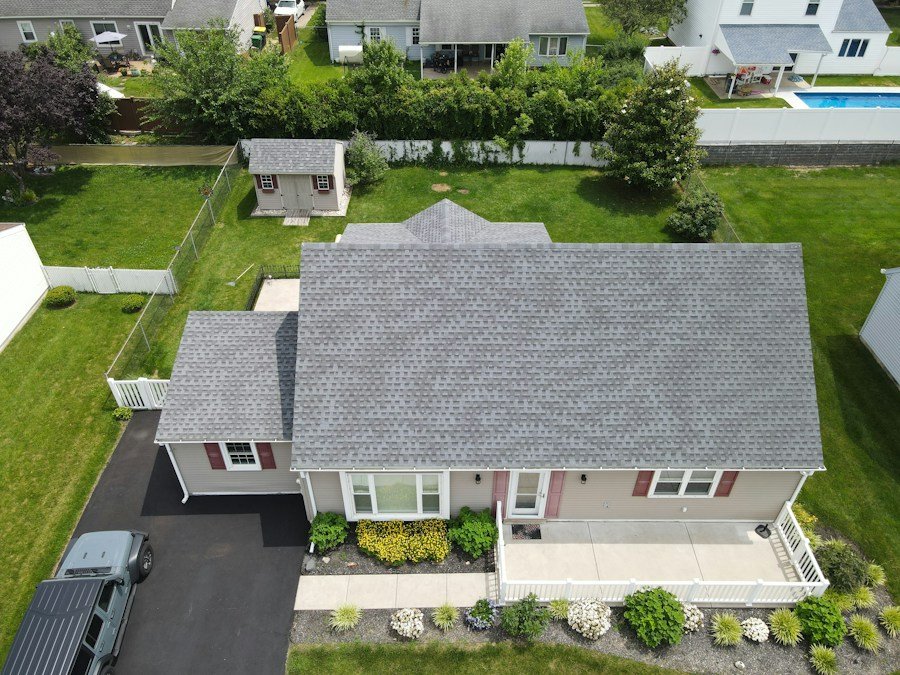
Ramblewood grew around the Ramblewood Country Club and first showed up as its own place in the 1970 census, so most houses here are split-levels, bi-levels and two-story colonials from that first boom. Many are on a second asphalt layer, with original box vents, aluminum drip edge and chimney flashing that has been tarred more than once. Mature hardwoods along Yorktowne Drive and Holiday Street shade the roofs, keep them damp and drop limbs in summer storms.
Birchfield
Birchfield, across Church Street from Ramblewood, mixes single-story homes and condominium buildings set among tall pines and oaks, with small lakes off Lake Drive. The July 2019 tornado ended here, snapping trees near Marigold Court, Sumac Court and Viburnum Lane. Low-pitch single-story roofs collect pine needles in their valleys, and condo buildings carry long gutter runs and soffits that wind can peel back, which is exactly the damage the survey recorded on nearby apartment buildings.
Rancocas Woods
Rancocas Woods sits in the township’s north end near I-295 exit 43 and Rancocas State Park, and its streets are lined with ranch-style homes under heavy tree cover. Long, low ranch roofs with shallow pitch hold snow and leaves, so ice dams and valley leaks are common. Many of these homes have attached garages and later additions where the old and new roofs meet at a cricket or a dead valley, a frequent leak point that we check first.
Holiday Village East
Holiday Village East is a 55+ community on Mount Laurel Road, with mostly single-story homes in a wooded setting across from the Ethel Lawrence Homes. Roofs here are mostly simple gables and hips, some with skylights, ridge vents and low overhangs. The association’s rules shape colors and products, so we check what the community requires before quoting. For many owners, the practical issue is safety: no one should be on a ladder clearing gutters, and we photograph everything so you can see it from the ground.
Laurel Creek, Laurel Point and Le Club
These are some of Mount Laurel’s attached communities: townhome rows at Laurel Creek and Laurel Point and condominium buildings at Le Club. A single roof plane can cover four to eight units, with shared ridges, valleys between end units and stepped party walls. Because the homes are attached, roof covering work needs a construction permit, and the master deed decides whether the owner or the association pays. We document where a leak starts so the right party handles it.
Devonshire, Tara Estates and Mill Run
The township’s later single-family subdivisions, including Devonshire’s cul-de-sacs, Tara Estates’ custom colonials of more than 3,000 square feet and Mill Run, have steep, cut-up roofs with several valleys, dormers and bump-outs. Leaks here start where a second-story wall meets a lower roof, at missing kick-out flashing above gutters, and around skylights over two-story foyers. Architectural shingles from the 1990s and 2000s are now reaching the age where their sealant strips let go in wind.
Masonville, Hartford, Fellowship and Centerton
Before the boom, Mount Laurel was a string of farm crossroads, and names like Masonville on Route 38, Hartford, Fellowship and Centerton still mark older farmhouses, churches and outbuildings among the subdivisions. These older houses often carry three generations of roofing on different wings, wood plank sheathing under asphalt, and metal or rolled roofing on porches, sheds and barns. A repair often means matching old framing that was never built to modern spacing.
What we fix in Mount Laurel
What Roof Problems Do Mount Laurel Homes Have Most?
The most common Mount Laurel roof problems are leaks on shared townhome roofs, worn second-layer roofs from the 1970s and 1980s boom, tree and limb damage in wooded sections, ice dams on low single-story roofs, wind-torn gutters and soffits on condo buildings, and failing low-slope sections on commercial and townhome roofs. Each traces back to how and when the township was built.
Leaks that cross townhome party walls
On a row in Laurel Creek or Laurel Point, water entering at one unit’s valley or ridge can travel along the deck and show up on a neighbour’s ceiling two units away. Step flashing along stepped party walls and the shared valleys between end units are the usual sources. We trace the path from inside each affected attic where we can, photograph the entry point, and write it up so owners and the association can agree on who repairs what.
Boom-era roofs on their second layer
Mount Laurel added more than 12,000 residents in the 1980s alone, and many houses from that decade and the 1970s have already had one re-roof laid over the original shingles. New Jersey allows only two layers, so the next job on these houses is a full tear-off. Until then, repairs on a two-layer roof must work through both, and nail pops, curled tabs and soft spots at the eaves are common.
Hardwood and pine damage in wooded sections
Ramblewood, Birchfield and Rancocas Woods were built into existing woods, and the 2019 tornado showed what wind does here: hardwoods snapped onto houses and a pine broke ten feet off the ground. Even ordinary thunderstorms drop limbs that crack shingles, punch through decking and rip gutters. After any storm, we check the whole roof, because a limb that bounced often leaves bruised shingles away from where it landed.
Ice dams on low single-story roofs
Ranches in Rancocas Woods and single-story homes in Holiday Village East and Birchfield have long, shallow eaves over living space and shallow attics with limited insulation room. Snow melts from attic heat, refreezes at the cold overhang and backs water under the shingles. The fix is usually a combination of ice and water shield at the eaves when the roof is redone, better air sealing and insulation, and clear soffit-to-ridge ventilation.
Gutters and soffits on condo and apartment buildings
The National Weather Service survey of the July 2019 tornado specifically recorded soffit and gutter damage on apartment buildings near Birchfield. Long gutter runs on multi-unit buildings catch wind like a sail, and vinyl or aluminum soffit pulls loose where it was only stapled. Once soffit is gone, wind-driven rain and animals get into the eaves. We re-hang gutters on proper hangers and refasten soffit and fascia before water rots the rafter tails.
Low-slope sections on townhomes and Route 73 buildings
Many townhomes have flat or low-slope roofs over bay windows, entry overhangs and rear bump-outs, and the offices, hotels and industrial buildings along Route 73 near Turnpike Exit 4 and on Gaither Drive run mostly on TPO, EPDM or modified bitumen. Seams, wall flashing and drains fail first. On homes, a shingled low-slope section is a frequent leak because shingles need more pitch than these small roofs have.
Mount Laurel weather
What Storms Have Damaged Mount Laurel Roofs?
Mount Laurel’s roof damage comes mostly from summer thunderstorms and the occasional tornado, plus heavy winter snow and the record rain of July 2004. The township saw two tornadoes in five days in July 2019, a first as far as the National Weather Service knew.
July 11, 2019: EF1 tornado through Ramblewood and Birchfield
Around 7:18 p.m., an EF1 tornado with winds up to 90 mph touched down at the Ramblewood Country Club golf course, crossed into Yorktowne Drive and Holiday Street, then crossed Church Street into Birchfield, lifting near Meadowrue Drive after about 1.3 miles. Hardwoods snapped onto a house near the golf course, trees came down near Marigold Court and Lake Drive, and apartment buildings lost soffits and gutters. No one was hurt.
July 6, 2019: EF0 landspout on Gaither Drive
Five days earlier, the National Weather Service confirmed a weak EF0 landspout at the Mt. Laurel Industrial Plaza on Gaither Drive, between I-295 and the New Jersey Turnpike, close enough to the later tornado that the two touchdowns were less than a mile apart. It overturned a parked car. A meteorologist called the pair a statistical coincidence, but for flat-roofed industrial buildings the lesson is that rooftop units and loose edge metal need to be secured.
July 12-13, 2004: the Rancocas and Pennsauken flood
Record rain over Burlington and Camden counties overwhelmed creeks and dams; the U.S. Geological Survey counted 13 failed dams in the Rancocas Creek basin, and the South Branch Pennsauken Creek, which drains western Mount Laurel, ran near a 100-year flood at Cherry Hill. The state’s flood response page listed Mount Laurel among affected townships. On roofs, rain that heavy finds every weak flashing and overloads gutters sized for normal storms.
January 23-24, 2016: the blizzard
The state climatologist recorded 10.5 to 22.2 inches of snow across Burlington County in this storm. In Mount Laurel, deep snow on low single-story roofs in Holiday Village East and Rancocas Woods meant ice dams in the following thaw, and drifting against townhome party walls and dormers loaded the roof where step flashing is weakest. Several days of melt and refreeze is when most winter leak calls begin.
June 29-30, 2012: the derecho
A derecho, a long-lived line of damaging thunderstorms, raced across South Jersey with regional gusts near 90 mph, cutting power to hundreds of thousands of customers for up to a week. In a township as wooded as Mount Laurel, the damage pattern was limbs on roofs, torn gutters and lifted shingles on exposed ridges. Lifted tabs that are not resealed after a storm like this often become leaks a year or two later.
Roofing services
How Do Our Roofing Services Work in Mount Laurel?
All 12 of our services are available in Mount Laurel, and each one adjusts to the township’s housing: attached rows, 55+ single-story homes, wooded 1970s neighbourhoods and newer estate roofs. Here is how each applies locally.
Roof Leak Repair in Mount Laurel
In Mount Laurel, leaks we trace most often start at shared townhome valleys, chimney flashing on Ramblewood split-levels, skylights in Holiday Village East and kick-out flashing on Devonshire colonials. We follow the water from the attic, photograph the source and fix the cause, not only the stain.
Emergency Roof Repair in Mount Laurel
When a hardwood comes through a Ramblewood or Rancocas Woods roof during a storm, request emergency help through our contact page at any hour. We tarp and secure the opening, photograph damage for your insurer and return for the permanent repair once the tree crew has cleared the limb.
Storm Damage Roof Repair in Mount Laurel
After a summer storm like the July 2019 tornado, Mount Laurel damage is usually tree impact, lifted shingles and torn gutters and soffits. We inspect the full roof, record each damaged area with photos and give you a written scope you can hand to your adjuster.
Roof Replacement in Mount Laurel
Many 1970s and 1980s Mount Laurel homes are on two layers already, so replacement means full tear-off, deck repair, ice and water shield at eaves and valleys, and balanced ventilation. Attached townhomes need a permit. Replacements carry our 10-year written workmanship warranty.
Roof Inspection in Mount Laurel
A Mount Laurel inspection covers shingles, flashing, attic ventilation and decking, with dated photos. It is useful before buying a Ramblewood split-level or a Laurel Creek townhome, after a storm, or when your association asks owners to document roof condition.
Flat Roof Repair in Mount Laurel
Low-slope roofs in Mount Laurel cover townhome bay windows and bump-outs, porch roofs on older Masonville and Hartford houses, and the commercial buildings near Exit 4. We repair modified bitumen, EPDM and TPO seams, re-flash walls and clear drains so water leaves the roof.
Metal Roof Repair in Mount Laurel
Metal roofing in Mount Laurel shows up on farm outbuildings left from the township’s rural era, porch roofs, bay-window caps and some commercial buildings along Route 38 and Route 73. We fix loose fasteners, failed seams and rusted panels, and seal penetrations so the metal sheds water again.
Slate Roof Repair in Mount Laurel
Slate is rare in Mount Laurel, mostly on a few older farmhouses and churches from before the boom. When we find it, we replace broken slates with matched pieces on copper nails or hooks and repair flashing, keeping the roof instead of covering it with asphalt.
Shingle Roof Repair in Mount Laurel
Asphalt shingles cover almost every Mount Laurel home. We replace wind-creased and missing shingles, reseal lifted tabs, fix nail pops and match color as closely as current product lines allow, which matters on townhome rows where one patch shows against the neighbours.
Roof Cleaning in Mount Laurel
Shade from Ramblewood hardwoods and Birchfield pines keeps roofs damp, so algae streaks and moss are common, especially on north slopes. We use low-pressure, shingle-safe cleaning, clear valleys of needles and can add zinc or copper strips to slow regrowth.
Gutter Repair in Mount Laurel
Mount Laurel gutters fill with oak leaves and pine needles twice a year and take wind damage on long condo runs. We re-hang sagging sections on hidden hangers, add drip edge where water runs behind gutters and repair fascia and soffit before rot sets in.
Commercial Roofing in Mount Laurel
Mount Laurel’s commercial roofs include offices and hotels along Route 73 near Turnpike Exit 4, industrial buildings on Gaither Drive and retail on Route 38. We repair TPO, EPDM and modified bitumen, flash rooftop units, and provide written condition reports for owners and property managers.
Mount Laurel rules
Do You Need a Permit or HOA Approval for Roof Work in Mount Laurel?
Permits & local review
A detached single-family house in Mount Laurel needs no permit for roof repair or a full re-cover, but an attached townhome or condo building does. Since March 2018, New Jersey treats roof covering work on detached one- and two-family homes as ordinary maintenance under N.J.A.C. 5:23-2.7, with no permit or inspection. That exception does not reach attached housing, so a re-roof on a Laurel Creek, Laurel Point or Le Club unit is filed with Mount Laurel’s construction office. A permit is also required anywhere for sheathing replacement, rafter or truss repair after a tree strike, or a third layer, which the code does not allow.
Association approval is a separate step. Townhome, condo and 55+ communities such as Holiday Village East usually control shingle color and product through an architectural review, and the master deed decides who pays. Mount Laurel’s code includes a flood damage prevention chapter (Chapter 83) that applies near Parkers Creek and the South Branch Pennsauken Creek, where major repairs to a damaged home can trigger elevation rules. The township is not on the Pinelands Commission’s list of Pinelands Area towns, unlike Evesham next door, and its code index shows no local historic district review for ordinary homes.
Insurance claims
Homeowners insurance usually pays for sudden roof damage in Mount Laurel, such as a tree falling in a storm, wind-torn shingles or the weight of snow, and usually excludes wear and age. That distinction matters on 1970s and 1980s roofs already on their second layer, because an adjuster will separate storm damage from long-term wear. For Hurricane Ida in 2021, FEMA designated Burlington County for public assistance only, not individual assistance, so homeowners relied on their own policies. Townhome and condo owners should check how the association’s master policy and their own HO-6 policy split roof coverage before filing. Take photos before cleanup, keep receipts for tarping, and get our written damage scope to your agent quickly.
Pricing · updated November 2026
How Much Does Roof Repair Cost in Mount Laurel?
As of November 2026, most Mount Laurel roof repairs run $350 to $1,500, while chimney work, flat-roof repairs, tree damage and slate run higher. Townhome permits, association material rules and tree-covered lots move the number, and every job gets a written, itemized quote after a free inspection. Our roof repair cost guide explains the ranges in detail.
Shingle and nail-pop repair
$350 – $800
Replacing wind-creased or missing shingles and resealing lifted tabs, the common fix on Ramblewood and Birchfield roofs after a thunderstorm, with color matched as closely as possible to the rest of a townhome row.
Pipe boot and vent flashing
$250 – $600
New boots and vent flashing on 1980s and 1990s Mount Laurel homes and townhomes, where original rubber boots have cracked and let water run down plumbing vents into bathroom ceilings.
Single-source leak repair
$400 – $1,500
Finding and fixing one leak, such as a shared valley between townhome units, a chimney on a split-level or a skylight in Holiday Village East, with minor deck repair if the wood is soft.
Chimney re-flashing
$600 – $1,800
New step and counter flashing on masonry chimneys common on Ramblewood split-levels and colonials, often replacing years of tar patches, with a cricket added on wide chimneys if needed.
Flat-roof patch or seam
$400 – $2,500
Seam, blister or wall flashing repair on modified bitumen, EPDM or TPO over townhome bump-outs and bay windows, porch roofs on older farmhouses, or small commercial roofs near Route 73.
Emergency tarp or rotted deck
$300 – $2,000+
Tarping after a tree strike in Rancocas Woods or Ramblewood, or replacing a rotted deck section found under a long-leaking valley; structural work on any home or deck work on townhomes needs a permit.
What moves the price in Mount Laurel
- Attached homes. Townhome and condo roofs in Laurel Creek, Laurel Point and Le Club need a construction permit, which adds fees, paperwork and an inspection that detached homes skip.
- Association rules. Holiday Village East and other associations may require a specific shingle line or color, which can limit material choices and affect price.
- Tree cover. Ramblewood, Birchfield and Rancocas Woods roofs sit under hardwoods and pines; limbs may need trimming before work and debris protection adds time.
- Layer count. Many 1970s and 1980s homes already carry two layers, so a repair works through both and a replacement includes full tear-off and disposal.
- Roof complexity. Devonshire, Tara Estates and Mill Run colonials have multiple valleys, dormers and skylights, which take more labor and flashing than a simple ranch gable.
- Access in townhome courts. Tight parking, shared driveways and units close together can mean hand-carrying materials and scheduling around neighbours.
- Older farmhouse framing. Masonville and Hartford farmhouses may have plank sheathing and irregular rafters that need extra work before new roofing goes on.
These November 2026 planning ranges draw on Roof Observations and Fixr New Jersey cost data and our own repair price bands. Treat them as a budgeting guide for Mount Laurel homes, not a quote; the real number comes after we inspect your roof.
Who does the work
Why Mount Laurel Homeowners Choose Roof Repair SNJ
- Repairing NJ roofs for 25+ years
- General liability + workers’ comp insurance
- Workmanship warranty: 2 years on repairs, 10 years on full replacements, in writing
- Photo report with every inspection
Check any roofer before you sign in Mount Laurel
Ask for the 13VH registration number and confirm it on the NJ license lookup. NJ law requires a signed written contract showing the registration number and total price, and gives you until midnight of the third business day to cancel (N.J.S.A. 56:8-151).
Nearby
How Do Roofs Differ in the Towns Around Mount Laurel?
Mount Laurel’s neighbours share its suburban timeline but differ in age and rules: Moorestown is older with a historic commission, Evesham reaches into the Pinelands, Cherry Hill’s housing is a decade older, and Maple Shade is denser. We serve all of them from the same Burlington County roof repair crews.
Evesham (Marlton)
Evesham grew alongside Mount Laurel with Kings Grant and other townhome and split-level communities, but part of the township lies in the Pinelands Area, so lot and site work can bring another layer of review. Sandy soils and pine cover mean more needles in valleys and gutters.
Moorestown
Moorestown is older, with large colonial and Victorian homes along Main Street and a Historic Preservation Commission that reviews exterior changes under a 2025 ordinance. Slate, cedar and steep roofs are more common than in Mount Laurel, and historic review can shape material choices.
Cherry Hill
Across the Turnpike, Cherry Hill’s subdivisions are mostly a decade older than Mount Laurel’s, built in the 1950s and 1960s. More of its ranches and split-levels are on second layers, and its heavier tree canopy near the Cooper River adds limb damage.
Maple Shade
Maple Shade is smaller and denser, with modest capes, ranches and garden apartments on tight lots near Route 73 and Route 38. Access is tighter than in most of Mount Laurel, and many homes have low-slope additions and older aluminum gutters.
Westampton
At the Turnpike’s northern edge, Westampton mixes newer subdivisions with farmland near Rancocas State Park. Roofs are generally younger than Mount Laurel’s boom-era stock, and open fields expose them to stronger wind than the wooded Mount Laurel neighbourhoods.
In depth
Mount Laurel Roofing Questions, Answered in Depth
A tree came down near my Ramblewood or Birchfield house: what roof damage should I look for?
Look beyond the spot where the tree or limb hit: check for cracked or creased shingles along the fall line, torn gutters and soffits, a sagging section of roof deck and any new stains on ceilings or in the attic. The July 11, 2019 tornado showed how damage spreads in these neighbourhoods. A hardwood snapped onto a house near the Ramblewood golf course, trees fell near Marigold Court and Lake Drive in Birchfield, and apartment buildings lost soffits and gutters, all within a path about 1.3 miles long.
When a limb lands on a roof, the impact often bruises shingles without tearing them. The mat fractures under the granules and the shingle starts to leak or blow off a season later. A trunk that rests on the ridge or across rafters can crack framing, and that is structural damage, which needs a permit and is the first thing an adjuster will ask about. Gutters bent by a falling limb may also have pulled the fascia board loose, opening the eave to rain.
Here is the order that protects you. Get people out of rooms under the damage. Photograph the tree on the roof from the ground before anything is moved. Have a tree service remove the weight; roofers should not cut trees off roofs. Then have the roof tarped, and keep receipts, since temporary repairs are usually part of a claim. We inspect the full roof, including slopes the tree never touched, because wind that drops a tree also lifts shingles elsewhere. You get dated photos and a written scope that separates storm damage from wear on an older roof, which is the question your adjuster will focus on. Storm damage roof repair explains our process in more detail.
Who fixes a leak in a Laurel Creek, Laurel Point or Le Club unit, and what permit is needed?
Your association’s master deed and bylaws decide whether the roof is your responsibility, the association’s, or shared, and because the home is attached, roof covering work needs a construction permit from Mount Laurel’s construction office. Those are two separate questions, and both should be answered before anyone climbs a ladder.
Start with the documents. Many townhome associations treat roofs as common elements maintained by the association; others make each owner responsible for the roof over their unit but require approved materials and colors; some split repair and replacement. Condominium buildings like Le Club almost always treat the roof as common property. If you are unsure, ask your property manager in writing and keep the answer.
Next, find the source. On a row, water often enters at a shared valley between two units, along step flashing at a stepped party wall, or at a ridge vent that spans several homes, then runs along the deck before dripping through a ceiling. The unit with the stain is not always the unit with the hole. We inspect from the attic where we can, photograph the entry point and write a report naming where the water comes in. That report is what lets owners, neighbours and the board agree on who pays.
Finally, the permit. The 2018 ordinary maintenance rule under N.J.A.C. 5:23-2.7 covers only detached one- and two-family homes, so a re-roof on attached townhomes is filed with the township and inspected. Small repairs are often handled differently than a full re-roof, so we confirm the requirement for your specific job. We also match shingle color as closely as current product lines allow, because a patch that does not match stands out on a uniform row and may draw a letter from the architectural committee.
Should I repair or replace the roof on my 1970s or 1980s Mount Laurel home?
If your roof is on its second layer and shows curling, missing granules or leaks in more than one place, replacement is usually the better value; a single-layer roof with one leak or a few storm-damaged shingles is a repair. The question comes up constantly in Mount Laurel because so much of the township was built at once. Population went from 11,221 in 1970 to 30,270 in 1990, which means thousands of houses got their first roofs within twenty years of each other and many have already had one overlay.
Start by counting layers. You can often see them at the edge of the roof above the gutter or at a gable end. New Jersey allows no more than two, so a two-layer roof cannot be covered again. Every repair on it has to work through both layers, which makes patches less reliable, and the next roof will be a full tear-off.
Then look at age and spread. An asphalt roof from the 1990s is near the end of its life. If shingles are cracking across many slopes, if granules pile up at downspouts, or if the deck feels soft at the eaves, patching buys little time. On the other hand, a roof installed in the last ten to fifteen years with one failed pipe boot or a few wind-damaged tabs is a straightforward repair in the few-hundred-dollar range.
Look in the attic too. Many boom-era homes in Ramblewood and Rancocas Woods were built with box vents and limited soffit intake, and poor ventilation shortens shingle life and feeds ice dams. If you replace, the new roof should include ice and water shield at eaves and valleys, new drip edge, new flashing and balanced intake and exhaust ventilation. We put both options in writing with photos, so you can compare a repair against a full roof replacement with real numbers.
What should owners in Holiday Village East and other 55+ homes know about their roofs?
Single-story homes in Mount Laurel’s 55+ communities have simple roofs that are easy to maintain, but their low pitch, skylights and shallow attics make ice dams and skylight leaks the most common problems, and owners should never be on a ladder to check. Holiday Village East on Mount Laurel Road is the township’s best-known active adult community, set among trees, and its homes share a common design language that the association protects.
Low-pitch roofs shed water more slowly than steep ones, so leaves and pine needles sit in valleys and behind chimneys, and snow lingers. When attic heat melts that snow, water runs down to the cold eaves and refreezes, building an ice dam that pushes water under the shingles. Ceiling stains near outside walls in late winter are the classic sign. The long-term fix combines ice and water shield along the eaves, better attic insulation and air sealing, and clear soffit vents feeding a ridge vent.
Skylights are the other weak point. Some homes in these communities have them over kitchens and baths, and after 20 or more years the flashing kit, the seals and sometimes the skylight itself fail. If a skylight is original, it often makes sense to replace it during a re-roof instead of re-flashing an old unit.
Check with the association before any work. Communities like this usually specify shingle color and product and may have rules on contractor hours and parking. Ask too whether the association or the owner is responsible for the roof. We can inspect without anyone in the household climbing anything, and every finding comes with photos you can review from your kitchen table, or forward to family who help with decisions. A yearly roof inspection is a practical routine for these homes.
Rancocas Woods ranches and creek-side lots: moss, moisture and flood rules
Rancocas Woods homes sit under heavy tree cover near Rancocas State Park and the Parkers Creek drainage, so roofs stay damp, grow moss and algae, and hold leaves in valleys; homes near mapped flood areas also need to know Mount Laurel’s flood rules before major repairs. These ranch-style homes have long, low roof planes that rarely see full sun, especially on north and east slopes.
Moss is more than cosmetic. It holds water against the shingle, lifts tabs as it grows and sends roots under the edges, and in winter that trapped water freezes. Black streaks of algae are mostly cosmetic but signal a roof that stays wet. We clean with low-pressure, shingle-safe methods, never a pressure washer that strips granules, and can install zinc or copper strips near the ridge to slow regrowth. Trimming limbs back so the roof dries after rain is often the best single step.
Leaves are the other problem. Shallow valleys and gutters on these ranches fill quickly in fall, and when they clog, water backs up under the first course of shingles and rots the fascia and the deck edge. Gutter guards help on some homes, but they still need checking.
Flood rules matter if a storm or a tree causes major damage. Mount Laurel enforces a flood damage prevention ordinance, Chapter 83 of the township code, and homes in mapped flood hazard areas along the township’s creeks can face elevation and other requirements when repairs to a damaged building become substantial. A normal roof repair does not trigger those rules, but a large rebuild after a fallen tree might, so check the property’s flood zone with the township before planning a big job. We also check whether attic moisture from a damp crawl space is adding to roof problems on these low homes, since the two often go together.
FAQ
Roof Repair in Mount Laurel, NJ: Frequently Asked Questions
Do I need a permit to replace my roof in Mount Laurel?
Not for a detached single-family home. New Jersey treats roof covering repair and replacement on detached one- and two-family houses as ordinary maintenance. Attached townhomes and condo buildings in Mount Laurel do need a construction permit, as does any home needing sheathing, rafter or structural repair, or a third layer.
Who is responsible for a townhome roof leak in Mount Laurel?
Your association documents decide. Some Mount Laurel associations maintain all roofs, some leave them to owners with approved materials, and some split repair and replacement. Check the master deed or ask management in writing, then get the leak source documented so the right party pays.
Did a tornado really hit Mount Laurel?
Yes, two in one week. The National Weather Service confirmed an EF0 landspout on Gaither Drive on July 6, 2019, and an EF1 with winds up to 90 mph on July 11, 2019, which crossed Ramblewood and Birchfield, snapping trees and damaging gutters and soffits.
How much does a roof repair cost in Mount Laurel?
Most Mount Laurel repairs cost $350 to $1,500 as of November 2026. Expect $600 to $1,800 for chimney re-flashing and $400 to $2,500 for a flat-roof repair. Townhome permits, association material rules and tree cover can raise the price. Your written, itemized quote follows a free inspection.
Is Mount Laurel in the Pinelands?
No. The Pinelands Commission’s list of Pinelands Area municipalities includes neighbouring Evesham but not Mount Laurel. Roof work on a Mount Laurel home follows the state construction code and the township’s own rules, without Pinelands review.
Why do roofs in Ramblewood and Rancocas Woods grow moss?
Both neighbourhoods were built into mature woods, so roofs stay shaded and damp, especially on north slopes. Moss and algae follow. Low-pressure cleaning, zinc or copper strips near the ridge and trimming limbs so the roof dries after rain all help Ramblewood and Rancocas Woods roofs last longer.
Can you match shingles on a Mount Laurel townhome row?
We match as closely as current product lines allow and check what your association specifies. Shingle colors change over the years, so a repair on an older Laurel Creek or Laurel Point row may differ slightly. We show you samples and photos before installing so there are no surprises.
What causes ice dams on Mount Laurel ranch and single-story homes?
Heat from the living space melts roof snow, which refreezes at the cold eaves of long, low roofs common in Rancocas Woods and Holiday Village East. Ice and water shield at the eaves, better insulation and air sealing, and clear soffit-to-ridge ventilation are the lasting fixes.
Should I repair or replace my 1980s Mount Laurel roof?
If it is already on a second layer and shows curling, granule loss or several leaks, replacement is usually the better value. A single-layer Mount Laurel roof with one leak or a few damaged shingles is a repair. We give you both options in writing with photos.
Do you repair commercial roofs near Route 73 in Mount Laurel?
Yes. We repair TPO, EPDM and modified bitumen roofs on offices, hotels and industrial buildings along Route 73 near Turnpike Exit 4, on Gaither Drive and on Route 38, including seams, wall flashing, drains and rooftop unit flashing, with written condition reports.
What should I do first after storm damage to my Mount Laurel roof?
Stay out of rooms under damage, photograph everything before cleanup, have a tree service remove any limbs, then get the roof tarped. Request emergency help through our contact page. We document the damage on your Mount Laurel home for your insurer and quote the permanent repair.
How do I check a roofer’s registration before work in Mount Laurel?
Ask for the contractor’s New Jersey home improvement registration number, which starts with 13VH, and look it up on the state’s verification site. Mount Laurel homeowners should also get a written contract with total price, insurance certificate and a three-business-day right to cancel.
Reviewed by the Roof Repair SNJ team · Last updated November 2026
Free inspection
Get a Free Roof Inspection in Mount Laurel
Whether it is a limb through a Ramblewood roof, a shared valley leaking into a Laurel Creek townhome or ice dams on a Holiday Village East home, we will inspect, photograph and give you a written, itemized quote. Book your Mount Laurel roof inspection or send us photos of the problem. Repairs carry a two-year written workmanship warranty.
No pressure and no obligation. If a repair will do, we’ll tell you.
Roof Repair SNJ
- Serving Mount Laurel and all of Burlington County
- Request roof service in Mount Laurel
- Mon–Fri 5:00 AM–10:00 PM · Sat 5:00 AM–6:00 PM · Emergencies 24/7
Sources: Mount Laurel, New Jersey (history, population, localities, roads, waterways) · Ramblewood, New Jersey (CDP history and 2020 housing) · Census Reporter: Mount Laurel township (ACS 2024 5-year) · The Sun: Second tornado caps off strange weather week in Mt. Laurel (July 2019) · NJ101.5: Mount Laurel’s second tornado of 2019 (EF1, 90 mph) · USGS: Flooding in New Jersey, July 12-14, 2004 · NJOEM: Burlington County flood 2004 township information · Office of the NJ State Climatologist: January 2016 blizzard totals · NWS Mount Holly: June 29-30, 2012 derecho · Mount Laurel Township Code index: Flood Damage Prevention (Chapter 83) · Mount Laurel Township Code index: historic entries · Pinelands Commission: Pinelands Area municipalities · FEMA DR-4614 (Ida) designated areas · Homes.com Mount Laurel local guide (development names) · N.J.A.C. 5:23-2.7 ordinary maintenance · NJ contractor registration lookup · N.J.S.A. 56:8-151 home improvement contracts · Roof Observations: New Jersey roof cost guide · Fixr: roof replacement cost New Jersey. Prices are planning ranges, not quotes. Permit and insurance information is general guidance; your town, policy and agent have the final word.