
Roof Repair NJ › NJ Locations › Union County › Summit
North Side · Hobart Avenue · Deantown · 07901
Roof Repair in Summit, NJ: Slate, Tudor and Victorian Roofs on the Hill City
Roof Repair SNJ repairs slate, cedar, copper and shingle roofs across Summit, from the Tudor Revival homes of the North Side and the Victorians of Hobart Avenue and Kent Place Boulevard to the vernacular cottages of Deantown and the Silk Mill district. You get a free inspection with photos, a written itemized quote and a 2-year written warranty on repairs.
- Slate, cedar and copper repaired in kind
- Tree-strike and ice-dam repairs on the ridge
- Free photo inspection, written itemized quote
Free roof inspection in Summit
Photos of every problem we find and an itemized written price before any work. Emergency requests handled 24/7.
Roof Repair SNJ
Summit · Union County · all 21 NJ counties
Free inspection
Roof, attic and gutters checked at no cost.
Insured
Liability and workers’ comp; certificate on request.
Written quotes
Itemized price in writing before any work.
Photo-documented
Every problem photographed, before and after.
Summit at a glance
Summit at a Glance: What Shapes Its Roofs
Summit is a ridge-top city of mostly owner-occupied, high-value homes, with twelve historic districts and a housing stock built largely between the 1880s and the 1940s. That means steep, complex roofs in premium materials, under a heavy tree canopy, on a hill that catches wind, ice and snow.
Population (2020 Census)
22,719
Summit covers about 6.05 square miles, with 8,365 housing units counted in 2020, most of them single-family homes on tree-lined streets.
Owner-occupied homes
68.3%
Census QuickFacts, 2020-2024. Most Summit roofs belong to the people living under them, who tend to repair original materials rather than downgrade.
Median owner home value
$994,500
QuickFacts 2020-2024. At these values, matching slate, copper and cedar during repair protects a roof that is part of what buyers are paying for.
Elevation
About 374 ft
Summit sits on Second Watchung Mountain, earning the name Hill City. Higher ground and open ridge lines mean more wind, ice and snow than towns in the valleys below.
Historic districts
12
From the North Side and Hobart Avenue to Deantown and the Silk Mill, plus 44 identified landmarks. The Historic Preservation Commission advises on board applications.
Zip codes
07901 and 07902
Summit’s two ZIP codes. Locals also search by landmarks such as Overlook Medical Center, the Village Green, the Reeves-Reed Arboretum and Springfield Avenue downtown.
Neighborhoods & homes
Which Summit Neighbourhoods Have Which Roofs?
Summit’s roofs are best understood through its historic districts: Tudor and Shingle Style estates on the North Side and Hobart Avenue, Queen Anne and Stick Victorians on Kent Place Boulevard and Morris Avenue, and modest vernacular homes in Deantown, the Silk Mill district and the Summit Home Land Company area. Each needs different skills.
North Side
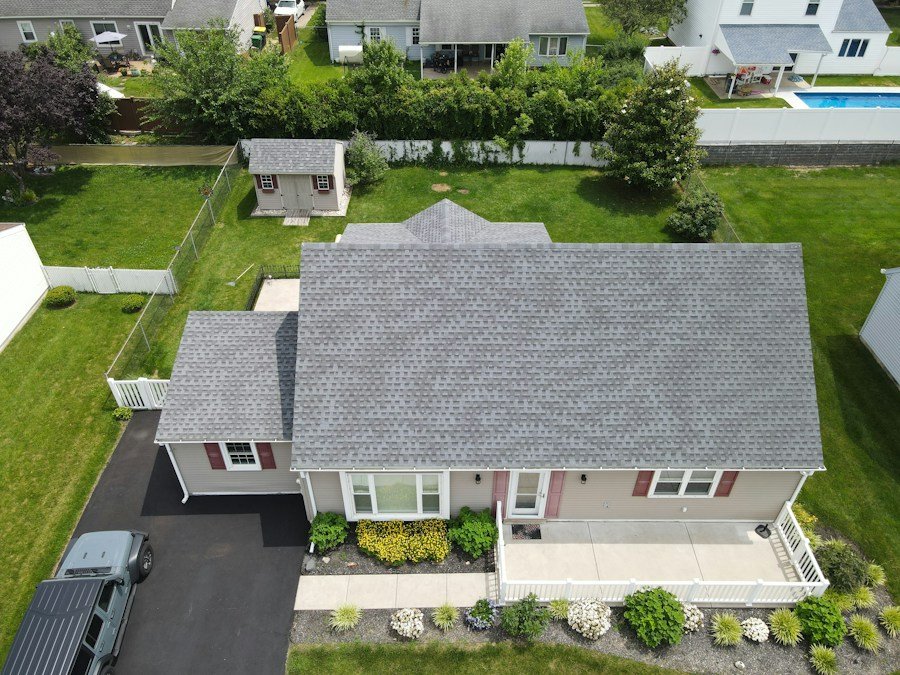
The North Side district covers most properties north of Springfield Avenue, bounded by Morris Avenue, Woodland Avenue, Canoe Brook Country Club and Route 24. Built from 1890 to the 1940s, it holds Queen Anne, Shingle Style, Colonial Revival and more than 100 Tudor Revival homes in park-like settings. Expect steep slate or tile roofs, half-timbered gables, massive chimneys and copper valleys and gutters. Tree limbs and ice dams on deep eaves are the classic problems here.
Hobart Avenue
The Hobart Avenue district runs about a mile from Franklin Place to the Morris Turnpike, with houses mainly from 1895 to the 1920s in Free Classic Queen Anne, Richardsonian Romanesque, Shingle, Colonial Revival and Tudor Revival styles. Some of Summit’s oldest resort-period houses sit between Franklin and Springfield, and the Reeves-Reed Arboretum is at 165 Hobart Avenue. Roofs here are large and cut up with towers, dormers and turrets, and often still wear original slate.
Kent Place Boulevard and Beekman Terrace
Kent Place Boulevard between Morris Avenue and High Street has High Victorian houses with Stick-style ornament, gabled Queen Annes and Colonial Revivals, several built by William DeForest. Nearby Beekman Terrace holds four estates from 1892 to 1906 in Tudor and Colonial Revival styles. These roofs mix slate, decorative wood shingles and ornate eaves with brackets. Water getting behind trim boards and failed flashing at porch roofs cause much of the damage.
Deantown
Deantown, in east Summit beyond Overlook Medical Center, runs roughly from Baltusrol Place through the area between Springfield Avenue and Morris Avenue up to North Street. It developed over about a century from the late 1800s, with vernacular Victorian houses and simple front-gabled and shed-roofed homes on smaller lots. Roofs are usually asphalt over old board decks, with low-slope shed sections over porches and additions that leak when shingles were installed below their minimum pitch.
Morris Avenue Area
Below Overlook, the Morris Avenue district runs from Doremus Street to Walnut Street and includes all of William Street. Most houses date from the 1880s to about 1920 in Victorian, Queen Anne and Colonial Revival styles, along with the Victorian Gothic Mount Olive Temple. Steep front gables, wraparound porch roofs and chimneys that have been rebuilt more than once are common. Porch roofs with old roll roofing and rusted tin are a frequent repair.
Silk Mill district
The Silk Mill and Silk Mill II districts cover Lafayette Avenue, Aubrey Street, part of Morris Avenue and a few structures on Weaver Street, with early twentieth-century worker housing near the surviving silk mill. The houses are vernacular, front-gabled or shed-roofed, and close together. Roofs are mostly asphalt shingles with simple flashing, so typical repairs are worn shingles, vent boots, chimney flashing and gutters that drain onto the house next door.
Prospect Street and Mountain-Oak Ridge
Prospect Street between High Street and Locust Drive has eclectic homes built from 1900 to 1915, and the Mountain-Oak Ridge district, bounded by Mountain Avenue, Oak Ridge Avenue, Elm Place, Glenside Avenue, Morris Avenue and Magnolia Place, has late Victorian and early twentieth-century houses. Both sit high on the ridge. Wind-driven rain against dormer walls, lifted ridge caps and gutters choked by oak and maple leaves are the problems we see most.
Summit Home Land Company area
East of Memorial Field and up toward the Middle School, bounded on the south by Mountain Avenue and Elm Place, the Summit Home Land Company district was an early twentieth-century planned development of modest Colonial Revival and Tudor Revival homes on modest lots. Many have steep front gables, one large chimney and asphalt shingles that replaced original slate. Ice dams on north-facing slopes and step flashing at the chimney are the usual leaks.
What we fix in Summit
What Roof Problems Are Most Common in Summit?
Summit’s most common roof problems come from three things: older premium materials like slate and copper reaching the end of their fasteners, a mature tree canopy that drops limbs and leaves, and a ridge-top location that brings wind and ice. Each is described below with what we usually do about it.
Tree strikes under the canopy
Summit’s tree-lined streets are part of its character, and in nearly every major storm they are also what damages roofs. Sandy in 2012 sent trees into homes and left hundreds of residents without power for weeks; Isaias in 2020 left many streets with fallen trees and wires. A limb strike can crack slate, puncture decking and pull gutters away. We tarp, document and repair, matching the original material wherever possible.
Ice dams on deep Tudor eaves
The North Side and Summit Home Land Company Tudors have long, steep slopes, deep eaves and shaded north faces. Snow melts over a warm attic, refreezes at the cold eave and backs water under slate or shingles. Summit’s elevation makes the freeze-thaw cycle longer than in the valley towns. Ice and water shield at the eaves on re-roofing, better attic ventilation and insulation, and clear gutters do more than heat cables.
Slate held by failing nails
Many Hobart Avenue, Kent Place and North Side roofs still carry original slate from 1890 to 1930. The stone itself often has decades left, but the iron nails rust and slates slide out. Replacing slipped and broken slates with matched salvage stone on copper hooks is far less expensive than replacement and keeps the roof that defines the house.
Copper valleys, gutters and flashing
Summit’s better homes use copper for valleys, half-round gutters, chimney flashing and built-in box gutters. Copper lasts, but solder joints crack, valleys wear thin where water and debris concentrate, and box-gutter linings split. Repair with matching copper and properly soldered seams, rather than coating with tar, is what keeps these details working on a hillside where heavy leaf fall concentrates water in the valleys.
Porch and shed-roof sections
Victorians on Morris Avenue and Kent Place and the vernacular homes in Deantown and the Silk Mill district have low-slope porch roofs and shed-roofed additions. These were often covered with roll roofing or shingles installed below their minimum slope. Water backs up under the laps, rots the fascia and leaks into porch ceilings. Low-slope membrane is the right material for these sections.
Mixed-material roofs after additions
Many Summit homes have been expanded over the past forty years, so a 1920s slate main roof often meets a newer architectural-shingle addition or a flat roof over a family room. The joints between old and new, especially where the addition’s roof tucks under original slate, are where leaks start. Careful step and counter flashing at these transitions solves most of them.
Summit weather
Which Storms and Weather Have Hit Summit Roofs?
Summit sits above the flood plains, so its roof damage comes mostly from wind, falling trees and heavy snow rather than flooding. The city’s own records and local reporting show a pattern of storms that bring down trees and leave neighbourhoods without power for days.
Sandy, October 29, 2012
Sandy’s surge never reached Summit, but its wind did. Trees crashed into homes and onto power lines, leaving hundreds of residents without power for weeks, and the wind bent the windows of the emergency command centre at the Summit firehouse inward. The library and middle school, with generators, became refuges. Roof damage came from limb strikes, uprooted trees and shingles and ridge caps lifted on exposed streets.
Irene, late August 2011
Irene brought heavy rain to Summit over the end of August 2011, with Martins Brook Park showing heavy signs of flooding and city officials reporting that their main difficulty was getting power restored by Jersey Central Power and Light. For roofs, saturated soil let trees topple, and long, wind-driven rain found weak flashing at dormers and chimneys.
Severe storm, September 17, 2018
A powerful afternoon storm with strong winds toppled trees near homes, brought down power lines and left hundreds of Summit customers without power for several hours. Franklin Elementary School closed the following day. Short, violent wind events like this lift shingles and drop limbs on roofs with little warning, which is why a post-storm roof check matters even after a brief storm.
Isaias, August 4, 2020
Tropical Storm Isaias left many Summit streets with fallen trees and wires. The city opened a charging station in the Broad Street east parking lot, the Department of Community Services scheduled curbside storm debris pickup, and crews waited for utilities to de-energize trees tangled in lines. Roofs were hit by limbs and whole trees, with punctured decks needing emergency tarps first.
January 22-23, 2016 blizzard
Union County received 19.0 to 28.3 inches of snow in the January 2016 blizzard. On Summit’s steep, shaded roofs, heavy snow loads, drifting against dormers and chimneys, and the freeze-thaw that followed produced ice dams on north-facing eaves across the North Side and Summit Home Land Company neighbourhoods, with leaks appearing during the thaw.
Roofing services
Roof Repair Services We Provide in Summit
All twelve of our roofing services are available in Summit, with slate, copper and storm repair the most requested on its older homes. Each card explains how the service applies to Summit roofs specifically.
Roof Leak Repair in Summit
On Summit’s complex roofs, leaks often come from where a dormer, tower or addition meets the main roof. We trace each leak from the attic or ceiling to the exact flashing or slate at fault and photograph it before quoting a repair.
Emergency Roof Repair in Summit
When a tree comes down on a North Side or Deantown roof, send an emergency request through our contact page at any hour. We tarp the opening, protect slate and copper from further damage and document everything for your insurer.
Storm Damage Roof Repair in Summit
Summit’s storm damage is mostly tree strikes, cracked slate and lifted shingles on ridge-top streets. We document every item with dated photos, separate storm damage from age-related wear and repair in matching materials.
Roof Replacement in Summit
When a Summit slate or cedar roof is truly finished, we replace it with new slate, cedar or premium architectural shingles suited to the house. On a detached one- or two-family home, the city’s permit chart lists roof replacement with no permit needed.
Roof Inspection in Summit
Our free Summit inspection covers slate condition, fasteners, copper valleys and gutters, chimneys, flashing at every dormer and the attic below. It is useful before buying an older home in the North Side or Hobart Avenue districts.
Flat Roof Repair in Summit
Summit’s flat roofs are mostly porches, family-room additions and garages, plus downtown commercial buildings on Springfield Avenue. We repair and replace these with modified bitumen, EPDM or TPO and flash them properly to the walls around them.
Metal Roof Repair in Summit
Copper and terne metal are common on Summit’s older homes, on bay windows, porch roofs, valleys and built-in gutters. We repair seams with proper soldering and replace worn sections in matching metal rather than covering them with coatings.
Slate Roof Repair in Summit
Slate is a Summit specialty. We replace slipped and broken slates with matched salvage stone on copper hooks and rebuild valleys and chimney flashing on Hobart Avenue, Kent Place and North Side homes. Learn more about our slate roof repair methods.
Shingle Roof Repair in Summit
Deantown, the Silk Mill district and many later houses use asphalt shingles. We replace wind-lifted shingles, fix step flashing at dormers and chimneys, and repair low-slope sections where shingles were installed below their rated pitch.
Roof Cleaning in Summit
Under Summit’s tall oaks and maples, roofs collect leaves, moss and debris. We clean slate and shingle roofs gently without pressure washing, clear valleys and gutters and treat moss on shaded north faces.
Gutter Repair in Summit
Summit homes often have copper half-round gutters or built-in box gutters behind cornices. We re-line box gutters, re-solder copper joints, re-hang gutters pulled down by ice or limbs and size downspouts for heavy leaf fall.
Commercial Roofing in Summit
Downtown Summit, along Springfield Avenue, Union Place and Summit Avenue, has commercial and mixed-use buildings in the National Register historic district. We repair membranes, parapets and rooftop flashing and arrange the permits commercial work needs.
Summit rules
Do You Need a Permit or Historic Review for Roof Work in Summit?
Permits & local review
For a detached one- or two-family home in Summit, roof repair or replacement is ordinary maintenance under N.J.A.C. 5:23-2.7, and the City of Summit’s own permit submittal chart lists residential roof patch, cover or replacement as no permit needed. The same chart notes that if plywood is replaced or added, a building technical section is required, so deck replacement does need a permit through the code and construction office in the Department of Community Services. Attached homes, townhouses, multi-family buildings, commercial roofs and any third layer need permits too.
Summit has twelve historic districts and 44 identified landmarks. The Historic Preservation Commission reviews applications that go to the Zoning and Planning Boards, and the city’s Historic Preservation Ordinance, adopted as Ordinance 25-3356 on October 7, 2025, sets up a Historic Site Verification for demolition and additions that results in non-binding recommendations. Roof repair alone does not usually go before the commission, but if your roof work is part of an addition, a variance or a demolition application, expect the commission’s input. Many owners in the North Side and Hobart Avenue districts choose in-kind materials anyway, because original slate and copper help the house keep its value.
Insurance claims
Homeowners insurance usually covers sudden roof damage in Summit, such as a falling tree, wind-lifted slate or snow load, and usually excludes age-related wear and slow leaks. Because tree strikes are Summit’s most common storm claim, photograph the tree, where it fell and the roof before anything is moved, if it is safe to do so. A tree from a neighbour’s yard is normally claimed on your own policy for damage to your home. Many Summit homes are insured with replacement-cost or high-value policies that pay to repair slate, cedar and copper in kind, while standard policies may argue for cheaper materials; check your declarations page. We provide dated photos and an itemized scope your adjuster can follow. Your policy and agent have the final say.
Pricing · updated November 2026
How Much Does Roof Repair Cost in Summit?
As of November 2026, most Summit roof repairs cost $350 to $2,500, with slate, copper and chimney repairs at the higher end. Steep pitches, premium materials and multi-storey Victorians add time and staging. These are planning ranges; your price follows a free inspection and written itemized quote.
Shingle and small repairs
$350 – $800
Replacing a few shingles on a Deantown or Silk Mill district home, resealing tabs and checking nearby flashing. Steep pitches and second-storey access add labor on taller houses.
Pipe boots and vent flashing
$250 – $600
Replacing cracked vent boots and flashing around bath fans and plumbing stacks, including copper flashing on slate roofs where rubber boots are not appropriate.
Single-source leak repair
$400 – $1,500
Tracing and fixing one leak at a dormer, tower, skylight or the joint between a slate main roof and a newer addition, common on renovated North Side and Hobart Avenue homes.
Chimney and skylight re-flashing
$400 – $1,800
Skylights usually $400 to $1,200; chimneys $600 to $1,800. Summit’s large Tudor chimneys often need copper step and counter flashing cut into mortar joints.
Flat and porch roof repair
$400 – $2,500
Patching or replacing low-slope porch roofs on Morris Avenue Victorians, family-room additions and garage roofs with modified bitumen or EPDM, with new flashing to walls.
Slate, copper valley and deck repair
$500 – $2,500+
Matched salvage slate on Kent Place and Hobart Avenue homes, copper valley rebuilds ($500 to $1,500) or rotted deck sections ($500 to $2,000+), which need a permit if plywood is replaced.
What moves the price in Summit
- Material matching. Matching original slate, copper and cedar costs more than asphalt and is what keeps a Summit house consistent.
- Roof height and pitch. Three-storey Victorians and steep Tudors need staging, roof brackets and extra safety setup.
- Complexity. Towers, dormers, turrets and multiple valleys mean more flashing and more labor per square foot.
- Tree work. After a storm, roof repair may need to wait for a tree service or the utility to clear limbs and lines first.
- Deck replacement. If plywood or boards must be replaced, Summit’s chart requires a building technical section, adding permit time and fees.
- Gutter systems. Copper half-round and built-in box gutters cost more to repair than aluminum.
- Driveway and lot access. Large lots help staging, but long driveways and landscaped grounds on Hobart Avenue estates may need extra protection and carrying distance.
Summit planning ranges as of November 2026, not quotes. Based on site-wide repair ranges, the Roof Observations New Jersey roof cost guide (January 2026, natural slate installed $31.00 to $40.35 per sq ft) and Fixr’s 2026 New Jersey replacement data. See our roof repair cost guide for more.
Who does the work
Why Summit Homeowners Choose Roof Repair SNJ
- Repairing NJ roofs for 25+ years
- General liability + workers’ comp insurance
- Workmanship warranty: 2 years on repairs, 10 years on full replacements, in writing
- Photo report with every inspection
Check any roofer before you sign in Summit
Ask for the 13VH registration number and confirm it on the NJ license lookup. NJ law requires a signed written contract showing the registration number and total price, and gives you until midnight of the third business day to cancel (N.J.S.A. 56:8-151).
Nearby
Roofs in Towns Around Summit
We also work in every town bordering Summit, and each has its own roof profile. Our Union County roof repair page covers Summit’s county neighbours from Westfield to Elizabeth.
New Providence
West of Summit, New Providence has more post-war colonials, split-levels and ranches with architectural shingles. Its roofs are simpler and newer than Summit’s, so typical work is shingle repair, pipe boots and skylight flashing rather than slate.
Chatham Borough (Morris County)
Across the Passaic to the northwest, Chatham Borough is a compact pre-war town with a Main Street Historic District. Its homes are smaller on average than Summit’s estates but share slate, cedar and steep colonial roofs.
Millburn and Short Hills (Essex County)
To the northeast, Short Hills has large stone and stucco homes with slate, cedar and copper much like Summit’s North Side, while downtown Millburn flooded badly from the Rahway River during Ida in 2021.
Berkeley Heights
Southwest along the Passaic valley, Berkeley Heights is mostly mid-century and later colonials and split-levels with asphalt roofs. Wind exposure on the Watchung ridge is similar, but slate is rare.
Springfield (Union County)
Southeast of Summit, Springfield mixes capes, colonials and garden apartments from the 1920s to 1960s. Shingle roofs and low-slope apartment roofs are more common than the slate and copper of Summit’s districts.
In depth
Summit Roofing Questions, Answered in Depth
Saving the slate on a Hobart Avenue or North Side home
Most slate roofs in Summit’s North Side and Hobart Avenue districts can be repaired for many more years, because the stone usually outlasts the nails, flashing and valleys around it. These homes were built mainly between 1890 and the 1940s, many with Pennsylvania or Vermont slate that can last a century or more.
A good slate assessment answers three questions. First, is the stone itself sound? Tap a slate: a clear ring means good stone, a dull thud or flaking surface means it is delaminating. Second, what is failing? Usually it is rusted iron nails letting slates slide, cracked slates from tree limbs or foot traffic, and worn copper or terne valleys. Third, what are the details doing? Chimney flashing, box gutters and the joints with newer additions often cause more leaks than the slate field.
Repairs follow from the answers. Slipped and broken slates are replaced with salvage stone matched for size, colour and thickness, set on copper hooks or nailed under the course above. Valleys are rebuilt in copper. Chimneys get new step and counter flashing let into mortar joints. Nobody should walk directly on the slate; ladders and hooks protect the roof. Tar or roofing cement on slate is a sign of a bad repair that will need to be undone.
Only when a large share of the stone is delaminating does replacement make sense, and even then many Summit owners choose new slate to keep the house’s character. Ask for a written count of failing slates and photos before agreeing to tear-off. Our slate roof repair in Summit starts with exactly that assessment.
When a tree hits your Summit roof: the first 48 hours
Tree strikes are the most common serious roof damage in Summit, and what you do in the first two days decides how smoothly the repair and claim go. Sandy in 2012, Irene in 2011, the September 17, 2018 storm and Isaias in 2020 all brought trees down onto Summit homes.
First, stay safe. If a tree or limb is tangled in wires, stay away and report it; during Isaias city crews had to wait for utilities to de-energize trees before removing them. Do not climb onto a damaged roof. Second, photograph everything from the ground: the tree, where it came from, the roof, gutters and any interior damage. Third, send an emergency request through our contact page. We will tarp the opening once the tree is safely off, protecting slate, copper and the interior from rain.
Fourth, call your insurer and keep receipts for the tree service, tarping and any temporary housing. A tree from a neighbour’s yard is normally claimed on your own homeowners policy for damage to your house. Fifth, do not let anyone rush you into a full replacement while you are stressed. A damaged slate roof can usually be repaired in the area of the impact with matched stone, and copper valleys and gutters can be rebuilt section by section.
Once the tree is removed, we inspect the deck, rafters and attic for structural damage. If rafters or sheathing must be replaced, Summit’s permit chart requires a permit for the plywood work, which we arrange. For storm documentation, our storm damage roof repair report lists each item with photos for your adjuster.
Ice dams on Summit’s Tudor and Colonial Revival homes
Ice dams are Summit’s most common winter roof problem, especially on the steep, shaded Tudor and Colonial Revival homes of the North Side and the Summit Home Land Company district. Summit’s elevation on the Second Watchung ridge means colder nights and longer freeze-thaw cycles than towns in the valleys below.
An ice dam forms when heat from the house melts snow on the upper roof, the water runs down to the cold eave, and it refreezes. The ridge of ice traps more meltwater behind it, which backs up under slate or shingles and into walls and ceilings. Deep eaves, cathedral ceilings, knee-wall attics and old bathroom vents that dump warm air into the attic all make it worse. During the January 2016 blizzard, which brought 19.0 to 28.3 inches to Union County, many Summit leaks appeared during the following thaw.
The lasting fix is mostly inside the attic: seal air leaks from the house, add insulation and make sure soffit and ridge ventilation work so the roof deck stays cold. On the roof, ice and water shield at the eaves and in valleys during any re-roof or major repair adds protection. Clean gutters before winter so meltwater has somewhere to go. Heat cables can help on a problem section but do not solve the cause. Never chip ice off slate; it breaks the stone. If you have ice dams now, safe removal of snow from the lower roof with a roof rake, and steam removal of the dam itself by a professional, prevent further damage until the root cause can be fixed.
Historic districts in Summit: what review means for your roof
Living in one of Summit’s twelve historic districts does not usually mean your roof repair needs commission approval, but it does mean your roof is part of what makes the district significant. The districts range from the North Side and Hobart Avenue to Deantown, the Silk Mill, Kent Place Boulevard, Prospect Street, Beekman Terrace, the Morris Avenue area, Mountain-Oak Ridge, the Summit Home Land Company area and the Downtown district on the National Register.
Summit’s Historic Preservation Commission reviews applications that go to the Zoning and Planning Boards and supports the historic plaque program and National Register nominations. The Historic Preservation Ordinance adopted on October 7, 2025 as Ordinance 25-3356 adds a Historic Site Verification for demolition and additions, which provides non-binding recommendations on a building’s significance. For straightforward roof repair or replacement on a detached house, the city’s permit chart lists no permit needed, and no board application is involved.
Where roof work does cross paths with review is when it is part of something bigger: an addition, a dormer requiring a variance or a partial demolition. Then the commission’s recommendations may shape materials and roof forms. Even when review is not required, in-kind repair in slate, copper and cedar is usually the best financial choice for a Summit home in a historic district, because buyers here pay for that character. If you are considering replacing slate with asphalt, get an honest written assessment of the slate first, and ask what a matching repair would cost. Our roof inspection includes that comparison.
Roofs in Deantown and the Silk Mill district
Deantown and the Silk Mill district are Summit’s working-class historic neighbourhoods, and their roofs are simpler, smaller and more affordable to maintain than the estates on the North Side. Deantown, in east Summit past Overlook Medical Center, grew over about a century from the late 1800s with vernacular Victorian houses and simple front-gabled and shed-roofed homes. The Silk Mill district, around Lafayette Avenue, Aubrey Street, part of Morris Avenue and Weaver Street, holds early twentieth-century worker housing near the surviving silk mill.
Most roofs here are asphalt shingles over old board decks, often one or two layers. Typical issues are worn shingles on south-facing slopes, cracked vent boots, chimney flashing that has pulled out of the mortar, and porch or shed roofs where shingles were installed at too low a pitch. Houses close together mean gutters may drain toward a neighbour, and access for ladders can be tight between homes.
Because these roofs are simpler, targeted repairs are usually economical, and a full replacement is often a straightforward one- or two-day job with no permit needed on a detached house. If you find soft spots in the deck, though, replacing boards or plywood requires a permit under Summit’s chart. When replacing, it is worth upgrading to ice and water shield at eaves, a proper drip edge and low-slope membrane on porch and shed sections. Owners here sometimes worry that historic designation makes repairs complicated; for routine roof work on a detached home it usually does not. See our roof repair NJ homepage for our general approach.
FAQ
Roof Repair in Summit, NJ: Frequently Asked Questions
How much does roof repair cost in Summit, NJ?
As of November 2026, most roof repairs in Summit cost $350 to $2,500. Simple shingle fixes run $350 to $800 and a single traced leak $400 to $1,500. Slate, copper valley and chimney work on older North Side and Hobart Avenue homes is at the higher end or above.
Do I need a permit to replace my roof in Summit?
Not for a detached one- or two-family house. Summit’s permit submittal chart lists residential roof patch, cover or replacement as no permit needed, matching state rules. If plywood is replaced or added, a building permit section is required. Attached, multi-family and commercial roofs need permits.
Does Summit’s Historic Preservation Commission review roof work?
Usually not for simple repairs. Summit’s Historic Preservation Commission reviews applications going to the Zoning and Planning Boards, and the 2025 ordinance adds non-binding review for demolition and additions. Roof work tied to an addition or variance may get commission input.
Can my slate roof in Summit be repaired instead of replaced?
Usually, yes. Most Summit slate from 1890 to 1930 is still sound; the nails, valleys and flashing fail first. Replacing slipped and broken slates with matched salvage stone and rebuilding copper valleys can extend the roof’s life for decades at a fraction of replacement cost.
What should I do if a tree falls on my roof in Summit?
Stay clear of any downed wires, photograph the damage from the ground, and send an emergency request through our contact page. After the tree is safely removed, we tarp the roof, inspect the deck and rafters, and document everything for your insurance claim.
Why do I get ice dams on my Summit home?
Summit’s ridge-top elevation brings cold nights and long freeze-thaw cycles, and its steep, shaded Tudor and colonial roofs hold snow. Warm air leaking into the attic melts snow that refreezes at the eaves. Air sealing, insulation and ventilation are the lasting fixes.
Who repairs copper gutters and box gutters in Summit?
Roof Repair SNJ repairs copper half-round gutters and built-in box gutters on Summit homes, re-soldering joints, re-lining box gutters and re-hanging sections pulled down by ice or limbs, using matching copper rather than coatings.
Is cedar roofing common in Summit?
Cedar shakes and shingles appear on some Shingle Style and Colonial Revival homes in Summit, especially in the North Side and Hobart Avenue districts. Cedar under Summit’s canopy needs regular cleaning to prevent moss and rot, and damaged pieces can be replaced individually.
Does insurance cover tree damage to my Summit roof?
Usually, yes, when a tree falls on your roof in a storm, homeowners insurance generally covers the damage, even if the tree was a neighbour’s. Gradual leaks and wear are usually excluded. Your policy and agent decide what is covered, and photos help the claim.
Do you work on homes in Deantown and the Silk Mill district?
Yes. We repair the asphalt shingle roofs, porch roofs and chimneys common on Deantown’s vernacular Victorians and the Silk Mill district’s early twentieth-century worker houses. Most routine roof work on these detached homes needs no permit in Summit.
How do I check a Summit roofer is registered?
Ask for the contractor’s New Jersey home improvement registration number, starting 13VH, and verify it on the Division of Consumer Affairs site. Your Summit contract must be written and signed, show the total price and include a three-business-day right to cancel.
Can you repair roofs on downtown Summit commercial buildings?
Yes. Downtown Summit’s commercial and mixed-use buildings along Springfield Avenue and Union Place sit in a National Register historic district. We repair low-slope membranes, parapets and rooftop flashing and arrange permits commercial roof work requires.
Reviewed by the Roof Repair SNJ team · Last updated November 2026
Free inspection
Request a Free Roof Inspection in Summit
Whether it is a slipped slate on Hobart Avenue, an ice dam on a North Side Tudor or a tree strike in Deantown, we will inspect the roof, photograph what we find and give you a written itemized quote. Schedule your free Summit roof inspection or send us photos. There is no cost and no obligation.
No pressure and no obligation. If a repair will do, we’ll tell you.
Roof Repair SNJ
- Serving Summit and all of Union County
- Request roof service in Summit
- Mon–Fri 5:00 AM–10:00 PM · Sat 5:00 AM–6:00 PM · Emergencies 24/7
Sources: U.S. Census Bureau QuickFacts: Summit city, New Jersey · N.J.A.C. 5:23-2.7 Ordinary maintenance · City of Summit permit submittal chart · City of Summit Department of Community Services · City of Summit Historic Preservation Commission · City of Summit historic districts: brief descriptions · Summit 44 landmarks and historic districts · Summit Historic Preservation Ordinance (Ord. 25-3356) · Summit, New Jersey (background) · Patch: Summit’s Superstorm Sandy memories · Patch: Looking back at Hurricane Irene in Summit · ABC7: Strong winds cause outages in Summit (Sept 2018) · Patch: Summit charging station after Isaias · City of Summit storm recovery message · NJ Weather and Climate Network: January 2016 blizzard recap · Roof Observations: New Jersey roof cost guide · NJ Division of Consumer Affairs license verification. Prices are planning ranges, not quotes. Permit and insurance information is general guidance; your town, policy and agent have the final word.