
Roof Repair NJ › NJ Locations › Hunterdon County › Flemington
Main Street · Bonnell Street · 08822
Roof Repair in Flemington, NJ: Historic District Homes and Main Street Buildings
Roof Repair SNJ repairs roofs in Flemington Borough, from Greek Revival and Victorian houses on Bonnell Street, Mine Street and Shields Avenue to the storefront and mixed-use buildings along Main Street. You get a free inspection with photos, a written itemized quote, and a clear answer on whether your work needs Historic Preservation Commission review or a Borough permit.
- Historic district repairs done in kind
- Main Street flat roofs and parapets
- Borough versus Raritan Township rules explained
Free roof inspection in Flemington
Photos of every problem we find and an itemized written price before any work. Emergency requests handled 24/7.
Roof Repair SNJ
Flemington · Hunterdon County · all 21 NJ counties
Free inspection
Roof, attic and gutters checked at no cost.
Insured
Liability and workers’ comp; certificate on request.
Written quotes
Itemized price in writing before any work.
Photo-documented
Every problem photographed, before and after.
Flemington at a glance
Flemington Borough at a Glance: What Shapes Roof Work Here?
Flemington is a one-square-mile county seat where most of the borough sits inside a historic district, so roof repairs are small in footprint but often detailed in what they must preserve. These six facts explain what makes a Flemington roof job different from one in the township around it.
Population (2020)
4,876
Hunterdon’s county seat since 1785 is a small, separate borough, incorporated on April 7, 1910, when it split from Raritan Township, which still surrounds it on every side.
Land area
1.08 sq mi
The whole borough is about a mile across, so the courthouse, Main Street shops and nearly every residential street are within a short walk of each other.
Housing units (2020)
1,974
The 2020 census counted 1,853 households and a 6.1 percent vacancy rate. Many units are apartments above Main Street shops or in converted older houses.
Median home value
$400,600
American Community Survey 2024 estimate for owner-occupied homes in Flemington, a little below the state median and well below most of Hunterdon County.
Share on the state register
65%
By 1980, about two thirds of the borough was on the New Jersey Register of Historic Places; the Flemington Historic District joined the National Register that September.
Average yearly precipitation
50.94 in
Flemington’s climate normals also show about 27.1 inches of snow a year and January lows near 21 F, a steady freeze-thaw cycle on older roofs.
Neighborhoods & homes
Which Parts of Flemington Have Which Roofs?
Flemington’s roofs fall into three groups: nineteenth-century houses inside the historic district, attached commercial and mixed-use buildings on Main Street, and newer commercial roofs along Routes 202 and 31. Here is what each part of the borough usually needs.
Main Street and the courthouse block
The Hunterdon County Courthouse, where the 1935 Lindbergh trial was held, the 1877 Union Hotel, the Hall of Records and the Presbyterian Church anchor Main Street. Between them are attached nineteenth-century commercial buildings, many with apartments upstairs. Decorative cornices and front slopes face the street, while the main roofs behind them are usually flat or low-slope with parapets. Parapet caps, internal drains and the joint where a storefront roof meets its neighbour cause most leaks.
Bonnell Street and Fleming Castle
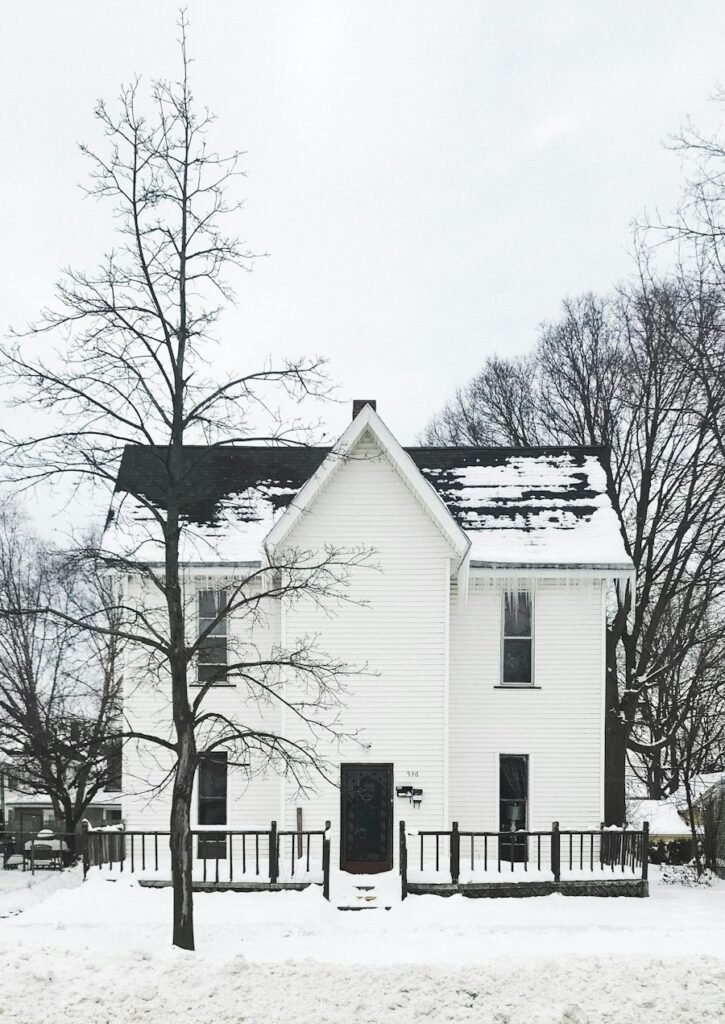
Bonnell Street is home to Fleming Castle, the Samuel Fleming House at No. 5, one of the contributing buildings of the historic district. Nearby streets mix older frame houses with steep gable roofs, side chimneys and later porches. Repairs here usually mean wood or slate details, old plank decking, and flashing at chimneys that were rebuilt more than once.
Mine Street and the Route 12 side
On the west side of the borough, Mine Street meets Route 12 at one of Flemington’s two traffic circles. Houses along these streets are mostly Greek Revival and later Victorian frame homes, often with low-pitched main roofs, front gables and wide cornices. Many have had several shingle layers added over original wood shingle, so we check layer count and decking before quoting a reroof.
Shields Avenue and Hopewell Avenue
These streets mark the southern edge of the Flemington Historic District, whose styles are recorded as Late Victorian, Greek Revival and Cottage. Expect two-storey houses with front porches, bay windows and small dormers, and some cottage-scale houses with steep roofs. Porch roofs with low slope, valleys over bays and gutters tucked into cornices are the details that most often leak on these blocks.
North Main Street
North Main Street forms the district’s northern boundary and carries a mix of larger Victorian houses, converted professional offices and apartment houses. Bigger roofs with hips, turrets or cross gables, several chimneys and longer gutter runs are typical. Because many of these buildings now hold two or more units or offices, roof replacement often needs a construction permit as well as historic review.
Liberty Village and the redevelopment sites
Liberty Village, which opened as one of the first outlet centres in the United States, stood empty by 2023 awaiting redevelopment, and a 2021 settlement cleared plans for a 100-room hotel and nearly 200 apartments at the Union Hotel site. New mixed-use buildings bring modern TPO and EPDM roofs to the borough, while the older houses next to these sites keep their historic roofs and review rules.
Flemington Circle and the Route 202 and 31 edge
Where Routes 202 and 31 meet at Flemington Circle, the borough’s edge turns to shopping plazas, offices and service buildings with large flat roofs. These are commercial membrane roofs with rooftop units, scuppers and parapet coping. Ponding at drains and seam failures around mechanical curbs are the usual problems, and replacement always needs a permit.
What we fix in Flemington
What Roof Problems Are Common in Flemington?
In Flemington the typical roof problems come from age and attachment: old cornice gutters, layered shingles over wood, low-slope porch roofs and parapets on Main Street’s attached buildings. These six issues come up most on borough inspections.
Gutters built into cornices
Greek Revival and Victorian houses in the historic district often have gutters set into the wood cornice or formed at the roof edge. Their metal linings crack at seams and rust through, and water rots the cornice and runs into the walls. Because gutters are listed among the features the Historic Preservation Commission usually reviews when replaced, relining the existing trough is often the simplest approved fix.
Too many layers over old wood shingle
Many Flemington houses started with wood shingles and have since had one or two asphalt layers added. New Jersey allows no more than two layers, and old wood shingle underneath holds moisture and makes nails loose. We count layers with a test cut and check the plank decking, because a reroof that reaches the third layer must be stripped and needs a permit.
Low-slope porch roofs
Front porches are a defining feature of the borough’s Late Victorian and Cottage houses, and their roofs are often nearly flat, covered in roll roofing, flat-seam metal or old membrane. Where the porch roof meets the house wall, flashing fails and water runs into the porch ceiling and the wall behind it. Proper wall flashing and, where appropriate, flat-seam metal restore the original look.
Parapets on attached Main Street buildings
Main Street’s commercial buildings share side walls, and their flat roofs sit behind brick parapets. Mortar joints in the parapet open up, coping stones or metal caps loosen, and water gets into the wall between two businesses. Because these are attached, mixed-use buildings, replacement needs a permit, and coordinated repairs with the neighbouring owner often save both of you money.
Gutter capacity in extreme rain
Flemington recorded 9.20 inches of rain from Ida in September 2021, among the highest totals in New Jersey. Small downspouts and narrow gutters on older houses could not carry that much water, so it overflowed into cornices, basements and porch roofs. Larger leaders, extra outlets and cleaning before late-summer storms are worth the cost here.
Freeze-thaw and ice dams
With January lows near 21 F and about 27 inches of snow a year, Flemington roofs freeze and thaw many times each winter. On houses with finished attics or poorly insulated upper floors, snow melts and refreezes at the eave, forcing water under shingles and into cornice gutters. Ice and water shield at the eaves during repairs, plus better attic ventilation, prevents most of it.
Flemington weather
What Weather Has Hit Flemington’s Roofs?
Flemington’s roof damage comes mostly from very heavy rain, early wet snow and long freeze-thaw winters rather than coastal wind. These events and conditions are the ones that matter most for borough roofs.
September 1-2, 2021: Ida’s 9.20 inches
The New Jersey State Climatologist’s Ida report lists Flemington at 9.20 inches, one of the state’s peak totals above eight inches. Rain that heavy found every weak spot: overflowing cornice gutters, leaking porch-roof flashing, and parapet joints on Main Street. Many borough owners discovered leaks that night that had been minor for years, and gutter sizing has been a common question since.
October 29, 2011: snow on leafy trees
A rare October storm put 4 to 8 inches of heavy, wet snow over most of Hunterdon County and 8 to 12 inches on its higher ground, while trees still had their leaves. Limbs broke under the load and power lines came down across the region. On Flemington’s tree-lined streets, falling limbs crushed gutters and damaged porch roofs, a risk any early storm can repeat.
December 16-17, 2020: early winter storm
Flemington recorded 6.3 inches of snow in this mid-December storm, followed by a cold stretch that kept snow on roofs. On older houses with warm upper floors, that snow melted and refroze into ice dams at the eaves. Cornice gutters full of ice and shingles lifted by refreezing water were the common results we see after storms like this one.
Long freeze-thaw winters
Flemington’s climate normals show a January average high near 38 F and low near 21 F, so most winter days swing across the freezing point. Water that seeps into cracked slate, mortar joints in chimneys and parapets, and open metal seams freezes and widens the gap each cycle. That is why chimney and parapet masonry often needs attention alongside roof repairs in the borough.
Roofing services
How Do Our Roofing Services Fit Flemington Properties?
Flemington owners mostly need careful leak repair on historic houses, flat-roof work on Main Street buildings, and gutter and cornice repair after heavy rain. Each service below is described for the borough, and our roof repair NJ page explains how we work across the state.
Roof Leak Repair in Flemington
We trace Flemington leaks to cornice gutters, porch-roof flashing, chimneys and parapet joints, where water often travels before it shows. Repairs in kind keep historic-district houses outside Historic Preservation Commission review whenever possible.
Emergency Roof Repair in Flemington
When a limb lands on a porch roof or a Main Street flat roof splits in a storm, request emergency help through the contact page. We tarp or seal the opening, photograph damage for your insurer and plan a permanent repair.
Storm Damage Roof Repair in Flemington
Flemington storm damage is usually heavy-rain overflow, broken limbs from early snow, and flashing pulled loose by wind. We document storm damage separately from age-related wear so your claim reflects what happened.
Roof Replacement in Flemington
Replacing a roof in the historic district usually goes to the Historic Preservation Commission first, and attached or multi-unit buildings need a Borough construction permit. We prepare the scope and photos and schedule after approval.
Roof Inspection in Flemington
A Flemington inspection checks layer count, decking, cornice gutters, porch roofs, chimneys and parapets. Buyers of older borough houses and Main Street buildings use the photo report to plan repairs and negotiate.
Flat Roof Repair in Flemington
Main Street buildings, rear additions and porch roofs across the borough are flat or low-slope. We repair modified bitumen, EPDM and TPO, reseal parapets and drains, and install new membranes when old layers are saturated.
Metal Roof Repair in Flemington
Flat-seam and standing-seam metal appear on Flemington porch roofs, bays and some commercial buildings. We reseal and solder seams, replace rusted panels and repaint metal so it lasts and keeps its historic appearance.
Slate Roof Repair in Flemington
Slate survives on some of Flemington’s civic and older residential buildings. We replace broken slates with matched pieces on copper hooks and re-flash chimneys and valleys, keeping repairs in kind for the historic district.
Shingle Roof Repair in Flemington
Most borough houses now have asphalt shingle roofs, often over original wood shingle. We replace damaged shingles, repair step flashing at dormers and porches, and tell you honestly when layers or decking mean a reroof is due.
Roof Cleaning in Flemington
Shaded north slopes on Flemington’s tree-lined streets grow moss and algae. We clean with low pressure that protects shingles and slate, and clear valleys and cornice gutters of the debris that causes overflow.
Gutter Repair in Flemington
Gutter work here ranges from relining cornice gutters on Greek Revival houses to adding larger leaders after Ida-scale downpours. We keep gutter profiles appropriate to the house so replacements fit the historic district.
Commercial Roofing in Flemington
Storefronts, offices and plazas near Flemington Circle and along Main Street need commercial membrane, parapet and drain work. We repair and replace these roofs with permits and, inside the district, historic review included in the plan.
Flemington rules
What Permits and Historic Reviews Apply to Roof Work in Flemington?
Permits & local review
A detached one- or two-family house in Flemington needs no construction permit for reroofing, but because most of the borough is in a historic district, roof replacement there usually needs Historic Preservation Commission review first. Under N.J.A.C. 5:23-2.7, roof covering work on detached one- and two-family homes is ordinary maintenance. Main Street’s attached and mixed-use buildings, houses with three or more units, decking or rafter work and a third layer need a Borough permit.
- Start with the Borough Building Department: The Borough asks owners to contact it early to learn whether review is needed.
- What is reviewed: All exterior work on properties in the historic district or on landmarks requires review, and replacing roofs, gutters, porches and siding usually falls under it.
- What is exempt: Ordinary repair or maintenance in kind is not reviewed. Ordinance 2026-11, introduced in April 2026, names in-kind repair of an existing roof as normal maintenance and says rear and side elevations are not reviewed unless visible from public ways.
- Timing: Full reviews are heard at the Commission’s monthly meeting on the third Wednesday at Borough Hall, with no fee, and emergency procedures exist for urgent health and safety repairs.
- Raritan Township is separate: Houses outside the borough line follow Raritan Township’s own offices and rules.
Insurance claims
For Flemington owners the main insurance questions are matching historic materials and separating sudden storm damage from long-term wear on older roofs. Wind, falling limbs and the weight of snow and ice are usually covered; rusted cornice gutters, layered shingles and worn porch flashing are usually treated as maintenance. If the Historic Preservation Commission expects a replacement to match slate, metal or wood details, ask your agent whether your policy includes ordinance or law coverage for those extra costs. Water that entered during Ida through overflowing gutters is handled differently from water that rose from the ground, which only flood insurance covers. Main Street building owners should check how their commercial policy treats shared parapets and walls. Our inspection report photographs each issue and labels whether it looks storm-related or age-related.
Pricing · updated November 2026
How Much Does Roof Repair Cost in Flemington?
As of November 2026, most Flemington roof repairs cost between $400 and $2,500, with cornice gutters, porch roofs and Main Street flat roofs the most common jobs. These are New Jersey planning ranges; our roof repair cost guide explains how each line on a quote is priced.
Shingle repair
$350 – $800
Replacing wind-damaged or cracked shingles on a borough house, matching colour where possible and checking whether older wood shingle underneath is making nails loosen.
Single-source leak repair
$400 – $1,500
Finding and fixing one leak, such as porch-roof wall flashing, a chimney on Bonnell Street or a dormer valley, with in-kind materials suited to the historic district.
Valley repair
$500 – $1,500
Replacing a worn or rusted valley over a bay or cross gable on a Victorian house, with new metal and shingles or slate reset along both sides.
Flat-roof patch or seam
$400 – $2,500
Repairing blisters, split seams and parapet base flashing on a Main Street commercial roof or a rear addition, including resealing drains and scuppers.
Slate repair
$500 – $2,500+
Replacing broken slates on an older civic or residential roof with matched pieces on copper hooks, keeping the repair in kind for Historic Preservation Commission purposes.
Rotted deck section
$500 – $2,000+
Replacing soft plank or plywood decking found under layered shingles or a ponding porch roof. Deck replacement needs a permit, which we include in the plan.
What moves the price in Flemington
- Historic matching: In-kind repairs to slate, metal and wood cornices cost more than generic materials but avoid a full review.
- Review timing: Visible replacements wait for the monthly Historic Preservation Commission meeting, which affects scheduling.
- Layer count: Houses with two shingle layers over wood shingle often need a full strip, plus a permit if decking is replaced.
- Attached buildings: Main Street roofs share parapets and walls, so flashing to a neighbour and permits add cost.
- Access and parking: Narrow streets, small lots and Main Street traffic limit dumpster and lift placement.
- Cornice and gutter repair: Rotted cornice wood behind failed gutters is often discovered once the lining is opened.
- Building height: Three-storey commercial fronts and steep Victorian roofs need staging and extra fall protection.
These November 2026 ranges are planning figures based on New Jersey data from Roof Observations and Fixr and our site-wide repair ranges. They are not quotes. Every Flemington roof gets a free inspection and a written itemized quote first.
Who does the work
Why Flemington Homeowners Choose Roof Repair SNJ
- Repairing NJ roofs for 25+ years
- General liability + workers’ comp insurance
- Workmanship warranty: 2 years on repairs, 10 years on full replacements, in writing
- Photo report with every inspection
Check any roofer before you sign in Flemington
Ask for the 13VH registration number and confirm it on the NJ license lookup. NJ law requires a signed written contract showing the registration number and total price, and gives you until midnight of the third business day to cancel (N.J.S.A. 56:8-151).
Nearby
How Do Roofs Around Flemington Differ?
Leave the borough and the houses get newer and larger, while the historic river towns to the south have their own commissions. Our Hunterdon County roof repair page covers all of these towns in more detail.
Raritan Township
Raritan Township surrounds Flemington on every side and is a separate municipality with its own construction office, though it shares the 08822 zip code. Most of it is late twentieth-century subdivisions of large colonials and contemporaries with complex shingle roofs, skylights and valleys, plus older farmhouses.
Readington Township
North and east of Flemington, Readington mixes farmland, newer subdivisions and historic villages, including the Whitehouse-Mechanicsville area, listed on the National Register in 2015. Roofs range from big shingle roofs on newer homes to slate and metal on farmhouses and barns.
East Amwell Township
South of Flemington, East Amwell is rural, with farmhouses, stone and frame homes and the village of Ringoes, a National Register district since 1999. Barns, metal roofs and long driveways are common, and the county fair has been held at South County Park there since 2003.
Delaware Township
West of Flemington, Delaware Township includes the Sergeantsville historic district, listed in 2009, and many eighteenth- and nineteenth-century stone farmhouses. Slate and cedar on older houses and steep, exposed roofs on ridgetops make repairs there more rural in character.
Lambertville
On the Delaware River south of Flemington, nearly all of Lambertville is a historic district, with brick and frame rowhouses. Its construction office notes that work may need its own Historic Preservation Commission, the State Historic Preservation Office and the D&R Canal Commission, a stricter stack than in Flemington.
In depth
Flemington Roof Questions, Answered in Depth
Is your house in Flemington Borough or Raritan Township?
Many homes with a Flemington mailing address are actually in Raritan Township, and the answer decides which construction office, which historic rules and which tax bill apply to your roof. Flemington Borough is a separate municipality of about 1.08 square miles that split from Raritan Township in 1910. Raritan Township surrounds it completely, making the pair one of New Jersey’s doughnut towns, and both share the 08822 zip code.
The quickest way to tell is your property tax bill or deed, which names the municipality. If it says Flemington Borough, your house is inside the one-square-mile borough, likely near Main Street, Bonnell Street, Mine Street, Shields Avenue or Hopewell Avenue, and possibly inside the Flemington Historic District. If it says Raritan Township, you are outside the borough even if your address reads Flemington.
This matters in three ways. First, permits: borough properties deal with the Borough Building Department, while township properties use Raritan Township’s own construction office. Second, historic review: the Flemington Historic District and the borough’s Historic Preservation Commission apply only inside the borough. Third, the type of house: borough properties are mostly nineteenth-century houses and Main Street buildings, while most township homes are late twentieth-century subdivisions with larger, more complex shingle roofs.
When you request an inspection, tell us what your tax bill says. We check the municipality before writing a scope, so the plan reflects the right permit rules and, inside the borough, whether the Historic Preservation Commission needs to see it. On a detached one- or two-family house in either town, a straightforward reroof needs no construction permit under the state’s ordinary maintenance rule, but structural work and attached buildings do.
Getting roof work through Flemington’s Historic Preservation Commission
Most everyday roof repairs in Flemington’s historic district are exempt from review because they are repairs in kind, but a visible roof replacement or a change of material usually goes to the Historic Preservation Commission. With about two thirds of the borough on the state historic register since 1980, this affects a large share of borough homes.
The Borough’s review page says all exterior work on properties in the historic district or on landmarks requires review, and that replacing roofs, windows, porches, gutters or siding usually falls under it. It also says ordinary repair or maintenance in kind does not need review. Ordinance 2026-11, introduced in April 2026 to align with the Certified Local Government program, lists in-kind repair of an existing roof as normal maintenance and states that rear and side elevations are not reviewed unless visible from public ways. It also sets out emergency procedures for urgent health and safety repairs.
In practice, replacing a few slates, relining a cornice gutter in the same profile or re-flashing a chimney is maintenance. Replacing an entire front slope, switching from slate or metal to asphalt, changing a gutter profile on the street side, or adding a skylight or dormer visible from the street is likely to need review.
The process is straightforward. Contact the Borough Building Department early, submit an application with photos, drawings and product information, and attend the regular meeting on the third Wednesday of the month at Borough Hall. There is no fee. We supply photos, a written scope and material details for your application and schedule work after approval, so the job is never stopped halfway.
Roofs on Main Street’s storefront and mixed-use buildings
Main Street’s attached commercial buildings need flat-roof expertise, parapet masonry work and a construction permit for replacement, plus historic review where the work is visible. The street’s nineteenth-century blocks around the courthouse and the Union Hotel often have shops on the ground floor and apartments or offices above, which makes them commercial or multi-unit buildings under the construction code.
The typical roof behind the façade is flat or low-slope, draining to a rear scupper or an internal drain, with brick parapets on the shared side walls. Over decades these roofs collect layers of roll roofing, coatings and patches. Leaks come from open parapet mortar, loose coping or caps, failed base flashing where the roof turns up the wall, and clogged drains that let water pond.
Repair starts with drainage. We check that water reaches the drain, clear and re-flash drains and scuppers, and fix low spots. Then we address the parapets, repointing and re-capping them and installing counter flashing let into the mortar. Where the roof has more than one old layer or saturated insulation, a new modified-bitumen, EPDM or TPO system is the long-term fix. Our flat roof repair page explains the membrane options.
Because these buildings share walls, cooperation with the neighbouring owner pays off. One continuous flashing detail installed on both sides of a shared parapet lasts longer than two separate patches. Tenants upstairs also need notice and protection during work. With the borough’s redevelopment around Liberty Village and the Union Hotel, more Main Street owners are upgrading roofs now, and we write scopes that show the Borough exactly what is being done.
Repairing Greek Revival and Victorian roofs in the historic district
The Flemington Historic District’s houses are recorded as Late Victorian, Greek Revival and Cottage in style, and each style has its own leak-prone details that a careful repair must respect. Greek Revival houses usually have low-pitched roofs, wide cornices with returns and gutters built into the cornice. Late Victorian houses bring cross gables, bays, porches, dormers and sometimes towers. Cottage-style houses tend to be smaller with steep roofs and decorative trim.
On Greek Revival houses the cornice gutter is the weak point. When its lining fails, water rots the cornice and soaks the wall below. We open the gutter, replace rotted wood to the original profile, and reline it with soldered metal or a fully adhered membrane under a metal apron. The low pitch of the main roof also means shingles need correct exposure and ice and water shield at the eaves.
On Victorian houses the problems spread out across more junctions. Valleys over bays wear, step flashing at dormer cheeks fails, and porch roofs leak where they meet the wall. Each needs its own flashing detail woven into the roof covering, not a bead of sealant. Original slate or flat-seam metal on porches and bays is worth keeping and can usually be repaired.
Most houses on these streets were built with wood shingles. Many have since had asphalt layers added, and New Jersey’s two-layer limit means a third layer is not allowed. When a full reroof is due, stripping to the deck lets us repair plank sheathing, add underlayment and restore proper ventilation. On the street-facing side, choosing a shingle colour and profile that suits the house helps the work move smoothly through the Historic Preservation Commission when review applies.
Gutters and downspouts after Ida’s 9.20 inches
Ida’s 9.20 inches of rain in Flemington showed that many older borough houses cannot shed extreme rainfall, and modest gutter upgrades are one of the best-value roof improvements here. On September 1 and 2, 2021, the New Jersey State Climatologist recorded Flemington among the state’s peak totals, and that volume overwhelmed small gutters, single downspouts and cornice troughs across town.
Overflow causes more damage than most people realise. Water spilling over a gutter soaks the fascia and cornice, runs down the wall into window heads, and pools at the foundation. On houses with built-in gutters, overflow goes inside the structure. On Main Street, a clogged drain lets water pond until it finds an open seam.
Upgrades that work well in the borough include adding a second downspout to long runs, enlarging outlets in cornice gutters, replacing small leaders with larger ones, and adding splash blocks or extensions so water leaves the foundation. On a historic-district house we keep the gutter and leader profiles appropriate to the street view, using half-round or cornice-style forms rather than oversized modern gutters, so the work stays in kind.
Maintenance matters as much as size. Late-summer storms arrive when trees are in full leaf and seed, so clearing gutters and valleys in August and again after leaf drop prevents most overflow. Check downspouts at ground level, where many are crushed or disconnected. Our gutter and roof-edge repair page covers the options, and our inspection report notes undersized gutters along with any roof leaks we find.
FAQ
Roof Repair in Flemington, NJ: Frequently Asked Questions
Do I need Historic Preservation Commission approval to fix my Flemington roof?
Not for repairs in kind. Flemington exempts ordinary repair or maintenance in kind, and Ordinance 2026-11 names in-kind roof repair as normal maintenance. Replacing a whole visible roof, changing material, or adding skylights or dormers visible from the street usually needs Commission review first.
Is my Flemington address in the borough or Raritan Township?
Check your property tax bill or deed. Flemington Borough and Raritan Township share the 08822 zip code, but the borough is only about 1.08 square miles. If the bill says Raritan Township, the township’s own construction office and rules apply, and the borough historic district does not.
Do I need a permit to reroof a house in Flemington Borough?
Not for a detached one- or two-family house under New Jersey’s ordinary maintenance rule. A permit is needed for attached or mixed-use Main Street buildings, homes with three or more units, decking or rafter work, and any third layer. Historic review is a separate step.
How much does roof repair cost in Flemington?
Most Flemington repairs cost $400 to $2,500 in November 2026. Small shingle fixes start around $350, cornice gutter and porch roof repairs fall in the middle, and slate or deck replacement can exceed $2,500. Every quote is written and itemized after a free inspection.
When does the Flemington Historic Preservation Commission meet?
Full reviews are heard at the Commission’s regular meeting on the third Wednesday of each month at Borough Hall, and there is no fee. The Borough recommends contacting its Building Department early to learn whether a Flemington roof project needs review at all.
Why do Greek Revival houses in Flemington leak at the cornice?
Many Greek Revival houses in Flemington have gutters built into the wood cornice. When the metal lining cracks or rusts, water rots the cornice and runs into the walls. Relining the gutter and rebuilding rotted wood to the original profile is the usual repair and counts as work in kind.
Can a Main Street building in Flemington get a flat roof repair instead of replacement?
Often yes, if the deck is dry and there is only one old layer. Repairing drains, parapet flashing and failed seams can add years. Saturated insulation or several old layers mean replacement, which needs a Borough permit because these are attached commercial or mixed-use buildings.
How much rain did Flemington get from Ida?
The New Jersey State Climatologist recorded 9.20 inches in Flemington from Ida on September 1-2, 2021, one of the state’s highest totals. Many borough gutters and downspouts overflowed, which is why larger leaders and regular cleaning are common recommendations on older Flemington houses.
Does Flemington’s historic district cover my whole street?
The Flemington Historic District is roughly bounded by Route 12, Route 31, North Main Street, Shields Avenue and Hopewell Avenue, and about two thirds of the borough was on the state register by 1980. The Borough’s searchable historic district list confirms individual properties.
How do I prevent ice dams on an older Flemington house?
Flemington’s January lows near 21 F and roughly 27 inches of yearly snow make ice dams common on houses with warm upper floors. Better attic insulation and ventilation, ice and water shield at the eaves and clean cornice gutters before winter prevent most of them.
Can I replace my Flemington porch roof with shingles?
Many Flemington porch roofs are too flat for shingles, which need adequate slope to shed water. Low-slope porches need membrane or flat-seam metal. Inside the historic district, keeping the original metal or a matching low-profile surface is also the easiest path through any review.
How do I check a roofer before hiring in Flemington?
Ask for the contractor’s New Jersey home improvement registration number starting with 13VH and look it up on the state verification site. Get a written contract with the total price, insurance certificate and three-day cancellation right, and ask how they handle Flemington historic review.
Reviewed by the Roof Repair SNJ team · Last updated November 2026
Free inspection
Get a Free Roof Inspection in Flemington
From a leaking cornice gutter on Mine Street to a ponding flat roof on Main Street, request your free Flemington roof inspection and send photos if you have them. You will receive a photo report, a written itemized quote and a clear answer on Borough permits and historic review. Nothing begins until you approve the plan.
No pressure and no obligation. If a repair will do, we’ll tell you.
Roof Repair SNJ
- Serving Flemington and all of Hunterdon County
- Request roof service in Flemington
- Mon–Fri 5:00 AM–10:00 PM · Sat 5:00 AM–6:00 PM · Emergencies 24/7
Sources: Flemington, New Jersey (Wikipedia) · Flemington Historic District (Wikipedia) · Borough of Flemington: Historic Preservation Commission review process · Borough of Flemington: Ordinance 2026-11, HPC amendments · Census Reporter: Flemington, NJ (ACS 2024) · Office of the NJ State Climatologist: Ida report · NWS Mount Holly: October 29, 2011 snowstorm · NWS Mount Holly: December 16-17, 2020 event review · NRHP listings in Hunterdon County, NJ (Wikipedia) · City of Lambertville: Construction Department · N.J.A.C. 5:23-2.7 Ordinary maintenance · NJ contractor registration lookup · N.J.S.A. 56:8-151 home improvement contracts · Roof Observations: New Jersey roof cost guide · Fixr: Roof replacement cost in New Jersey. Prices are planning ranges, not quotes. Permit and insurance information is general guidance; your town, policy and agent have the final word.